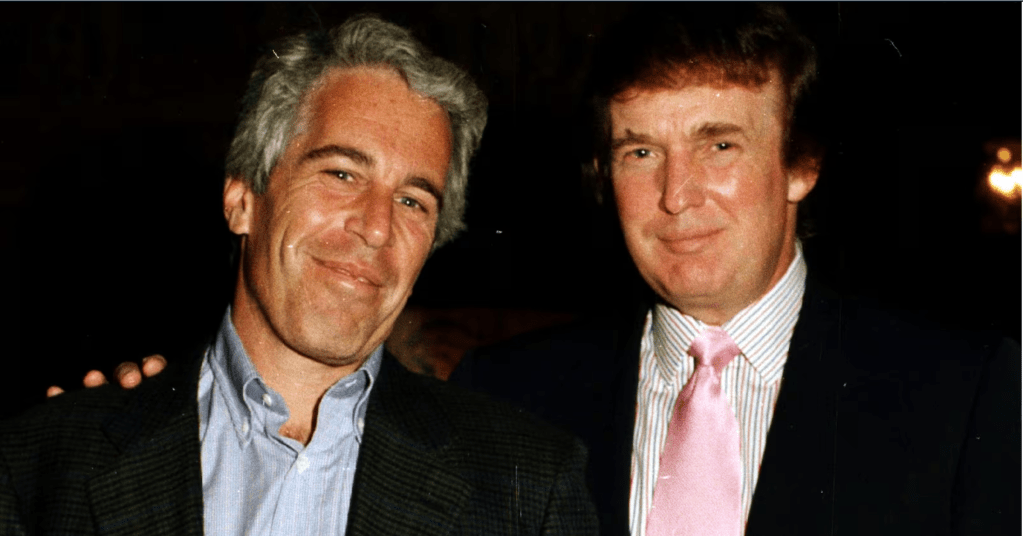
Jeffrey Epstein with Donald Trump. (Davidoff Studios Photography/Getty Images.)
After the welcome February 19 arrest of the former Prince Andrew over his tawdry and traitorous ties to the late Jeffrey Epstein, much can be said before I somehow turn this into a literature post:
— The monstrous Epstein was an abusive pedophile, sex trafficker of girls and young women, blackmailer, possible Russian and/or Israeli intelligence agent, etc.
— Major consequences for the elite (mainly rich white men) who were in Epstein’s orbit have mostly been meted out to those outside the United States.
— Nearly all the prominent Americans who were in that orbit have faced little more than some public scorn. A small number lost jobs or other positions, but none have faced Epstein-related criminal charges.
— Americans who were in Epstein’s orbit include President Trump (who has VERY suspiciously fought like hell to keep The Epstein Files secret); Trump cabinet members Howard Lutnick and Robert F. Kennedy Jr.; Trump strategist Steve Bannon; former President Bill Clinton; former Clinton cabinet member Lawrence Summers; tech billionaires Elon Musk, Peter Thiel, and Bill Gates; former Victoria’s Secret CEO Leslie Wexner; attorney Alan Dershowitz; filmmaker Woody Allen; intellectual Noam Chomsky; Giants football team co-owner Steve Tisch; and others.
All the debauchery and lack of accountability have not gone unnoticed by famous characters in literature, even if their thoughts on Epstein never quite made it into the novels they inhabit. For instance, fictional pedophile Humbert Humbert is perverted enough to hypothetically admire Epstein, even if Epstein was only two years old when Vladimir Nabokov’s Lolita got published in 1955. Perhaps HH was prescient in addition to deviant.
A Game of Thrones, the first novel in George R.R. Martin’s “A Song of Ice and Fire” series, includes 13-year-old Daenerys being forced to marry the adult warlord Drogo. Maybe she found some of her courage by anticipating the perseverance of Epstein survivors who continue to seek justice despite their attempts at that being blocked or ignored for decades — most recently by the Trump regime’s ghoulishly sycophantic attorney general Pam Bondi.
While thirsting for revenge against her sexual abuser, the resourceful Lisbeth Salander of Stieg Larsson’s The Girl with the Dragon Tattoo and its sequels might have theoretically considered also unleashing retribution on the depraved Epstein. At minimum, the computer-savvy Salander was capable of hacking into Epstein’s grotesque email conversations with various wealthy sickos.
While looking down from heaven in Alice Sebold’s The Lovely Bones, raped-then-murdered teen Susie Salmon could have also kept a disgusted eye on Epstein before he started looking up from hell after his 2019 death. (It has been said that Epstein committed suicide in prison, but many feel he was killed to prevent him from possibly spilling the beans on his fellow guilty elites.)
The female collaborators to the grossly misogynist men in Margaret Atwood’s The Handmaid’s Tale might wish they could contact Epstein collaborator Ghislaine Maxwell for extra collaboration advice, or even ask to join Maxwell in the cushy Texas jail the Trump regime transferred her to as a way to increase the chances of her not implicating former close Epstein pal Trump.
Finally, a reader could wonder if Jane Eyre, after becoming aware of Edward Rochester’s marital history, suspected Rochester of having Epstein ties despite the two men existing two centuries apart and one of them being fictional. Thankfully, British author Charlotte Bronte lived during Queen Victoria’s time rather than the former Prince Andrew’s time.
Comments on, or additions to, this rather fraught topic?
Misty the cat says: “Trying to outrun the big predicted snowstorm is a new Winter Olympics sport.”
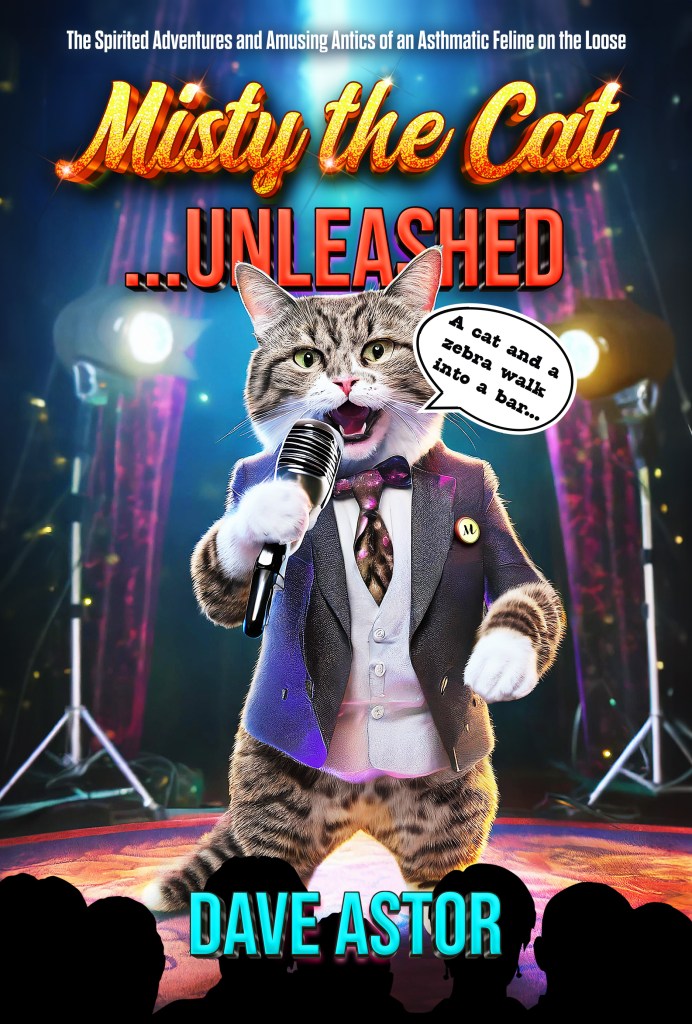
My comedic 2024 book — the part-factual/part-fictional/not-a-children’s-work Misty the Cat…Unleashed — is described and can be purchased on Amazon in paperback or on Kindle. It’s feline-narrated! (And Amazon reviews are welcome. 🙂 )
This 90-second promo video for the book features a talking cat: 🙂
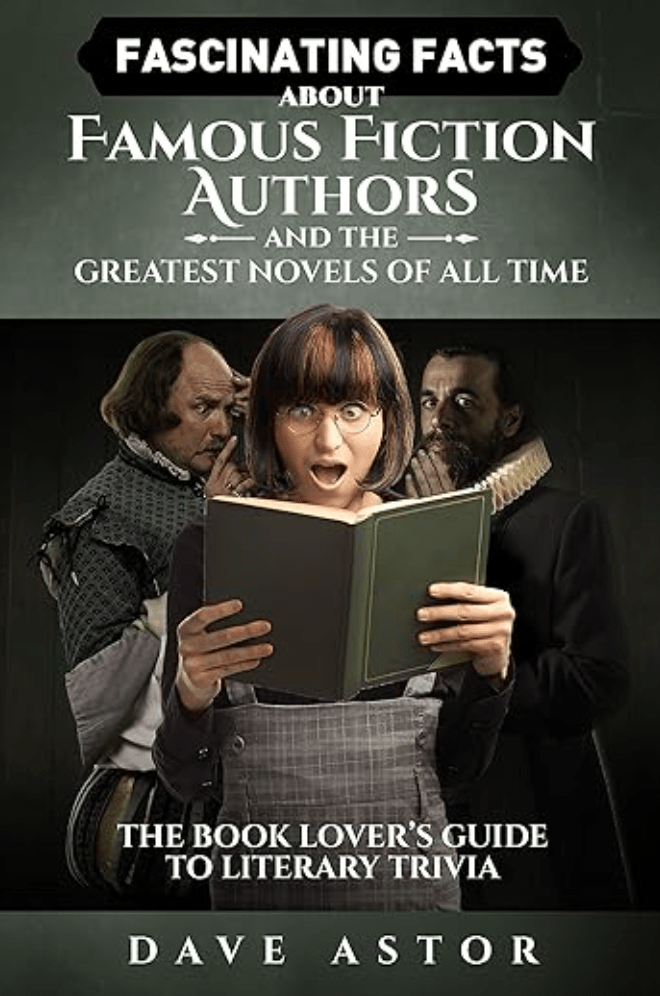
I’m also the author of a 2017 literary-trivia book…
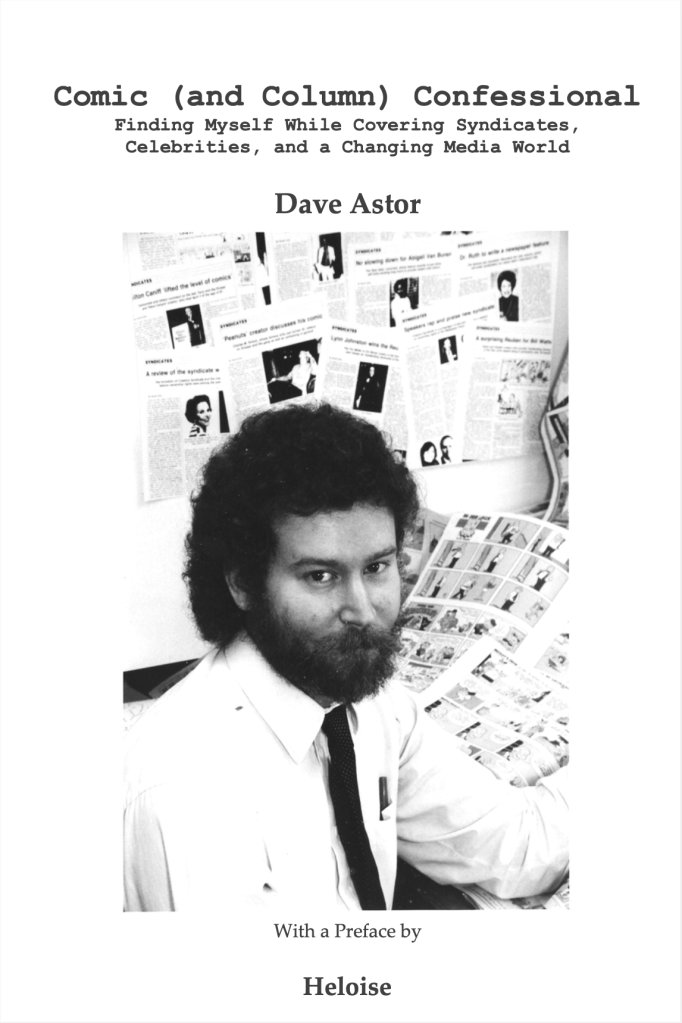
…and a 2012 memoir that focuses on cartooning and more, including many encounters with celebrities.
In addition to this weekly blog, I write the 2003-started/award-winning “Montclairvoyant” topical-humor column every Thursday for Montclair Local. The latest piece — about a bad tax deal and a controversial upcoming school vote — is here.
 Dave Astor on Literature
Dear David
We think the Epstein scandal shows clearly the power of information. In a way, Epstein dealt cleverly with information. We believe that the sexual aspect of the scandal is being brought to the fore, particularly successfully in prudish countries such as the USA, in order to obscure the political dimension of the whole affair.
The Fab Four of Cley
🙂 🙂 🙂 🙂
LikeLiked by 2 people
Thank you, Klausbernd! You are absolutely right that this is a political scandal as well as a sexual scandal. Epstein affected world events via blackmail and with his other interactions with prominent politicians, tech oligarchs, etc. And he may have literally been an agent for Israel and/or Russia. The corporate/mainstream media in the U.S. is certainly emphasizing the sexual much more than the political in its inadequate coverage; progressive podcasts and other independent media are doing much better jobs.
LikeLiked by 1 person
I think the Epstein files are so horrific they surpass the most perverse works of fiction.
LikeLiked by 1 person
Thank you, Luisa! Well said and, unfortunately, so true.
LikeLiked by 1 person
🙏🌷🙏
LikeLiked by 1 person
Virginia Giuffre was 17 years and 7 months old when she was photographed with Andrew Mountbatten, which in NY is 7 months above the age of consent and 5 months away of adulthood. Nobody is going to make me believe she didn’t know what she was doing. Child marriage is currently legal in 34 states, and 4 U.S. states do not require any minimum age for marriage, with a parental or judicial waiver. The only mistake Mountbatten made, is that he denied the whole thing. He should have said: “Yes, I did it. So what?”.
LikeLike
Thank you for the comment, Shaharee, but I have to disagree. What the former Prince Andrew did was very wrong, even if Virginia Giuffre was 17. That’s still underaged, still a big age gap (Andrew was in his 40s at the time), and he had to know that she was sex-trafficked and undoubtedly pressured into having sex with him and others. Also, Andrew was recently arrested for sharing sensitive British government information with Epstein. Andrew is NOT a good person.
LikeLiked by 1 person
Mountbatten was not the first one and will also not be the last one being blackmailed into sharing sensitive information because of some sexual vice. And all those teenage prostitutes lie about their age, up to the point of even falsifying their id’s. Only when the meal has been served, jumps the cat upon the table. Just think about the hypocrisy of living into a country where 34 states allow underage marriages (in some cases even 13 years old ones) and then creating such a media storm about this issue.
LikeLike
If you don’t want to get blackmailed, don’t do the sexual vice. As a wealthy prince, Andrew would have had no problem filling his sexual needs with adult women who truly consented.
And if 34 states allow underage marriage…they shouldn’t.
Finally, I’m not sure the U.S. — or, more specifically, officials such as Trump and his White House minions — is/are being hypocritical. Those Republicans don’t seem to feel pedophilia, sexual assault, and sex-trafficking are moral problems as they fight to cover up the Epstein scandal.
LikeLike
Flood the zone with shit is one of Trump’s favourite strategies. By the time the world has finished reading all of the Epstein files, we’re one legislation further and Trump has completed his agenda.
LikeLiked by 1 person
Very true, Shaharee, that Trump continues to flood the zone with awful words and actions at least partly designed to distract as he, oligarchs, and others enact a far-right agenda. Today’s totally unnecessary assault on Iran (with and on behalf of Israel) is the latest example of trying to distract from the Epstein scandal, trying to distract from the way the economy and rights are being trampled, etc. I wonder how much blackmail “dirt” Israel has on Trump. And the assault on Iran again shows that Trump campaigning as being “antiwar” was among his countless lies.
LikeLike
Thank you ever so much for your kind wishes Dave!
Yes, as this shameful/horrific story unfolds, UK authorities are taking it very seriously! More prominent figures are being arrested!!
Thanks Dave,
Sharon
LikeLiked by 1 person
Good for the UK, Sharon! Among other things, it’s impressive that King Charles III is willing to accept the arrest of his (grotesque) brother Andrew.
LikeLiked by 1 person
Hi Dave!
The arrest of Andrew Mountbatton is unprecedented, but proves no one is above the law!!
My regards!
LikeLiked by 1 person
Yes, Sharon! I hope (probably in vain) to see something similar in the U.S.!
LikeLiked by 1 person
I hope so too, Dave! Vile crimes warrant strong punishment! So terrible!
LikeLiked by 1 person
“Vile crimes warrant strong punishment” — totally agree, Sharon!
LikeLiked by 1 person
Many apologies Dave, for the late response. I have been unwell for a time!
Dave, these stories unfolding in the news regarding the late paedophile Jeffrey Epstein and Andrew Mountbatten are the stuff of true horror.
Except, in this example real-life is more horrifying than any work of fiction could ever be!!
Thanks Dave,
With kindest regards,
Sharon
LikeLiked by 1 person
Thank you, Sharon! There’s never a rush to comment. 🙂 Very sorry you’ve been ill; I hope you’re starting to feel better.
I hear you that the Epstein scandal is so horrific that it might not seem realistic if it was fictional. Very glad that the UK authorities, unlike the U.S. authorities, realize that at least some punishment is warranted for this VERY serious, repugnant criminal behavior.
LikeLiked by 1 person
A few more for you, Dave. Bluebeard, with his chamber full of the corpses of former wives, from the fairytale of Perrault, along with his modern counterpart in Angela Carter’s wonderful ‘The Bloody Chamber’. Both the bridegroom and his entire line in this latter are warped abusers of women–and I love that it’s the bride’s mother who rides to her rescue. There’s also the eponymous character of ‘Effi Briest’ by Theodore Fontane, which is based on a true story. Effi is married by her parents to a much older man who wanted to marry her mother, when she was a girl, but he wasn’t considered suitable. There’s something rather sick about him marrying the daughter as he couldn’t get the mother, and Effi ends up having a brief affair with another man. It’s she, of course, who’s eventually punished, but her husband and her seducer certainly belong to the Epstein gang.
LikeLiked by 1 person
Thank you, Laura, for those additional very interesting/disturbing examples. All well-described by you. Forced marriages of girls or young women to much-older men is sickening — and those relationships are creepy even when “consensual.”
LikeLiked by 1 person
So true. I remember reading that the actor Roger Moore said he stopped playing James Bond because the ‘Bond girls’ of the films were about the same age as his granddaughters, and it felt very wrong. Good man.
LikeLiked by 1 person
Didn’t know that about Roger Moore, Laura. Very commendable of him to react that way to Hollywood’s frequent much-younger women/much-older men pairings.
LikeLiked by 1 person
Hello Dave,
You seem to have covered the fiction I would have mentioned.
As you stated at the beginning, this post is inspired by fact, unfortunately.
Child brides and concubines is something that really bothers me. It’s a practice that continues today in certain parts of the world, and in cult religions.
https://www.bbc.com/news/uk-17534262
You bring to mind a movie – Wedding in White. (1975) I saw it in the late 80’s. It disturbed me greatly then, and still haunts when I think about it.
Fiction
In the 1940’s a soldier brings a friend home on army leave. The setting is a small rural town. The teen sister of the brother is bedded by the friend. She gets pregnant. The brother and friend have gone.
The father makes her marry his best friend, whose wife has died. His friend is OLD – 60’s. Creeped me right out.
And let’s not forget the rampant pedophilia in the Catholic Church and other religions that are main stream, not cultist.
In this regard, every day is a sad day on planet earth.
LikeLiked by 1 person
Thank you, Resa! “Wedding in White” sounds like a very disturbing movie, and of course things that disturbing can also happen in real life. The pedophilia and other vile sexual crimes in the Catholic Church and other religions? Epstein and his ilk would feel right at home. 😦 Makes one realize that utopian fiction might be the most unrealistic fiction of all. 😦
LikeLike
Hi Dave, this is a very interesting and well thought out post. There are many female characters in many novels who have suffered greatly at the hands of entitled and selfish men. Tess of the D’Ubervilles was a victim of her father’s ambition and Slex D’Urberville’s selfish arrogance. She was also a victim of Angel’s self righteousness.
LikeLiked by 2 people
My own Estelle in my novel, A Ghost and His Gold, was a victim of ruthless and hard men and women.
LikeLiked by 1 person
Thank you, Robbie! Glad you liked the post! I appreciate the examples from Thomas Hardy’s memorable novel and from your own work.
“There are many female characters in many novels who have suffered greatly at the hands of entitled and selfish men” — sadly and totally true. 😦
LikeLike
Yes, that has always been the way of the world for some reason. I’ve never managed to fathom that reason out 💖
LikeLiked by 1 person
Some men need a mental makeover!
LikeLike
I LOVE what you did here, Dave. Bringing the parallels and relevance forward…especially what you wrote about the GoT character, Daenerys here:
“Maybe she found some of her courage by anticipating the perseverance of Epstein survivors who continue to seek justice despite their attempts at that being blocked or ignored for decades — most recently by the Trump regime’s ghoulishly sycophantic attorney general Pam Bondi.”
I have no additions or insights, but you’ve put some wheels in motion in my head and for that I am grateful! 😊💝😊
LikeLiked by 1 person
Thank you, Vicki! Glad you enjoyed this disturbingly themed post and the “Game of Thrones” part of it! It is infuriating what Epstein did, what his collaborators have gotten away with, and how little justice the survivors have gotten.
LikeLiked by 1 person
With you all the way and it’s hard not to be ashamed and embarrassed when we see how a former royal in the U.K. is being held accountable for his association with the despicable Epstein. We can and must do better. Appreciate you, Dave. 💝
LikeLiked by 1 person
So true, Vicki, that the U.S. “powers that be” could learn a lesson from the UK in this instance. But they don’t want to. 😦
LikeLiked by 1 person
Agree!
LikeLiked by 1 person
A shame. 😦
LikeLiked by 1 person
I would have loved to see Lisbeth Salander take on Epstein!
LikeLiked by 1 person
Thank you, Marie! That would have been epic. Epstein wouldn’t have stood a chance against the adult Lisbeth.
LikeLiked by 1 person
Many thanks, Dave, for this very interesting topic, which seem to have no beginning and no end! I would like to mention once more “A woman of Substance” by Barbara Tayler Bradford and the relationship between the very young Emma and the son of the rich miller. They had fallen in love and it was him who convinced her to make love, but when she told him that she was pregnant he asked her what she intended to do as a consequence!
LikeLiked by 1 person
Thank you, Martina! You mentioned yet another wealthy, selfish, entitled guy — lots of them in fiction and in real life. And, yes, something like the Epstein scandal doesn’t seem to have a near-term ending as the guilty elites try to evade responsibility, and will probably mostly continue to succeed at that. 😦
LikeLiked by 1 person
Thank you very much, Dave, for your very well said answer😀
LikeLiked by 1 person
You’re very welcome, Martina! 🙂
LikeLike
And another one, Dave. I’m sure the pigs from ‘Animal Farm’ would feel right at home in the Epstein set; looking to get their snouts in the trough in any way possible.
LikeLiked by 1 person
Yes, Laura! And very cleverly said! (Reminds me of some of the characters featured on Pink Floyd’s “Animals” album, which was partly inspired by the Orwell novel you mentioned.)
LikeLiked by 1 person
Ah yes! ‘Pigs on the Wing’, along with sheep and dogs. Even more apt! 🙂
LikeLiked by 1 person
Definitely an album that remains relevant!
LikeLiked by 1 person
Some great thoughts about various interesting novels, especially ‘I, Claudius’ (fab series as well). However, all I would say is… ugh and eish about certain real people on the telly at the moment.
LikeLiked by 1 person
Thank you, Chris! Yes, “I, Claudius” was both a great novel and a great TV series. As you say, what we’re seeing these days on TV (or online) re the “Epstein class” is absolutely ugh. 😦
LikeLiked by 1 person
Hello, Dave and friends! I am very impressed with the UK for bringing down important men who have been involved with Epstein, not just Prince Andrew, but Peter Mandelson. It appears the US will do nothing to punish our sex offenders. However, I do think the law can’t take action unless there is evidence of a crime. Let’s hope the Epstein documents reveal incontrovertible proof of identifiable people committing rape and/or pedophilia.
A literary example of a truly evil seducer is Don Juan, who existed in Spanish folklore but (according to the Internet) first appeared in literature in a 1630 play by Tirso de Molina. Don Juan was originally not presented as charming (unlike Casanova, who was a real person) but always as a vile, arrogant aristocrat who was a murderer, as well as a user of women. Apparently, Mozart and Lord Byron romanticized him, making him a somewhat sympathetic character. I don’t think many women would see him that way.
By the way, it’s nothing to do with literature, but while we’re lamenting that privileged people don’t get punished for their crimes, let’s not forget pedophile priests.
LikeLiked by 4 people
Thank you, Kim! It IS impressive that the UK has taken some serious actions in the Epstein case. Makes the U.S. government and U.S. legal system look pathetic by comparison, but of course rich and powerful white men must be protected. 🙄 True that criminal evidence is needed, which makes it especially frustrating that the Trump regime is withholding or redacting many documents that probably contain that evidence.
Don Juan is a great example, and it’s a shame that (fictional or real) figures like that sometimes get romanticized.
And, yes, pedophile priests. 😦 Among the worst of the worst. 😦
LikeLiked by 3 people
Dave – this is certainly a fraught and troubling subject. What strikes me in moments like this is how long humanity has wrestled with power and its corruption. From Egyptian mythology to Greek tragedy to Norse legend, we see the same patterns. Rulers undone by hubris, gods misusing authority, innocent lives caught in the wake of ambition. These stories endure because they reflect something perennial in us. Mythology, epic, and drama were early attempts to understand the consequences of unchecked power and the fragile nature of justice. Books continue that tradition. They don’t invent these tensions. They reveal them. And perhaps by recognizing the pattern, we are reminded that conscience and accountability have always mattered. As you know, I am ready (very slowly) Faust. This quote from Faust Part One resonate strongly with themes of power, knowledge, and moral blindness. This is from Mephistopheles: “Ich bin der Geist, der stets verneint.” “I am the spirit that ever denies.” I got goosebumps when I read these words!
LikeLiked by 4 people
Thank you, Rebecca! So very true that something like the widespread Epstein scandal is as old as time, with certain differences among the similarities. Absolutely power often does corrupt absolutely. 😦 And Goethe is a great writer to read to explore the depths that humankind’s elites can sink to.
LikeLiked by 3 people
I always go back to the famous quote by Sir Walter Scott in Ivanhoe: “For he that does good, having the unlimited power to do evil, deserves praise not only for the good which he performs, but for the evil which he forbears.”
LikeLiked by 1 person
Superb quote, Rebecca! Wish a greater number of prominent people lived up to that.
LikeLiked by 1 person
I feel the same way, Dave! Alas…
LikeLiked by 1 person
😦
LikeLiked by 1 person
I don’t have anything to add, except that I hope all of them get their just rewards. It won’t happen during this Presidency, but better late than not at all. (K)
LikeLiked by 1 person
Thank you, Kerfe! I also fervently hope the whole “Epstein class” gets their just rewards. I agree that this won’t happen while Republicans hold all the levers of power in the federal government. Maybe there’ll be some justice after the midterms or the 2028 election, though both elections could of course be rigged/stolen by the Trump regime.
LikeLiked by 1 person
It’s like a labyrinth with too many possible paths. All that is needed is a few Republicans in Congress to remember the oath of office they swore to uphold. Every time I hear one of them say they are “troubled” I wonder what it would take to get them to say “this is wrong”.
LikeLiked by 1 person
Excellent point, Kerfe! A relatively small number of Republicans in the House and/or Senate could definitely force more of the truth to come out in the Epstein scandal (and stop some of Trump’s worst excesses in other areas). Saying they’re “troubled” is indeed pretty weak sauce.
LikeLiked by 1 person
I’m wondering if Dorian Gray might have been involved if Oscar Wilde had known about Epstein.
LikeLiked by 3 people
Ooh, that would be a possibility for such a hedonistic character. Thank you, Dan!
LikeLiked by 2 people
Here’s another one, Dave. The dissolute Duke of Mantua, from Verdi’s opera ‘Rigoletto’. The opera was based on the 1832 play ‘Le roi s’amuse’ (“The King Amuses Himself”) by Victor Hugo. The play concerned King Francis I of France, and was banned after only one performance, the King being portrayed as depraved and the play considered offensive to public morals. Verdi downgraded the role of the king to a fictional Duke who enjoyed seducing the women of his court, or the innocent daughters of the men. Absolutely Epstein company.
LikeLiked by 1 person
Thank you, Laura! Excellent example, and very well-described! I didn’t realize Victor Hugo was also a playwright. Kings and would-be kings amuse themselves, but we are not amused.
LikeLiked by 1 person
Quite. But hopefully we’ll have the last laugh, bitter though it may be.
LikeLiked by 1 person
Yes, Laura, that is the hope. Kings and wannabe-kings don’t live forever…
LikeLike
How about Hannibal Lecter, created by Thomas Harris? I imagine that he would delight in savoring Epstein’s brain for dinner. As for the Dementors in the Harry Potter series, they are sucking up all the happiness from the souls of Epstein’s co-conspirators and stuffing their dreams with the trauma of their victims.
LikeLiked by 2 people
Thank you, Rosaliene! Great comment! Somehow I’ve never read or watched Hannibal Lecter in book or movie form, but I’ve of course heard about him; Epstein would’ve deserved whatever fate he got from Lecter. And if the Dementors went after Epstein and his co-conspirators? Have at ’em! But sadly the ultra-rich American elites rarely get their comeuppance. 😦
LikeLiked by 1 person
I’ve never read any of the Dune novels, but I’ve heard that Baron Vladimir Harkonnen is the kind of person who would be in Epstein’s orbit.
LikeLiked by 2 people
Thank you, Michael! Sounds like an excellent example! I haven’t read the “Dune” books, either, though I’d like to try at least the first one.
LikeLiked by 1 person
Hi, Michael. I’ve read the ‘Dune’ novels, and Harkonnen is absolutely the sort who’d be in Epstein’s orbit, vile creature that he is.
LikeLiked by 2 people
A difficult topic, Dave, and the comments below along with your own notes name many of the prime contenders. I had the inkling of an idea, and couldn’t quite come up with the exact text, so googled it and got the following:. Fanny Burney’s ‘Evelina, or the History of a Young Woman’s Entrance into the World,’ in which wealthy men use women like horses to race against each other. The degraded Captain Mirvan and his circle arrange a race between two elderly women and bet on them as if they were racehorses. It’s been called ‘a depiction of the cruel and degrading nature of gentlemanly “sport” and the dehumanizing treatment of individuals by the upper classes. Evelina is Burney’s first novel, known for its satire of social behaviors and its portrayal of the vulnerability of women in a male-dominated society.’ Written, I might note, by a female author who doesn’t often get her due. And then there’s John Cleland’s ‘Fanny Hill’, where the eponymous protagonist is required to both perform and watch voyeuristic sex. And let’s not forget the Marquis de Sade and ‘Justine’, Leopold von Sacher-Masoch’s ‘Venus in Furs’ and ‘The Story of O’ by Pauline Reage. Sorry. Getting carried away. Unfortunately there are far too many contenders – authors or characters – who’d fit right into the Epstein circle.
LikeLiked by 1 person
Thank you, Laura! I read “Evelina” — a terrific 18th-century novel — a number of years ago and had forgotten that aspect of it. Some wealthy men were just as disgusting and misogynist then as they are now. Frances Burney was an astute observer of society and a great novelist, diarist, etc. And I appreciate those other examples. If Epstein-like figures from throughout history all gathered together, it would be an enormous/sordid crowd. 😦
LikeLiked by 1 person
I hesitate to mention (but I will) Richard Adams’s Maia, which has a lot of sexual abuse of girls as part of the plot. Although he presents it as evil, he certainly wallows in it. I admit I found the book compelling years ago, but am of mixed minds about it now.
LikeLiked by 1 person
Thank you, Audrey! “Maia” sounds a lot different than “Watership Down” — the only Richard Adams book I’ve read. One can usually tell if an author is wallowing in something they purport to be criticizing, and that seems to be the case in “Maia.” Disturbing. 😦
LikeLiked by 1 person
Indeed, but the book is still getting high ratings and enthusiastic reviews. And I have to say the right things happen in the end; it’s just a rather graphic road to get there.
LikeLiked by 1 person
I see, Audrey. So, not TOO bad.
LikeLiked by 1 person
I mention Alice Munro here. I have almost all she’s written. And then, after her death, the big reveal. What now? https://www.latimes.com/entertainment-arts/books/story/2024-07-12/alice-munro-andrea-skinner-sexual-abuse-commentary an answer? But what with the books? I cannot unread Munro. I can bin the books. But what of it?
LikeLiked by 1 person
Thank you, Dingenom! I remember reading about that Alice Munro situation, and understand your feelings about that awful behavior being associated with a writer you had been a fan of. I had previously read only one of Munro’s story collections, and loved it, but she certainly went down in my estimation after her behavior was revealed. It does raise the age-old question of how much we should separate an author from her or his work (something I’ve blogged about in the past). I guess I do that on a case-by-case basis. For instance, I hate J.K. Rowling’s bigoted views of trans people, but still read her novels, while I can’t bring myself to read books by the far-right Ayn Rand.
LikeLiked by 2 people
Well, Makkai’s piece for the LA Times (vide the link) is exactly about that. It doesn’t solve the dilemma for me altogether. Can you simply excise major literary composition (Munro was a Nobel Prize for literature laureate) from the body of literature that every next generation if writers builds on? It is almost indecent. To me, a key consideration in Makkai’s article is this: “In the case of Munro, the revelations don’t just defile the artist, but the art itself. I need to face the fact that Alice Munro was never looking down with grace and irony on her saddest characters.” This is what may convince me to accept radical “Munroectomy”.
LikeLiked by 1 person
Whether an author’s awful behavior (or going along with awful behavior) seeps into their work is key. And it colors how a reader would interpret an author’s work (as you noted, “I need to face the fact that Alice Munro was never looking down with grace and irony on her saddest characters”). In Rowling’s case, I’ve read all her novels (the “Harry Potter” ones, “The Casual Vacancy,” and her more recent crime fiction) and never noticed an anti-trans element; she certainly compartmentalizes!
“Munroectomy” — a great word!
LikeLiked by 1 person
Speaking of depravity, how about the Emperor Caligula, who appeared in I, Claudius?
LikeLiked by 3 people
Fantastic mention, Liz! Forgot about that one. Maybe because I read “I, Claudius” a LONG time ago. 🙂 Thank you!
LikeLiked by 3 people
I read the ‘Claudius’ books many years ago too, Dave. Not just Caligula, but Tiberius in those books would fit the bill – and although I’m sure Messalina fits, I can’t quite work out how …
LikeLiked by 2 people
A rogues’ gallery, Laura. 😦 Epstein, Trump, etc., would have fit in quite well. 😦
LikeLiked by 2 people
You’re welcome, Dave! I read it in the late ’70s. Caligula made a big impression on me.
LikeLiked by 2 people
I read “I, Claudius” sometime in the ’70s as well, Liz. And, yes, Caligula is quite memorable — and not for positive reasons!
LikeLiked by 2 people
Interesting topic. Epstein and his companions (men and women) reveal both the entitlement of the wealthy and powerful and also their depravity. Justice for the victims? Not likely in our country.
Sally Hepworth, in Darling Girls, explores abuse and trauma of girls in the foster care system. Miss Fairchild, the foster mother, has her own history of childhood abuse and trauma, which she visits on the girls in her charge.
Lisa Gardner’s Alone is a story of the long-term damage of a pedophile.
Night Came with Many Stars by Simon Van Booy–well, it makes me shake my head at how devalued girls are (a father loses his 13-year old daughter in a poker game).
LikeLiked by 1 person
Thank you, Madeline! Your first paragraph skillfully/totally sums things up!
And I appreciate those three very relevant examples of this topic, including the very shocking third one. Reminds me of a similar awful situation in Thomas Hardy’s “The Mayor of Casterbridge.”
LikeLiked by 2 people
I was just going to mention the wife-selling of that text!
LikeLiked by 2 people
Yes, Laura! Hard to forget that Hardy-created scenario. 😦
LikeLiked by 1 person
It was an actual feature of life back then, from what I’ve read since reading Hardy’s book. Frightening but not surprising, unfortunately.
LikeLiked by 1 person
I’ve heard that, too, Laura. Economic desperation and such. A terrible feature. 😦
LikeLiked by 1 person