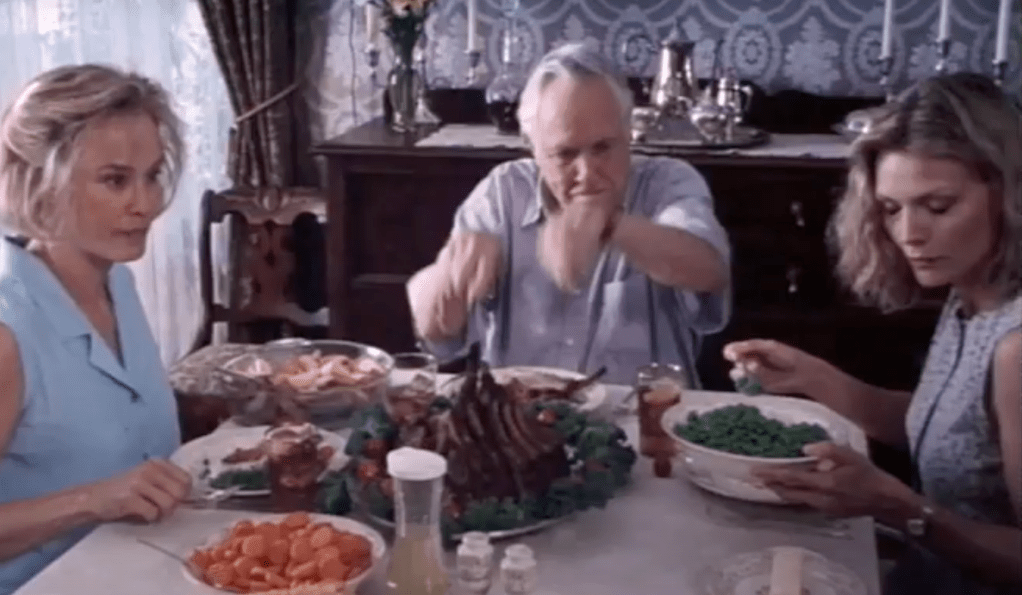
From the trailer for the movie version of Jane Smiley’s A Thousand Acres novel. (Screen shot by me.)
One might think novels fully or partly set on farms would tend to be low-key or even boring. Far from true, of course, because human emotions are complex and events can be quite dramatic whether the milieu is rural, suburban, or urban.
Yes, novels featuring farmers often include family discord, marital problems, characters fleeing rural life, backbreaking work, awful weather, money troubles, takeovers by agribusiness, etc. And it almost goes without saying that there are uplifting times, too.
A Thousand Acres, which I read last week, is a prime example of a “farm novel” with multiple layers. Jane Smiley’s Iowa-set book focuses on the fraught relationship between three adult sisters and the even more fraught relationship between that trio and their publicly respected but privately despicable widowed farmer father. It’s painful to read about the dark moments the Cook family goes through, but well worth the effort as the King Lear-influenced novel gets more riveting with each chapter after a slow start. A skillfully written and psychologically nuanced book much deserving of its 1992 Pulitzer Prize for fiction.
Also set in Iowa farm country is W.P. Kinsella’s novel Shoeless Joe, better known for inspiring the movie Field of Dreams. More about baseball and father-son bonds than farming, but the rural setting is indelible.
Over in Tennessee, Dellarobia Turnbow of Barbara Kingsolver’s Flight Behavior is a farm woman dissatisfied with her marriage and life in general who tries to do something about that — even as the novel’s overarching theme is about the sadly disastrous effects of climate change. Not surprisingly, Kingsolver had a rural upbringing (in Kentucky).
Willa Cather spent some of her childhood on the Nebraska prairie, which is the partial setting of perhaps her best novel: My Antonia. Antonia Shimerda is a farm woman, and the book’s main character is her friend-from-childhood Jim Burden, who moves to the city but continues to feel a strong pull toward his rural roots.
The title character of John Edward Williams’ Stoner novel also leaves the farm (William Stoner becomes a University of Missouri literature professor). But, as is the case with Jim Burden, his farm upbringing has a big formative influence on him.
In Zora Neale Hurston’s Their Eyes Were Watching God, Janie Crawford’s first marriage is to a farmer. Things do not end well.
R.D. Blackmore’s Lorna Doone focuses on farmer John Ridd and his risky love for Lorna in 17th-century England. The book’s long-ago time frame is a reminder that there was of course more farmland when the world was less populated, meaning a larger percentage of older novels have a rural setting.
Heck, even my densely populated state of New Jersey had lots of open space a century ago, and rural NJ is the setting for Albert Payson Terhune’s His Dog — about a struggling farmer whose life changes enormously when he takes in an amazing canine.
John Steinbeck’s The Grapes of Wrath opens in Oklahoma — where a devastating drought, The Great Depression, and rapacious agribusiness force the Joad family off their farm. They head to California, where roving farm workers such as themselves are treated horribly by rich landowners.
Another book with a farm setting is E.B. White’s Charlotte’s Web, beloved by many younger readers (and many older ones, too).
Then there’s George Orwell’s Animal Farm, a satirical fable that can hardly be called a “farm novel.” But there IS the word “Farm” in the title. 🙂
Any farm-set novels you’d like to mention? (Including ones set outside the United States; my post is mostly U.S.-centric.)
My literary-trivia book is described and can be purchased here: Fascinating Facts About Famous Fiction Authors and the Greatest Novels of All Time.
In addition to this weekly blog, I write the 2003-started/award-winning “Montclairvoyant” topical-humor column for Baristanet.com every Thursday. The latest piece — about a way-too-pricey bridge replacement — is here.







 Dave Astor on Literature