 As an adult who reads fiction, it’s interesting to occasionally encounter a novel in which the goings-on are viewed from a child character’s perspective.
That approach can bring readers’ memories back to their own younger years, and inspire analysis of whether the author successfully captured the kid perspective or instead created a character who sounds like a mini-adult.
Child narrators in fiction convey the process of learning about life, sound innocent or not so innocent, and don’t understand certain things or are precocious enough to understand more than might be expected. Also, some fictional kids THINK they don’t understand certain things but understand more than they realize — or might not grasp certain things yet telegraph that lack of grasp in a way that helps the readers to understand those things.
It’s not easy for adult novelists to narrate from a child’s perspective. The writers can’t be TOO knowing, and might have to navigate the difficult process of yanking themselves back to the mindset of their own childhood as fodder for taking a younger approach in a book. In fact, some novels told from a child’s perspective feature adult characters looking back and telling the stories from the vantage points of their kid selves.
When successfully created, child narrators can be memorable/poignant protagonists, can grab the sympathy of readers, and more.
Among the examples of this kind of novel is Jamaica Kincaid’s Annie John, which I read last week. It’s a coming-of-age story, set on Antigua in the Caribbean, starring a brainy girl who’s at first rather innocent and then becomes more calculating and angry. From Annie’s perspective, we learn a lot about her, her friends and classmates, her love-hate relationship with her parents, and Antiguan life in general.
One of the most famous novels featuring a kid’s-eye view is Harper Lee’s To Kill a Mockingbird. Scout Finch takes the reader through a journey that includes how she views her upstanding lawyer father Atticus and learning about the harsh realities of the world — most notably the virulent racism in 1930s Alabama. (Photo is of Scout and Atticus in the To Kill a Mockingbird movie.)
Some novels told from a child’s perspective take the young protagonists up to the start of adulthood or even well into adulthood, but have many early chapters chronicling the kid years. That’s certainly the case with Ms. Kincaid’s book (which ends with Annie leaving Antigua for a job in England at age 17) and with the stars of the English novels David Copperfield and Jane Eyre.
Charles Dickens’ semi-autobiographical classic chronicles David Copperfield’s mixed bag of a childhood, his school experiences, and eventually his two marriages — with many vivid supporting players (including Mr. Micawber) along the way.
Jane Eyre’s child perspective in the early chapters of Charlotte Brontë’s novel is fascinating as she recounts her difficulties living in the household of her cruel aunt and then her time in a harsh school for orphans. The young Jane is often unhappy, yet displays plenty of mental strength and a kind of fierce confidence that helps her as she grows from girl to woman.
There are also novels that unfold via a third-person/omniscient/adult narrator yet feature child or teen protagonists so memorable that it almost seems like the books are told from their perspectives. L.M. Montgomery’s Anne of Green Gables and James Baldwin’s Go Tell it on the Mountain are among the notable examples.
Your favorite novels told from a child’s point of view?
My literary-trivia book is described and can be purchased here: Fascinating Facts About Famous Fiction Authors and the Greatest Novels of All Time.
In addition to this weekly blog, I write the award-winning “Montclairvoyant” topical-humor column for Baristanet.com. The latest weekly piece — about back to school and more — is here.
 Last week’s post focused on characters who miss each other. This week, the focus will be on those who HATE each other.
 I was away last week, and greatly missed my cat Misty. Which reminded me that reading about fictional characters who miss a living animal or a living person can be a very poignant thing. Hopefully followed by a happy reunion, but not always.
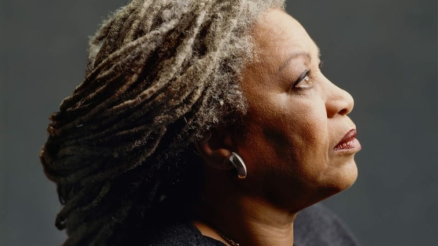 I was starting to read Alice Walker’s novel The Temple of My Familiar the morning of August 6 when I learned that literary great Toni Morrison had died the day before. So it seemed time to write a long-overdue piece about female authors of color.
 Many novels of the past 50 years or so, including literary ones, have been fairly candid in their references to sexual matters. That’s the case with parts of John Irving’s In One Person, Zadie Smith’s On Beauty, Jonathan Franzen’s The Corrections, Alice Walker’s The Color Purple, Erica Jong’s Fear of Flying, Rita Mae Brown’s Rubyfruit Jungle, Philip Roth’s Portnoy’s Complaint, Jacqueline Susann’s Valley of the Dolls, and numerous other fiction books. (Fifty Shades of Grey? Haven’t read it.)
 We’ve all heard the phrases “No good deed goes unpunished,” “When bad things happen to good people,” and “Only the good die young.” So it goes in literature, as it goes in real life. Likable, ethical, admirable characters often have negative things happen to them.
 There’s bad nostalgia, such as Donald Trump’s delusional belief that the United States was once great (perhaps for a good number of affluent white males but often not for other demographics). And there’s more positive nostalgia, which will be the subject of today’s blog post. More positive nostalgia in literature, that is.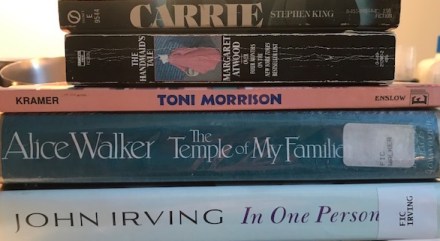

 Dave Astor on Literature