 Many novels of course contain character groupings — family members, or friends, or work partners, or other associations. Interesting interactions often result, and things can get even more interesting when the people are very different from each other.
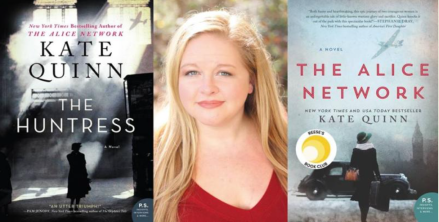
That came to mind last week while reading Kate Quinn’s The Alice Network. Her gripping historical novel — which has parallel World War I and post-World War II story lines that eventually merge in memorable fashion — features the coming together of three characters who at first couldn’t seem more different: bitter, foul-mouthed British/French WWI spy Eve Gardiner, pregnant-American-college-student-in-Europe Charlie St. Clair, and Scottish WWII veteran/ex-convict Finn Kilgore. They not only appear to have few personality traits in common, but Eve treats Charlie worse than dismissively. But eventually the relationships take a turn, and we also find out that Eve and Charlie share something/someone awful in their pasts despite their 35-year age gap. Can that something/someone be exorcised?
Yes, characters who are very different can often (not always) have unexpected similarities that enable them to surprisingly get along. Or maybe that’s not so unexpected and surprising — heck, we’re all human, many of us suffer, and we all want some happiness. Still, when thrust-together disparate characters don’t get along, there’s a huge potential for riveting drama and fireworks: fights, insults, simmering hatred, etc. All of which is frequently more compelling than when people do get along.
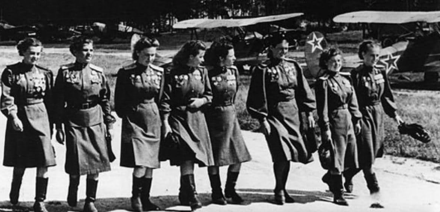
Kate Quinn also created an odd grouping in her subsequent, even better novel, The Huntress. Those joining to hunt a Nazi woman (Annaliese) guilty of many murders include Russian aviator Nina, British ex-journalist Ian, American WWII vet Tony, and a Boston-based photographer (Jordan) suspicious of her stepmother: the aforementioned Annaliese, who hid her Nazi identity when fleeing to the U.S. and marrying Jordan’s father. Eve Gardiner even has a cameo!
In Toni Morrison’s Sula, the title character is outgoing, independent, and unconventional, while the novel’s co-star Nel is a quieter, more traditional sort. They are childhood friends despite those differences, but eventually grow far apart — for reasons such as a tragedy they jointly witnessed as kids, and, when they’re adults, Sula gravely betraying Nel.
Then there are the brothers Udayan and Subhash in Jhumpa Lahiri’s The Lowland. The former is a revolutionary, the latter is content to live a lower-key life pursuing his education. Subhash is also more responsible, eventually marrying Udayan’s pregnant wife Gauri after Udayan is murdered by paramilitary police. Subhash and Gauri end up being a major mismatch as well.
Very different types are frequently placed together in the military (think Herman Wouk’s The Caine Mutiny), the workplace (think Emile Zola’s The Ladies’ Delight), the classroom (think L.M. Montgomery’s Anne of Green Gables), and shared apartments (think Margaret Atwood’s The Edible Woman). Of course there’s also Neil Simon’s iconic play The Odd Couple, about two complete opposites (neurotic neat-freak Felix Unger and fun-loving slob Oscar Madison) sharing a rental after their respective marriages fall apart.
Disparate groups can also involve different species, especially when one gets into the sci-fi or fantasy realm. For instance, J.R.R. Tolkien’s The Hobbit and his subsequent trilogy The Lord of the Rings feature hobbits, humans, wizards, dwarves, and elves on epic quests. That cross-cultural collaboration creates a good deal of tension, though the characters basically get along enough to do what they need to do.
In the animal world, there are the two dogs and one cat who together try to find their way home through 300 miles of Canadian wilderness in Sheila Branford’s The Incredible Journey. Of course, it’s not unheard of for canines and felines to get along. 🙂
Novels and characters you’d like to mention that/who fit this theme?
Speaking of trios, there was the three-person rock band Rush — whose drummer Neil Peart unfortunately died January 7 at the age of 67. He was widely considered the best rock drummer in history (I agree) and was also an exceptional lyricist — as well as a book author and voracious reader. Some Rush songs contained literary references; one of them was “Xanadu,” inspired by Samuel Taylor Coleridge’s “Kubla Khan” poem. Here’s that tune featuring Peart, guitarist Alex Lifeson, and singer/bassist/keyboardist Geddy Lee — all virtuosos on their instruments. I got interested in Rush about five years ago at the urging of former frequent commenter here “Ana,” and then backtracked to listen to the band’s work from the 2000s, 1990s, 1980s, and 1970s. “Xanadu” is from 1977, when Rush tended to do longer tracks.
My literary-trivia book is described and can be purchased here: Fascinating Facts About Famous Fiction Authors and the Greatest Novels of All Time.
 Some novels grab you from the first page or even first sentence, while others build more slowly. Sometimes so slowly — or so confusingly or so off-puttingly — that one flings the book away. (Hopefully not while reading it on an electronic device. 🙂 )
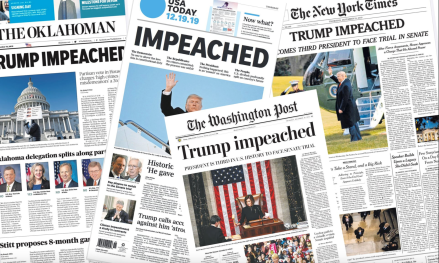 It’s always nice when wrongdoers suffer consequences, as was the case last week when the ultra-corrupt Trump was impeached by the U.S. House of Representatives. Sure, the repellent Republican majority in the U.S. Senate will acquit the Ogre-in-Chief after ignoring the huge trove of proof that he’s a criminal, but at least Trump got some comeuppance.
 Today’s theme? Novelists who keep readers off-balance by defying expectations with certain characters.
 One of literature’s pleasures is reading an established living author for the first time, loving the novel, and knowing you not only have past books but (most likely) future ones to enjoy by that writer.
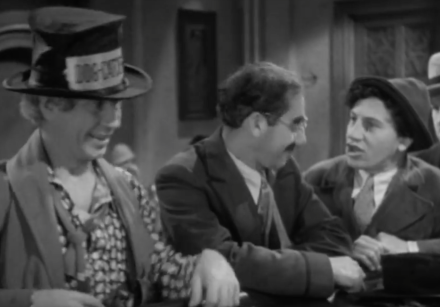 In Marx Brothers movies, we have the talkative Groucho and Chico and the mute Harpo. “So it goes” with novels — there are some loquacious characters as well those who say little or nothing, though of course most are somewhere in between on the speaking scale.
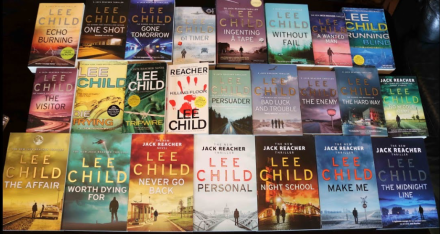 Some fiction authors are rather formulaic while others vary their approach with almost every novel — and I like both kinds of writers.