 One great thing about reading novels is enjoying some very eccentric characters. You might only find them once in a while, but they’re worth the wait.
The latest quirky fictional person I stumbled upon is the father in Polish author Bruno Schulz’s memorable, melancholy, lushly prosed The Street of Crocodiles (1934). This odd dad houses a huge number of live birds in the family attic, is convinced that mannequins feel imprisoned in their lifeless bodies, etc.
Clearly, some eccentric characters have psychological issues, though that’s not always the case. Some are quite sane, albeit…different.
Quite different is health resort owner Masha, briefly mentioned in last week’s blog post when I discussed Liane Moriarty’s Nine Perfect Strangers. That Australian immigrant from Russia is highly intelligent, driven, ruthless, voyeuristic, an outside-the-box thinker, a fitness fanatic after suffering a massive heart attack, and…weird.
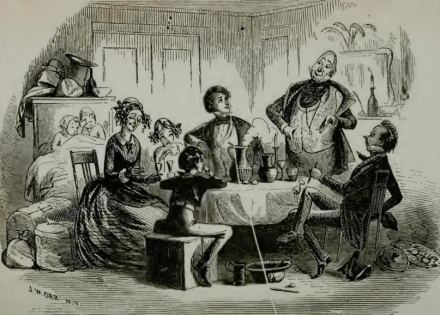
There are some authors — including Charles Dickens and John Irving — we associate with quirky characters in multiple books. One of Dickens’s best-known eccentrics is David Copperfield supporting player Mr. Micawber (standing in the image above), who’s partly ridiculous and partly hilarious in his perpetual unrealistic optimism. One of Irving’s quirkiest creations is A Prayer for Owen Meany‘s title character — an obsessive fellow who speaks in a high-pitched voice, feels he’s God’s instrument, and believes he can predict the date of his own death (correctly, as it turns out).
It’s a bonus when an appealingly odd character appears more than once — as is the case with “Sully” in Richard Russo’s Nobody’s Fool and later in Everybody’s Fool. Donald Sullivan is a brainy, funny blue-collar guy who’s comically unambitious.
There are of course eccentric types who appear in way more than two novels, aka series. J.K. Rowling’s Harry Potter books are certainly peopled with many a quirky cast member — including the spacey Luna Lovegood, to name just one. And, when you think about it, Lee Child’s Jack Reacher is a rather peculiar guy who roams from place to place meting out justice. No permanent home, carries little more than a toothbrush, and can even tell time to the minute without a watch.
Getting back to appeared-in-just-one-book characters, notable eccentrics include the silly/likable/delusional star of Miguel de Cervantes’ Don Quixote, the clairvoyant/telekinectic/distracted Clara del Valle Trueba of Isabel Allende’s The House of the Spirits, the strange/cruel/passionate Heathcliff of Emily Bronte’s Wuthering Heights, the slobby/antisocial/uproarious Ignatius J. Reilly of John Kennedy Toole’s A Confederacy of Dunces, the overeating/clownish/sympathetic Samson-Aaron of Herman Wouk’s Marjorie Morningstar, the brilliant/offbeat/anxiety-ridden architect title character of Maria Semple’s Where’d You Go, Bernadette, and Sylvie Fisher of Marilynne Robinson’s Housekeeping. The calm/independent Sylvie has wanderlust, eats dinner only in the dark, hoards magazine and newspapers…
I’ve barely scratched the surface in naming eccentric characters. Some of your favorites?
My literary-trivia book is described and can be purchased here: Fascinating Facts About Famous Fiction Authors and the Greatest Novels of All Time.
In addition to this weekly blog, I write the award-winning “Montclairvoyant” topical-humor column for Baristanet.com. The latest piece — about silver linings in the time of coronavirus — is here.
 Some novels FOAC. Some don’t.
 Every decade has its share of memorable novels. Today I’m going to focus on the 1880s.
 I don’t think I’ve ever published a blog post on my birthday before, so I’ll “celebrate” by listing some novelists I love or like and how old they are. Why? Because it’s easier to make a list than to write a regular blog post of the kind I’ll resume next week. 🙂
 “War is hell,” but it can also be almost an abstraction. Unless you’re directly affected, it might not seem quite as horrible as it actually is or as senseless as it usually is. Novels and other kinds of fiction can help.
 With the coronavirus wreaking havoc throughout the world — and American “leader” Donald Trump predictably responding to that pandemic in the most incompetent, empathy-lacking, and self-serving way imaginable — it would be understandable if book lovers would want to read only escapist fiction for a while. But if you’re a glutton for punishment, there are some very compelling novels out there with pandemic themes — many pessimistic about the situation and the reaction to it, others a bit more optimistic.
 I’ve blogged about fiction written by
  Have you ever read a novel that’s mostly low-key, subtle, understated, and even seemingly simple yet is compelling or charming or funny or emotionally wrenching or all of the above? Sure you have, and I have, too.
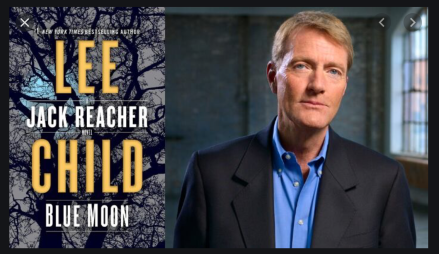 After reading Lee Child’s latest Jack Reacher novel last week, I thought about how page-turning that series is and how it reflects our times. Heck, there’s an amazing/harrowing “fake news” reference near the end of that recent book, which chronicles Reacher’s battle against rival mobs that ruthlessly control a city.
 Dave Astor on Literature