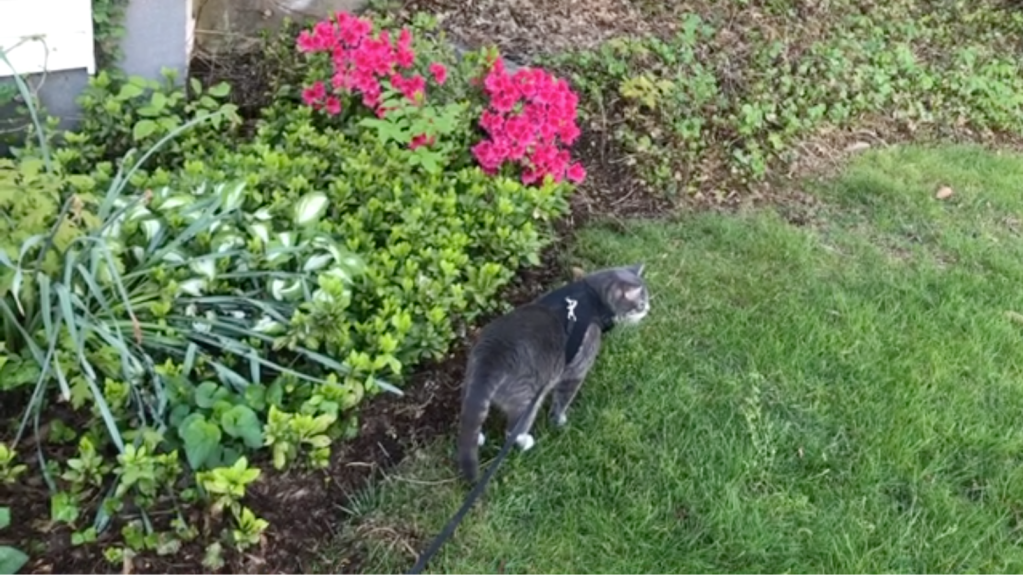
My cat Misty is the star of my in-progress book. (Photo by me.)
This is a tale of why it can take an author a long time to start writing their next book.
Back in early 2017, my Fascinating Facts literary-trivia book was published. I spent more than five years sporadically writing it, with my time limited by being the father of a 2007-born girl my wife and I had adopted despite us not exactly being young parents. 🙂 (I also have an adult daughter, Maggie, from my first marriage.)
I’m aware that many of you who read this blog are authors, so you know the adrenaline rush one feels when your latest book comes out. You’re thrilled, you’re into marketing it, and that energy often translates into eagerly starting another book soon after.
But, for me, some reality set in six years ago — albeit a reality more about time constraints than procrastination. My aforementioned daughter, Maria, had turned out to be quite an athlete (at one point simultaneously doing softball, soccer, and gymnastics), so the driving to practices and games/meets — and watching said games/meets — took up lots of hours.
Then my Florida-based mother Thelma’s health began failing in mid-2017, and there were countless phone calls I made from New Jersey talking with her, with doctors, with hospitals, with home-aide agencies, with the aides themselves, etc. Adding to the stress was that my mother, even when younger and healthy, was not an easy person to get along with. In retrospect, I have to laugh about how, when I gave her a copy of Fascinating Facts a couple months before she got sick, she pronounced it “boring.” Naturally, because the not-boring book was mostly about novelists, and my mother rarely read novels — or nonfiction books, for that matter — during her life.
Still, Thelma was in need, and, while I decided not to travel to Florida because of having a preteen at home and my professor wife Laurel commuting to New York City several days a week, my phone became practically attached to my ear.
Writing a book at that time was not a priority, and not really possible.
My mother died in April 2018, after which I obviously did go to Florida. Five times in fact — first for the funeral and then four more times that year. I did five short trips rather than a couple of long trips mostly to try to work around Laurel’s teaching schedule so one of us would always be home with/for Maria.
Anyway, I and my sister Linda went through lots of stuff at Thelma’s small-but-packed condo and dealt with her rather problematic will/estate. (Long story I won’t get into here.)
Adding to the craziness was Thelma’s modest home sustaining major damage when flooded by its water heater in July 2018. That same month I had jury duty and was picked for a trial. And that same month our cat Misty, who we adopted in December 2017, had a scary asthma flare-up that might have killed him if we hadn’t gotten him to an animal hospital for an overnight stay in an oxygen room. July 2018? #&@&#!
Also making it harder to write a book was spending lots of time with Misty, who we eventually began walking every morning on a leash to help his health and give him a break from our not-large apartment. Pets deserve their humans’ attention, and Misty loves his strolls!
The years went on. Still tons of sports activities for Maria, though she eventually dropped the soccer. And many time-consuming doctor appointments and physical-therapy sessions, because she played so aggressively that she often got injured. Concussions, sprains, and more.
Plus I was of course writing this weekly literature blog, as well as a weekly humor column about my New Jersey town of Montclair. With those deadlines, I never procrastinated. Plus I’m on the board of the National Society of Newspaper Columnists, copy-edit its newsletter, and often wrote for that newsletter before cutting back in 2020.
I began to think maybe I wouldn’t start my next book until Maria went to college. I certainly had several ideas in mind, so it was frustrating to have those ideas remain trapped in my brain.
In October 2022, during Maria’s second season on Montclair High’s gymnastics team, she tore her ACL during a class at a private gym — throwing a big wrench in her life and her parents’ lives. She was in a lot of pain, and needed to be driven everywhere; her trusty bike was out of the question for a while. And she was devastated and quite grumpy about not being able to do competitive sports until at least September 2023 — nine months after the reconstructive surgery she had on her right knee in December 2022.
Then I myself had a major operation in January of this year. As I dealt with constant bleeding for about six weeks, I began to think of mortality and how I really, really wanted to write a third book sooner rather than later. (My Comic (and Column) Confessional memoir had come out in 2012, preceding Fascinating Facts by five years.) So I resolved to start a book, buoyed by the knowledge that I would have some extra time to do so. Because while Maria still needed to be driven to post-surgery physical therapy three days a week, there would be no high school softball season for her this spring and all the driving to practice and game-watching that entailed. While I would greatly miss the games…many more hours to write!
But fate has a way with things. Maria learned that Montclair High’s crew team was looking for a coxswain, which doesn’t require strenuous exercise and thus could be done while Maria recovered from her ACL tear. But the time devoted to crew would make softball seem like a picnic, because, in addition to the three PT sessions a week, Laurel or I are now driving Maria almost every day to and from practices at a river that’s not very close and involves navigating an often-crowded highway (Route 3, which New Jersey motorists use to get to nearby New York City). Maria joined the team too late for us to join a parent carpool. Ugh.
I resolved to continue the book, though, even though it means less sleep and less relaxation time — other than reading novels, of course. 🙂 The book, with the working title of Misty the Cat’s (Partly True) Memoir, is written by me in the voice of my beloved feline as the kitty relates his life, chronicles his daily walks, tells jokes, offers information about his species, etc., in an effort to pass the time while stuck in a dangerous situation. Nearly 26,000 words so far, and I hope it will come out sometime in 2024.
Any thoughts on time constraints, procrastination, and more?
My literary-trivia book is described and can be purchased here: Fascinating Facts About Famous Fiction Authors and the Greatest Novels of All Time.
In addition to this weekly blog, I write the 2003-started/award-winning “Montclairvoyant” topical-humor column for Baristanet.com every Thursday. The latest piece — about my town’s poor-performing township manager FINALLY getting fired after being credibly accused of misogynistic and racist actions — is here.