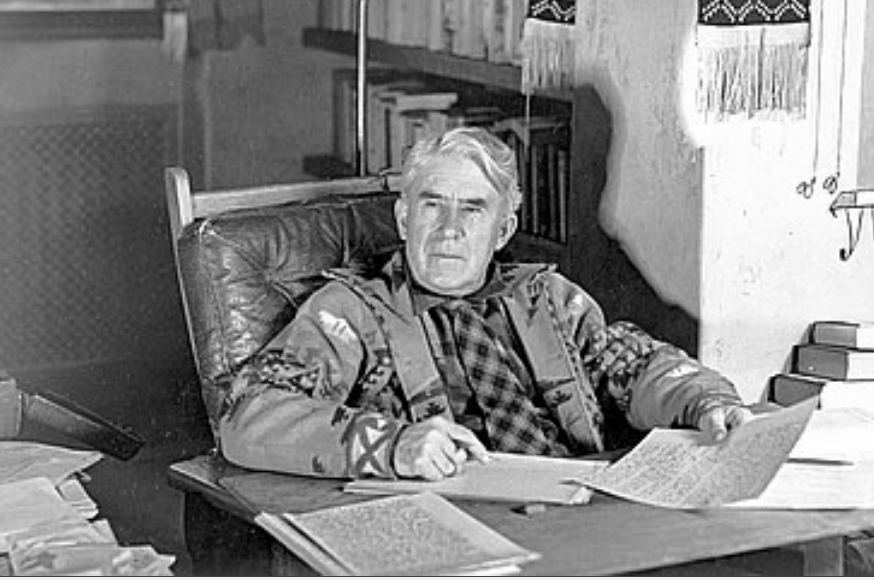
Zane Grey (Oregon Historical Society Research Library).
I’m not a big fan of western novels, movies, and TV series — those book and screen creations set in the American West, often during the 1800s, often populated with outlaws, sheriffs, cowboys, gunfights, horses, saloons, etc. — and of course more than a few times featuring lone, laconic strangers riding into town. Sure, such creations frequently offer excitement, courage, the pioneering spirit, and so on, but they can also be off-putting.
Why? A predominant focus on white men, even though there were many cowboys of color in the real 19th-century American West. Brutality toward, and repulsive stereotyping of, Native Americans. Rampant sexism — whether in the form of condescending chivalry or macho viciousness. Also, many western creations can be rather formulaic.
But there have been some western novels I’ve found compelling, and usually it was because they were sort of anti-westerns satirizing/criticizing the genre or turning some conventions on their head.
Among the novels I’ve liked a lot are Charles Portis’ True Grit and Isabel Allende’s Daughter of Fortune. They attracted me for several reasons — including the fact that they both star female characters: teen Mattie Ross in the first novel and Eliza Sommers in the second. The half-Chilean Eliza is also not a totally white heroine.
In the young-adult-fiction realm, the 19th-century portion of Louis Sachar’s Holes novel features a white Texan named Kate Barlow who becomes a deadly and charismatic outlaw after the Black farmer she loves is killed by racists.
Then there’s Cormac McCarthy’s Blood Meridian, one of the most violent literary novels ever written as it depicts the homicidal barbarity of a gang of white men in the 19th-century West who ruthlessly slaughter male and female Native Americans, Mexican Americans, and others. No whitewashing of white misdeeds here, and the writing is amazing, but it’s an ultra-painful read.
There are also some nasty goings-on in McCarthy’s absorbing Border Trilogy (All the Pretty Horses, The Crossing, Cities of the Plain) — but not at the carnage level of Blood Meridian.
Among other western books I’ve enjoyed is The Prairie — the 1827 installment of James Fenimore Cooper’s “Leatherstocking” novels quintet best known for The Last of the Mohicans. Protagonist Natty Bumppo is a mostly likable guy whose attributes include having relatively tolerant views about Native Americans for a man of his time.
I also enjoyed some of The Virginian, Owen Wister’s influential 1902 novel responsible for a number of the tropes that would later appear in other western novels (including many written by the ultra-prolific Zane Grey) as well as in western movies and TV series. Derivative in those later creations, kind of original in Wister’s book.
The idea for this post occurred to me while reading Zane Grey for the first time last week. I looked for his most famous work — Riders of the Purple Sage — at my local library, but, after not finding it there, chose another Grey novel at random: the Nevada-based Boulder Dam. Turned out to be set in the post-frontier 1930s, so not a classic western, but it was quite a page-turner. Still, it had some of the disturbing flaws of certain western novels — disdain for Native Americans (Grey vilely called them “savage red-skinned tribes” in the prologue), racial slurs against African Americans, and false insinuations that only white men are capable of doing great things. Also, to repeat a word from my second paragraph, the novel was rather formulaic and featured a young male protagonist (Lynn Weston) who, while appealing, perodically didn’t seem believable as a character creation.
I haven’t read Larry McMurtry’s Lonesome Dove, Jack Schaefer’s Shane, or Thomas Berger’s Little Big Man, but saw the compelling movie versions of the latter two.
Which reminds me that film icon John Wayne of course appeared in various westerns (including the first movie version of the aforementioned True Grit) while usually playing brave, “manly” characters even as he didn’t serve in World War II in real life. There is some dispute about whether the right-wing Wayne deliberately avoided enlisting or made an attempt to do so but wasn’t selected because of his age (over 30 at the time), his movie stardom, and his having a family. Yup, the actors who played fictional cowboys were often not so courageous in real life.
Your thoughts on the western genre? Novels in that realm you’ve liked or not liked?
My literary-trivia book is described and can be purchased here: Fascinating Facts About Famous Fiction Authors and the Greatest Novels of All Time.
In addition to this weekly blog, I write the 2003-started/award-winning “Montclairvoyant” topical-humor column for Baristanet.com every Thursday. The latest piece — about the tone-deaf hiring of a communications person by my town’s school district — is here.






 Dave Astor on Literature