Feline Post Includes Mentions of Jane Austen and ‘The Host’

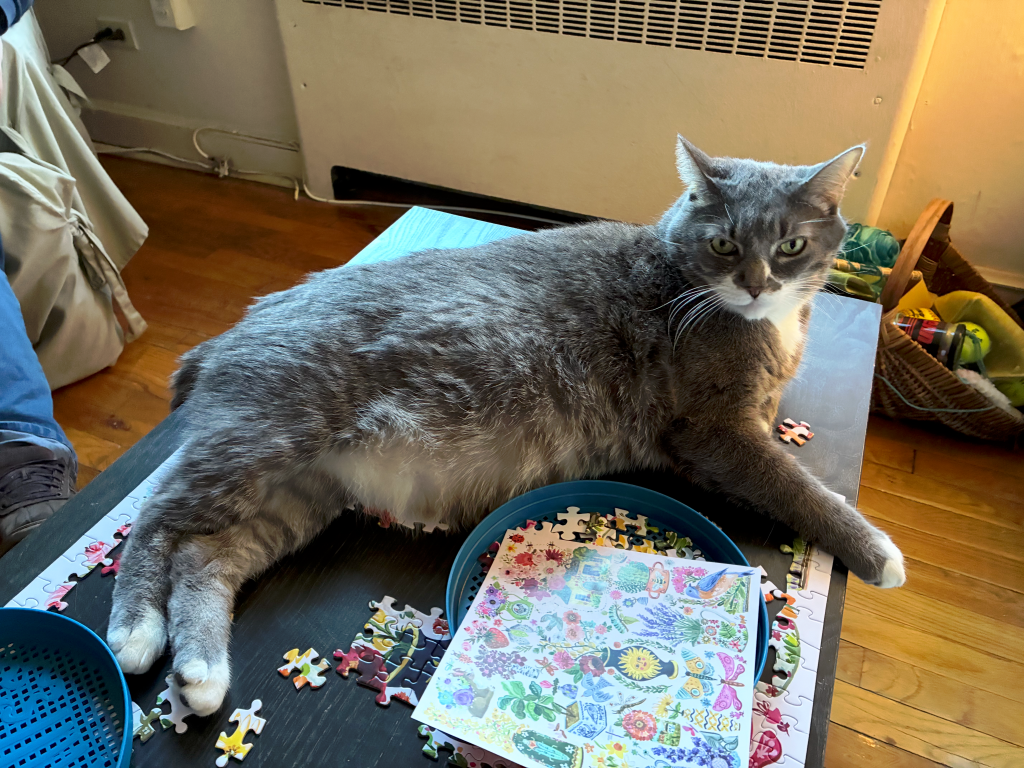
I, Misty the cat, say: “Putting together a guest blog post is like putting together a puzzle.” (Photo of my kitty self taken by my adult female human Laurel.)

Misty the cat here, returning for my every-two-month takeover of Dave’s blog — which I do by gunpoint, minus the gun. This is a particularly memorable time for me to post because tomorrow is the 8th anniversary of my adoption into my forever family, from whom I’ve received everything I could desire except a bed the size and shape of Buckingham Palace. King Chuck III has some ‘splaining to do.

And in nine days — December 16 — there’ll be a milestone moment for literature: the 250th anniversary of Jane Austen’s 1775 birth! Rebecca Budd, who comments here every week, has already posted about that anniversary in one of her great blogs. The year 1775 was also significant for being the start of the American Revolutionary War and for Apple’s rollout of the iMusket 9.

Back to Austen. I’m often (well, never) asked how I rank her six novels, and here’s my kitty answer: 1, 2, 3, 4, 5, 6. Oh, you want titles, too? 1) Persuasion. 2) Pride and Prejudice. 3) Sense and Sensibility. 4) Mansfield Park. 5) Emma. 6) Northanger Abbey. This is also Dave’s order of faves (rhyme alert!), which means we were both bribed by the same literary scholars. Austen’s early 19th-century books have aged well…partly because I keep them in my wine cellar. Actually, I don’t have a wine cellar. No cat does.

And today, December 7, is the 84th anniversary of the 1941 attack on Pearl Harbor, an event vividly depicted near the end of Herman Wouk’s compelling novel The Winds of War. If those winds had become strong enough, Wouk’s book would’ve been titled The Hurricanes of War — storms that fall alphabetically between Hurricane Violin and Hurricane Xylophone.

The Winds of War was followed by Wouk’s epic War and Remembrance — the title of which has the initials “WAR.” Coincidence? Well, Hurricane Coincidence falls alphabetically between Hurricane Bassoon and Hurricane Didgeridoo.

My current reading? I, Misty the cat, recently finished Twilight author Stephenie Meyer’s The Host, an excellent work of sci-fi that stars a being who lives inside a human body. So, no, the book is not a historical novel about Johnny Carson, who was not related to The Heart Is a Lonely Hunter author Carson McCullers, who was a top-notch writer but apparently didn’t know that a heart can’t hunt animals without a permit and that vegans prefer Fannie Flagg’s novel Fried Green Tomatoes at the Whistle Stop Cafe. Also, American frontiersman Kit Carson was not a feline like me.

Natty Bumppo did the frontiersman thing, too, in James Fenimore Cooper’s five “Leatherstocking” novels that included The Last of the Mohicans. Cooper was an American contemporary of aforementioned Englishwoman Jane Austen, and there are even rumors that they collaborated on a novel called The Last of the Emmas. So I’m puzzled (see photo) that we later had people such as actresses Emma Thompson and Emma Watson.

The latter of course played Hermione Granger in the Harry Potter movies based on the J.K. Rowling novels. Seven books, eight movies, and nine lives (experienced by cats like me). Plus there are 10 characters in Agatha Christie’s famed mystery novel And Then There Were None, whose plot focuses on the number of dry-food pellets left in my bowl after I finish eating. No mystery where those pellets went.

Which books do I want for Christmas? Charles Dickens’ A Christmas Carol, Fannie Flagg’s A Redbird Christmas, John Grisham’s Skipping Christmas, Betty Smith’s A Christmas Tree Grows in Brooklyn, Anthony Burgess’ A Christmas Orange, Fyodor Dostoevsky’s Christmas and Punishment, Aldous Huxley’s Brave New Christmas, Barbara Kingsolver’s Demon Christmashead, E.M. Forster’s A Passage to Christmas, Chinua Achebe’s Christmas Falls Apart

Dave will reply to comments as I either finish the puzzle I’m photographed with or swat every piece of that puzzle into January 2026.

I, Misty the cat, say: “There’s gotta be a sidewalk sale around here somewhere.”

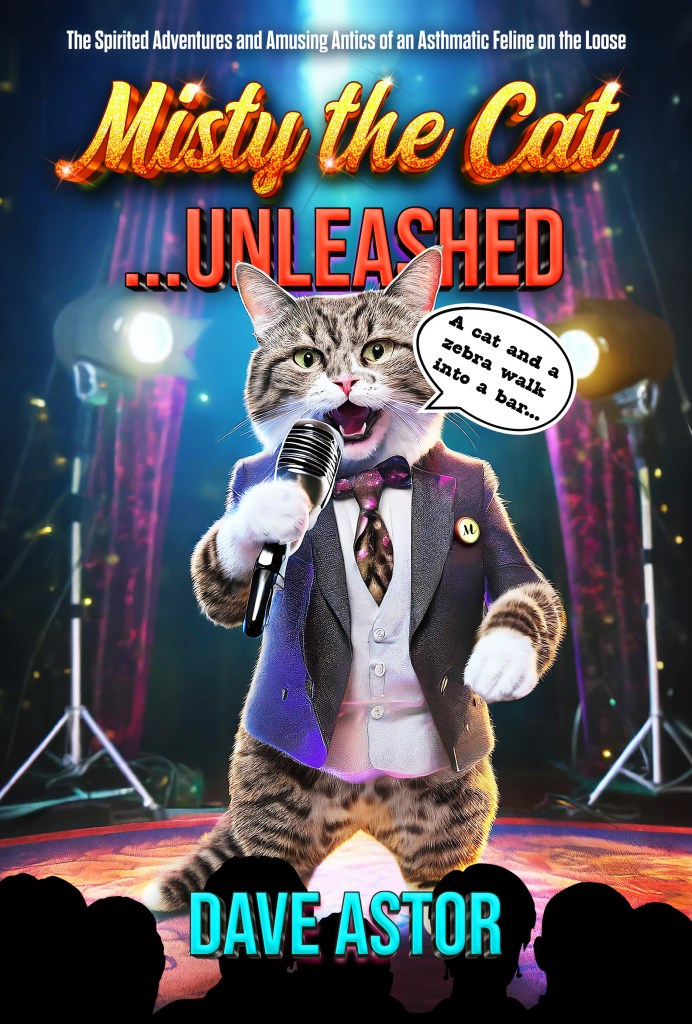
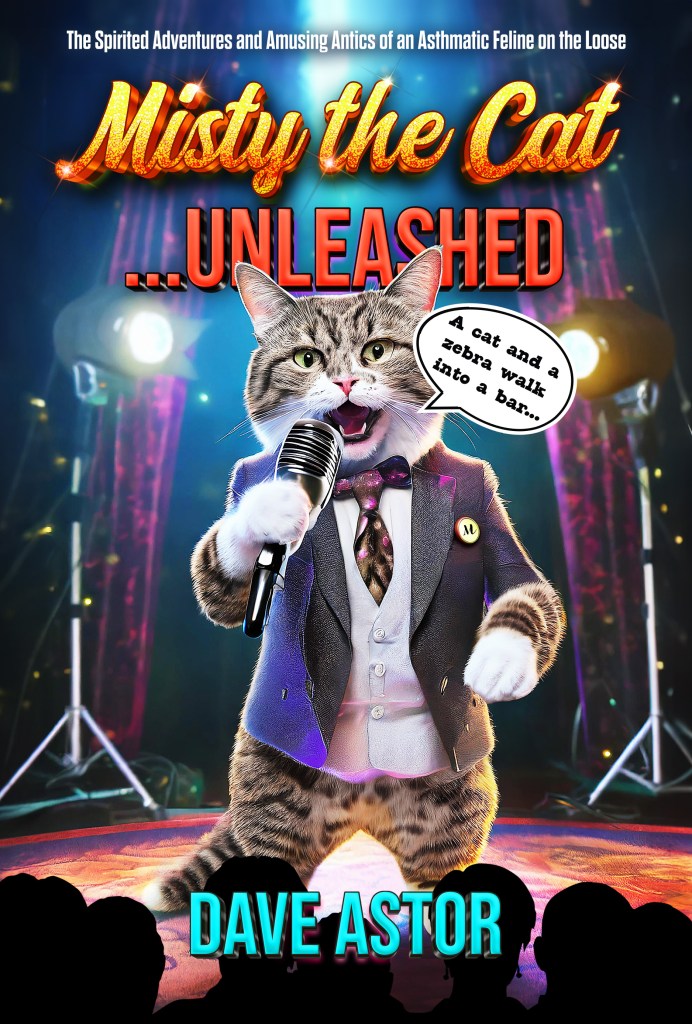
Dave and my comedic 2024 book — the part-factual/part-fictional/not-a-children’s-work Misty the Cat…Unleashed — is described and can be purchased on Amazon in paperback or on Kindle. It’s feline-narrated! (And Amazon reviews are welcome. 🙂 )
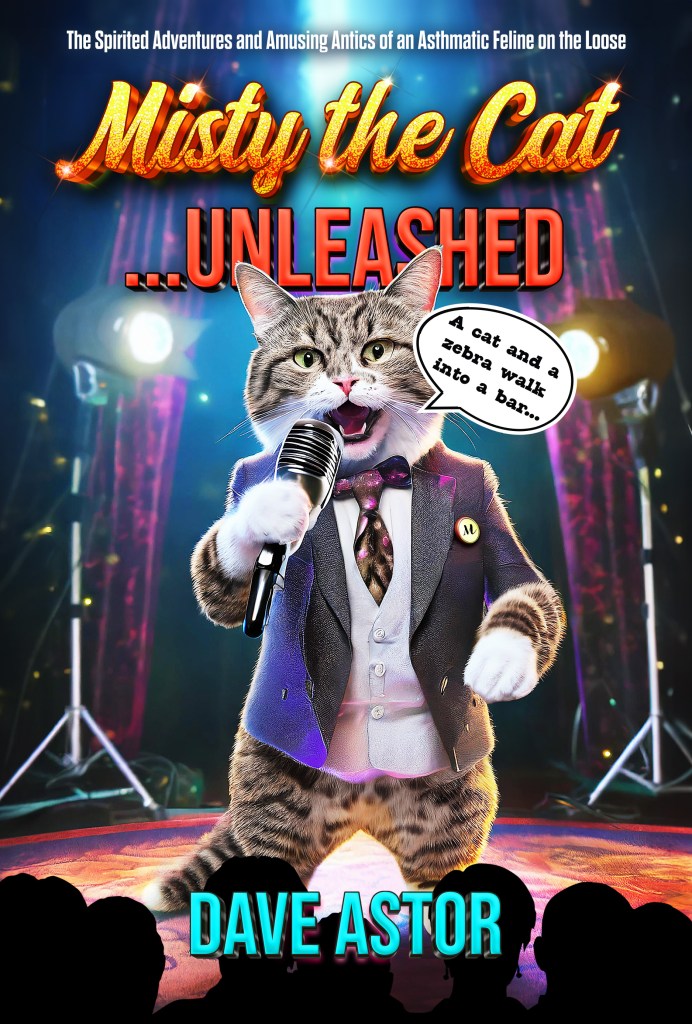
This 90-second promo video for the book features a talking cat: 🙂

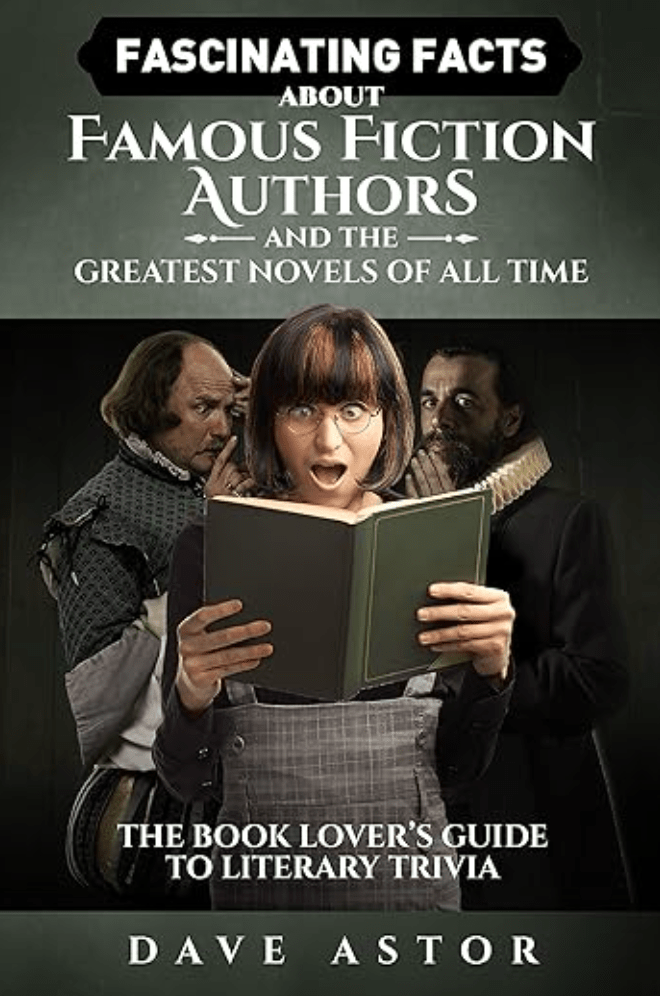
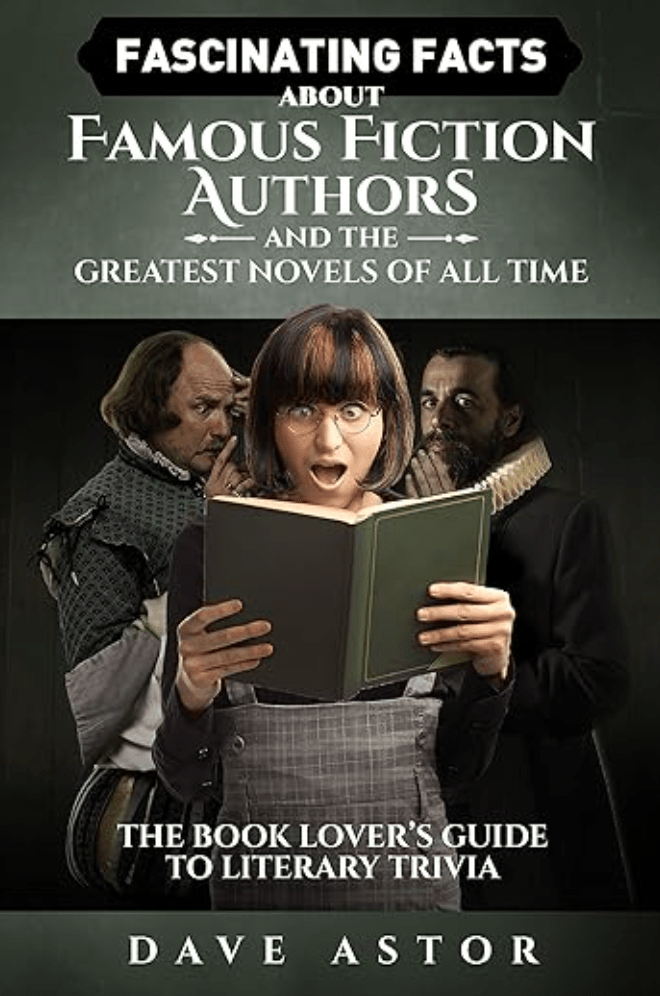
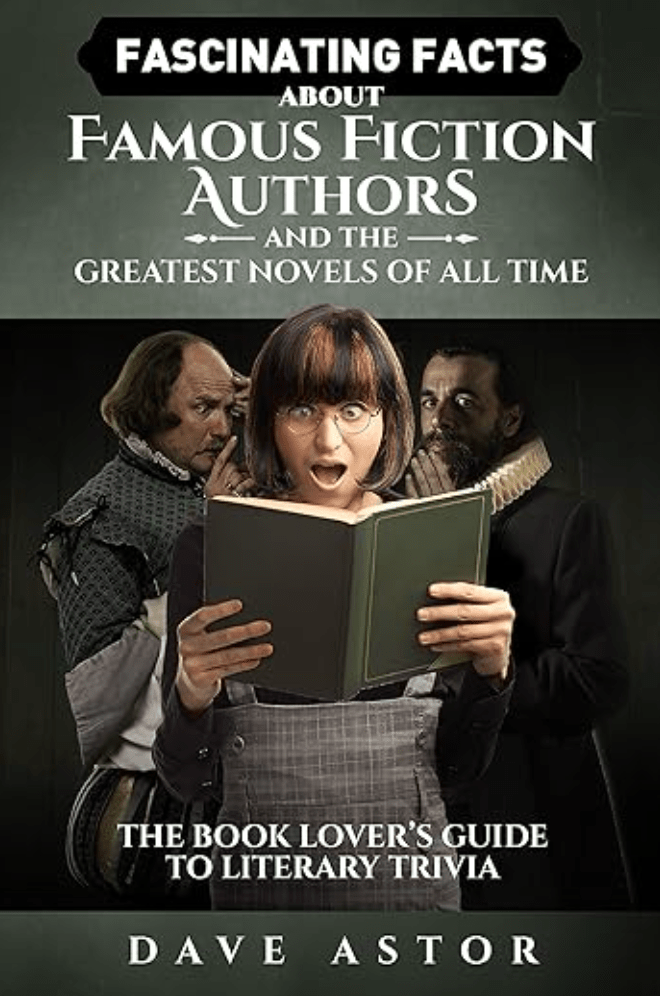
Dave is also the author of a 2017 literary-trivia book

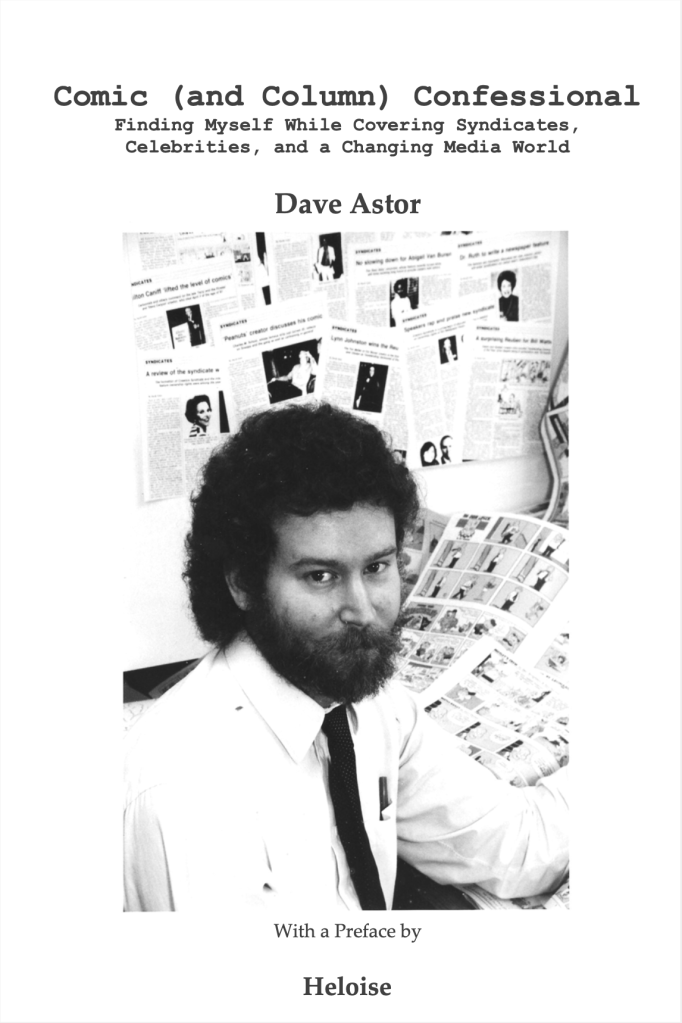
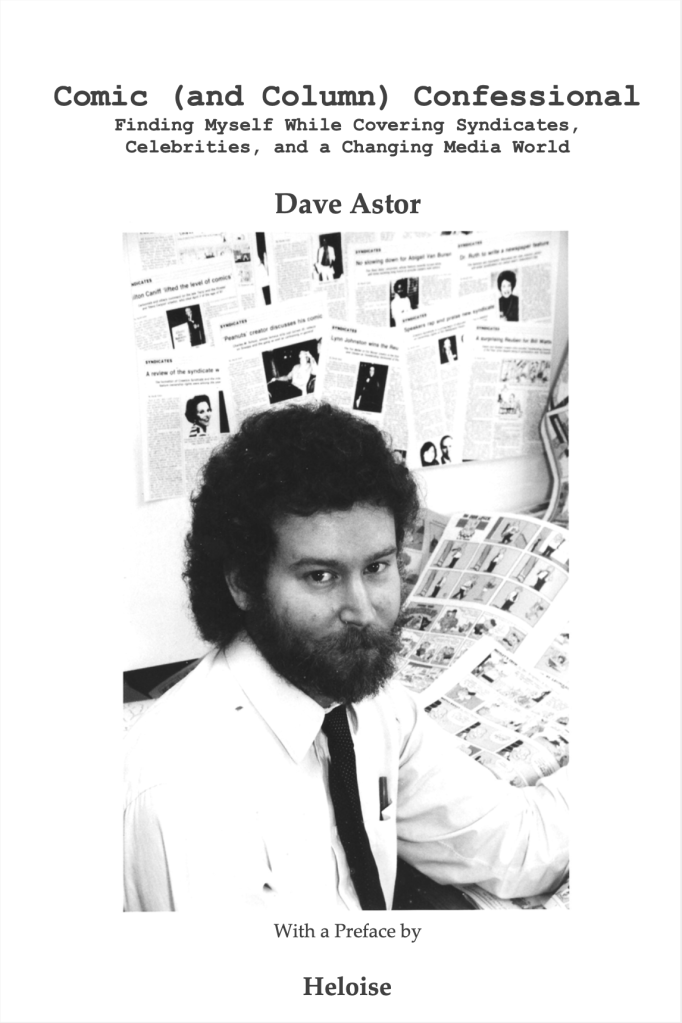
…and a 2012 memoir that focuses on cartooning and more, including many encounters with celebrities.
In addition to this weekly blog, Dave writes the 2003-started/award-winning “Montclairvoyant” topical-humor column every Thursday for Montclair Local. The latest piece — from which Sir Walter Scott should remove himself from discussion of a referendum-halting court decision — is here.

Spies in Literature

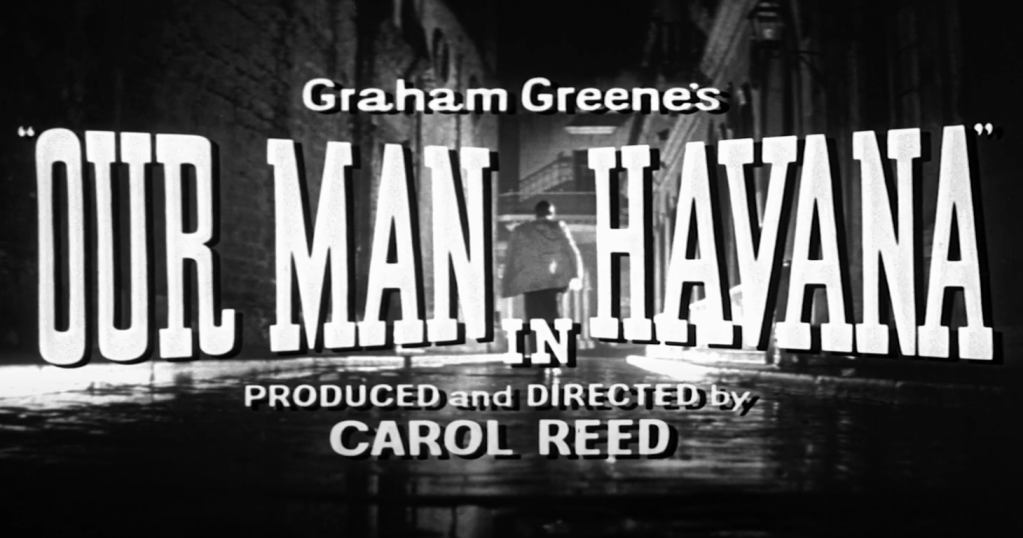
From the trailer for 1959’s film version of Our Man in Havana.

I should have posted this “Spies in Literature” piece last Sunday the 7th in honor of Agent 007 James Bond, but I hadn’t yet finished the novel that inspired what you’re about to read.

That interesting 1958 book is Graham Greene’s Our Man in Havana, and while its protagonist James Wormold is not a typical spy (he’s a vacuum-cleaner salesperson who reluctantly accepts recruitment as an agent), he nonetheless ends up in espionage.

Wormold is a satirical creation — the reports he submits to headquarters are pure fiction — but many other spies in literature are quite serious characters even if some humor might occasionally enter the mix. These secret agents can make for compelling reading as they get into adventures, risk their lives, save lives, end lives, do undercover work for good or evil patrons, inhabit a milieu of geopolitical machinations, etc.

I initially mentioned James Bond, and have seen a couple of movies starring him, but must admit I’ve never read any of the Ian Fleming novels that inspired the long-running 007 film franchise.

But I have enjoyed a handful of other books with spy characters. One author quite famous for that genre is John le Carré, whose The Russia House (1989) is the only novel of his I’ve read. It unfolds near the end of the Cold War — just before the breakup of the Soviet Union — and is pretty absorbing.

The Cold War of course has inspired many a spy novel, which could include Viet Tranh Nguyen’s The Sympathizer if the Vietnam War is considered partly a manifestation of that era’s United States/Soviet Union tensions. His seriocomic 2015 novel — set in 1975 and subsequent years — is told by an unnamed North Vietnamese mole in the South Vietnamese army who remains embedded in a South Vietnamese immigrant community in the U.S. Its sequel, The Committed, was published in 2021.

Obviously, not all espionage novels have a Cold War connection. For instance, James Fenimore Cooper’s 1821-released The Spy (hmm…I wonder what its title character is 🙂 ) takes place during the American Revolutionary War of several decades earlier.

And in the Harry Potter series, Severus Snape is a spy of sorts — and the most complex and morally ambivalent character in those seven J.K. Rowling novels.

I’ve barely touched the surface here, as I haven’t read that many books with secret-agent characters. Any thoughts on spies in literature? Your favorite characters and novels in this realm?

Misty the cat says: “I see thorns but not birds, so ‘The Thorn Birds’ novel doesn’t exist.”

My comedic 2024 book — the part-factual/part-fictional/not-a-children’s-work Misty the Cat…Unleashed — is described and can be purchased on Amazon in paperback or on Kindle. It’s feline-narrated! (And Misty says Amazon reviews are welcome. 🙂 )

This 90-second promo video for the book features a talking cat: 🙂

I’m also the author of a 2017 literary-trivia book

…and a 2012 memoir that focuses on cartooning and more.

In addition to this weekly blog, I write the 2003-started/award-winning “Montclairvoyant” topical-humor column every Thursday for Montclair Local. The latest piece — about another LONG Township Council meeting and more — is here.

They’re Serious about Series and Standalone Novels

Some authors are good at two or more things: novels and short stories, fiction and nonfiction, literary fiction and mass-audience fiction, etc. For this post, I’ll add to that by focusing on authors who are good at series as well as standalone novels. It certainly requires some different writing muscles to wrap up things in one book vs. extending things across multiple books.

This topic occurred to me last week as I read Val McDermid’s A Place of Execution, a superb standalone novel with a concluding twist that will knock your socks off. My previous experience with McDermid was with her series fiction, including the books starring “cold case” detective Karen Pirie.

I followed A Place of Execution with Martin Cruz Smith’s Independence Square — his 10th in the series starring Russian investigator Arkady Renko that began with Gorky Park. (Independence Square was okay; not as good as the earlier Renko books.) Smith has also written standalone novels such as Rose.

Sometimes, authors toggle throughout their careers between standalone books and series — as has been the case with Smith and McDermid as well as authors such as Walter Mosley with his Easy Rawlins books and much more. Other times, authors start with standalone novels before hitting on a hit series and focusing on that — as did Sue Grafton, who wrote two standalones before launching her popular Alphabet Mysteries (25 in all; she reached the letter “Y” before she died).

J.K. Rowling has also written many more series novels than standalone ones: seven Harry Potter books, then The Casual Vacancy one-off, then seven Cormoran Strike/Robin Ellacott crime novels (so far).

L.M. Montgomery followed her classic Anne of Green Gables with seven sequels over the years, during which time she also penned the Emily trilogy and standalones such as The Blue Castle.

Stephen King is known mostly for standalone novels, with a sprinkling of sequels and trilogies, but has also written many books in The Dark Tower series.

Some long-ago authors also toggled. For instance, James Fenimore Cooper wrote the five “Leatherstocking” novels (including The Last of the Mohicans) as well as various standalone books. Alexandre Dumas did both as well — many standalones (most famously The Count of Monte Cristo) as well as The Three Musketeers and its five sequels (sometimes published as fewer sequels when certain books were combined into one edition).

Your thoughts about and examples of this topic?

Misty the cat says: “My fitness tracker better record backward steps.”

My comedic 2024 book — the part-factual/part-fictional/not-a-children’s-work Misty the Cat…Unleashed — is described and can be purchased on Amazon in paperback or on Kindle. It’s feline-narrated! (And Misty says Amazon reviews are welcome. 🙂 )

This 90-second promo video for my book features a talking cat: 🙂

I’m also the author of a 2017 literary-trivia book

…and a 2012 memoir that focuses on cartooning and more.

In addition to this weekly blog, I write the 2003-started/award-winning “Montclairvoyant” topical-humor column every Thursday for Montclair Local. The latest piece — about a lot of school news during a non-school time — is here.

Authors Who Lived in More Than One Country

I recently finished Vladimir Nabokov’s Pale Fire, and, after musing about how clever that novel is, I read a Wikipedia biography of the author.

It turned out that Nabokov wrote his first nine novels in Russian before switching to English — after which he authored his two most famous books: the controversial Lolita and the aforementioned Pale Fire, which consists of a poem followed by an extended, often-hilarious analysis that’s less about the poem than about the weird analyzer (who may or may not be a king who escaped to the U.S.).

Nabokov’s life got me thinking about other authors who lived in more than one country, and what effect that had on their work. Obviously, writers with multinational backgrounds might be compassionate or bitter about leaving one’s place of origin, more cosmopolitan, more knowledgeable about the world, more attuned to the pros and cons of various countries and political systems, more aware that human emotions anywhere tend to be alike rather than different, and so on.

The brilliant Nabokov was born in Russia and then lived in Germany before emigrating to America. Ending up in the U.S. is the template for many authors, and I’ll mention some of them first. But there are also a number of U.S.-born writers who went abroad, as well as serial-country authors who never lived in the fifty states. I’ll discuss some of those authors second and third. Meanwhile, I’ll mention here that Nabokov later left the U.S. for Switzerland.

German novelist Erich Maria Remarque also ended up in Switzerland, but lived a number of years in America after getting on the hate list of the vile Nazi regime. His last novel — Shadows in Paradise — is set in the U.S., but doesn’t measure up to his masterpieces such as the antiwar All Quiet on the Western Front, Arch of Triumph, and The Night in Lisbon.

There’s also Khaled Hosseini, whose riveting novel The Kite Runner was obviously inspired in part by his move from Afghanistan to America (with an in-between stay in France). English writer Aldous Huxley of Brave New World fame spent much of his life living in “The New World” (California, to be exact). Nigerian author Chinua Achebe (Things Fall Apart) resided a number of years in the U.S., too.

American-born authors living overseas for long periods? Two prime examples are Henry James (England) and Edith Wharton (France). Then there’s James Fenimore Cooper (in Europe from 1826 to 1833) and Nathaniel Hawthorne (in Europe from 1853 to 1860, when he strayed from his fiction’s usual New England settings to place The Marble Faun in Italy). Also, authors Richard Wright and James Baldwin went to France, partly to escape America’s virulent racism. Willa Cather lived in the U.S., but spent many summers at the only house she ever owned — in Canada (the setting of her little known but superb historical novel Shadows on the Rock). Another American author, Mary McCarthy, spent a lot of time in a second home in Paris.

Multinational authors with little or no time in the U.S. include, among others, Gabriel Garcia Marquez (Colombia, Venezuela, Spain, Mexico); Fanny Burney (England, France, England); Polish writer Joseph Conrad (who ended up in England); Kazuo Ishiguro (whose family moved from Japan to England when he was five); Russian writer Ivan Turgenev (who spent significant time in Germany and France); and Emile Zola (who left France for England to avoid jail after his brave role in debunking the anti-Semitic framing of Capt. Alfred Dreyfus).

Who are some of your favorite authors with lives lived in two or more countries? Why is this an advantage to a writer? Any disadvantages? (The box for submitting comments is below already-posted comments, but your new comment will appear at the top of the comments area — unless you’re replying to someone else’s comment.)

A note: After today, I will not post a new piece for perhaps three weeks or so for the usual summer reasons, but will pick up the pace starting in mid-August!

For three years of my Huffington Post literature blog, click here.

I’ve also written more than 50% of a literature-related book. But I’m still selling my part-funny Comic (and Column) Confessional memoir that recalls 25 years of covering/meeting cartoonists such as Charles Schulz (“Peanuts”) and Bill Watterson (“Calvin and Hobbes”), columnists such as Ann Landers and “Dear Abby,” and other notables such as Hillary Clinton, Coretta Scott King, and various authors. The memoir also talks about the malpractice death of my first daughter, my remarriage, and life in New York City and Montclair, N.J. — where I write the award-winning weekly “Montclairvoyant” humor column for The Montclair Times. I can be contacted at dastor@earthlink.net to buy a discounted, inscribed copy of the book, which has a preface by “Hints” columnist Heloise and back-cover blurbs by “The Far Side” cartoonist Gary Larson, among others.