Lit With Wit That Might Side-Split

On March 8, I marked International Women’s Day with a post about memorable women characters in fiction. On March 15, I marked The Ides of March (when Julius Caesar was killed) with a post about memorable murders in fiction. So, what holiday can I mark today? I did an online search, and discovered that March 22 is National Goof Off Day! Meaning I could write a post about some of the funnier novels I’ve read.

But a search showed I wrote a post like that back in this blog’s first year: 2014. Hmm…guess I’ll rerun that piece today (many of you had yet to become readers here 12 years ago). Then, I’ll add some humorous or part-humorous novels I’ve read since 2014 — or read before that but forgot to mention in my previous Obama-era post.

Here’s the 2014 piece, with a new first paragraph and some other editing:

Some novels are quite funny, in a satirical or just plain silly way. They include books that range from mostly comedic to those that are serious and/or dramatic and/or poignant but contain one or more hilarious scenes — such as Ishmael and Queequeg, pre-ship voyage, in the inn bedroom in Herman Melville’s Moby-Dick.

For instance, there’s Charles Dickens’ laugh-out-loud first novel: The Posthumous Papers of the Pickwick Club, which features the fabulously funny Sam Weller. That book launched Dickens into a popularity stratosphere he never left — even as his increasingly ambitious novels were never quite that humorous again. Was Bleak House a jest-fest? Don’t think so.

Colette had a similar career arc, entering the novel-writing realm with the sidesplitting Claudine at School before moving on to weightier (yet still engaging) works. The title character in Colette’s late-career Gigi wouldn’t last a minute in a battle of witticisms with the rambunctious Claudine.

Speaking of first novels, the seriocomic Harry Potter and the Sorcerer’s Stone has more laughs per square page than any of the six subsequent novels in J.K. Rowling’s series.

Also hilarious is Philip Roth’s Portnoy’s Complaint, in which the “thing” that hits an incandescent bulb is not a light-dazzled moth.

Then there’s Jeeves in the Offing, or almost any other P.G. Wodehouse novel or story starring the brilliant British valet and his rather clueless “master” Bertie Wooster. Wodehouse could make a shopping list funny.

In a very different milieu, novels don’t get much more amusing (or ribald) than Erskine Caldwell’s Tobacco Road and God’s Little Acre. Delightful “southern humor” can also be found in Charles Portis’ Norwood and The Dog of the South, Rita Mae Brown’s Rubyfruit Jungle novel and Sneaky Pie Brown mysteries, and Fannie Flagg’s Fried Green Tomatoes at the Whistle Stop Cafe. Mixed with the laughs in those books are serious themes such as poverty, racism, sexism, and homophobia.

Academia can also be a great source of humor and satire, as evidenced by novels such as Zadie Smith’s On Beauty, Richard Russo’s Straight Man, and Adam Langer’s Ellington Boulevard.

Returning to older novels, we see Mark Twain mixing strong antiwar satire with goofy humor in A Connecticut Yankee in King Arthur’s Court, Henry Fielding even naming a character “Lady Booby” (for her personality) in his uproarious Joseph Andrews, and Miguel de Cervantes being much funnier than one expects in Don Quixote.

More hilarity? Valancy Stirling dramatically parts with her oppressively conventional mother and other relations in L.M. Montgomery’s moving/inspiring The Blue Castle, but the conversations the newly confident Valancy has with her family are as funny as the funniest sitcom.

Italo Calvino is very droll in his short-story-collection-as-novella Marcovaldo. John Steinbeck, so earnest in The Grapes of Wrath and East of Eden, will crack you up in Tortilla Flat, Cannery Row, and Sweet Thursday. And you don’t need an explanation from me about how dizzyingly comedic are Lewis Carroll’s Alice’s Adventures in Wonderland and Through the Looking Glass.

Now, as I write in 2026, here are some funny or part-funny (in certain cases darkly so) novels I’ve read since the above 2014 post — or read before that but didn’t mention back then. A number of those books of course have many serious moments, too. Alphabetical by author:

Margaret Atwood’s Oryx and Crake, Jane Austen’s Northanger Abbey, Fredrik Backman’s A Man Called Ove, Charles Bukowski’s Hollywood, Mikhail Bulgakov’s The Master and Margarita, Frances Burney’s Evelina, Charles Dickinson’s The Widows’ Adventure, Stanley Elkin’s The Rabbi of Lud, Helen Fielding’s Bridget Jones’s Diary, Jaroslav Hasek’s The Good Soldier Svejk, Joseph Heller’s Catch-22, Elin Hilderbrand’s The Hotel Nantucket, Jonas Jonasson’s The 100-Year-Old Man Who Climbed Out the Window and Disappeared, Bel Kaufman’s Up the Down Staircase, Steve Martin’s The Pleasure of My Company, Terry McMillan’s How Stella Got Her Groove Back, Viet Thanh Nguyen’s The Sympathizer, Terry Pratchett’s Small Gods, Maria Semple’s Where’d You Go, Bernadette, (Ms.) Lionel Shriver’s So Much for That, Zadie Smith’s White Teeth, Jonathan Swift’s Gulliver’s Travels, J.R.R. Tolkien’s The Hobbit, John Kennedy Toole’s A Confederacy of Dunces, Voltaire’s Candide, and Kurt Vonnegut’s Slaughterhouse-Five, to name a few.

And while Fyodor Dostoevsky’s The Brothers Karamazov is mostly dead serious, it does have one uproarious scene.

Novels you consider very funny — overall or in part?

Misty the cat says: “Odd that one of those cars looks like a dumpster.”

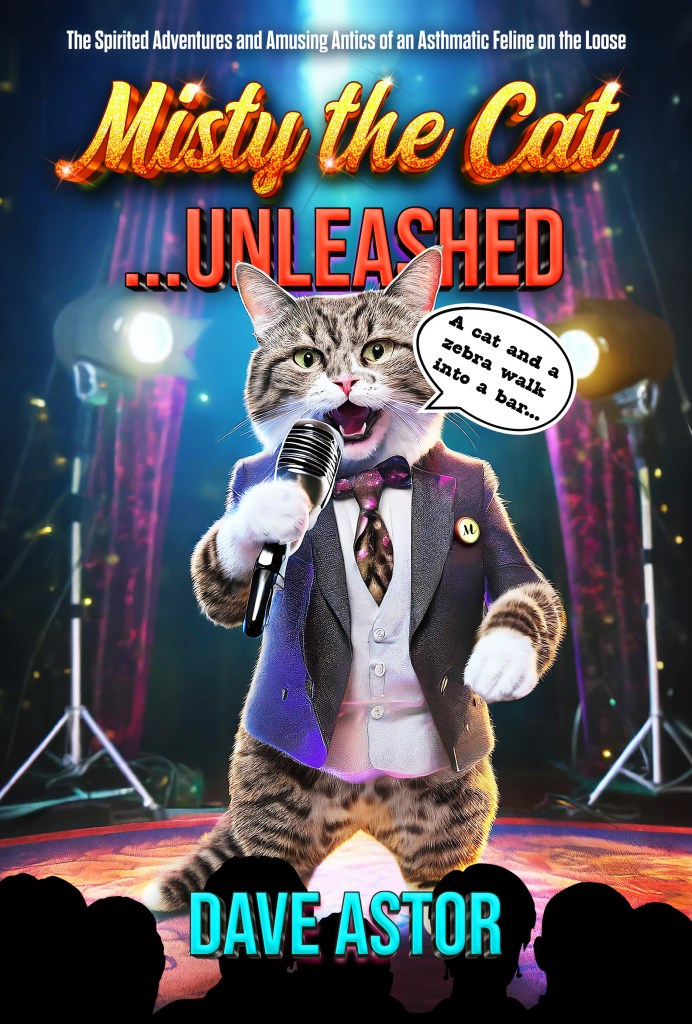
My comedic 2024 book — the part-factual/part-fictional/not-a-children’s-work Misty the Cat…Unleashed — is described and can be purchased on Amazon in paperback or on Kindle. It’s feline-narrated! (And Amazon reviews are welcome. 🙂 )
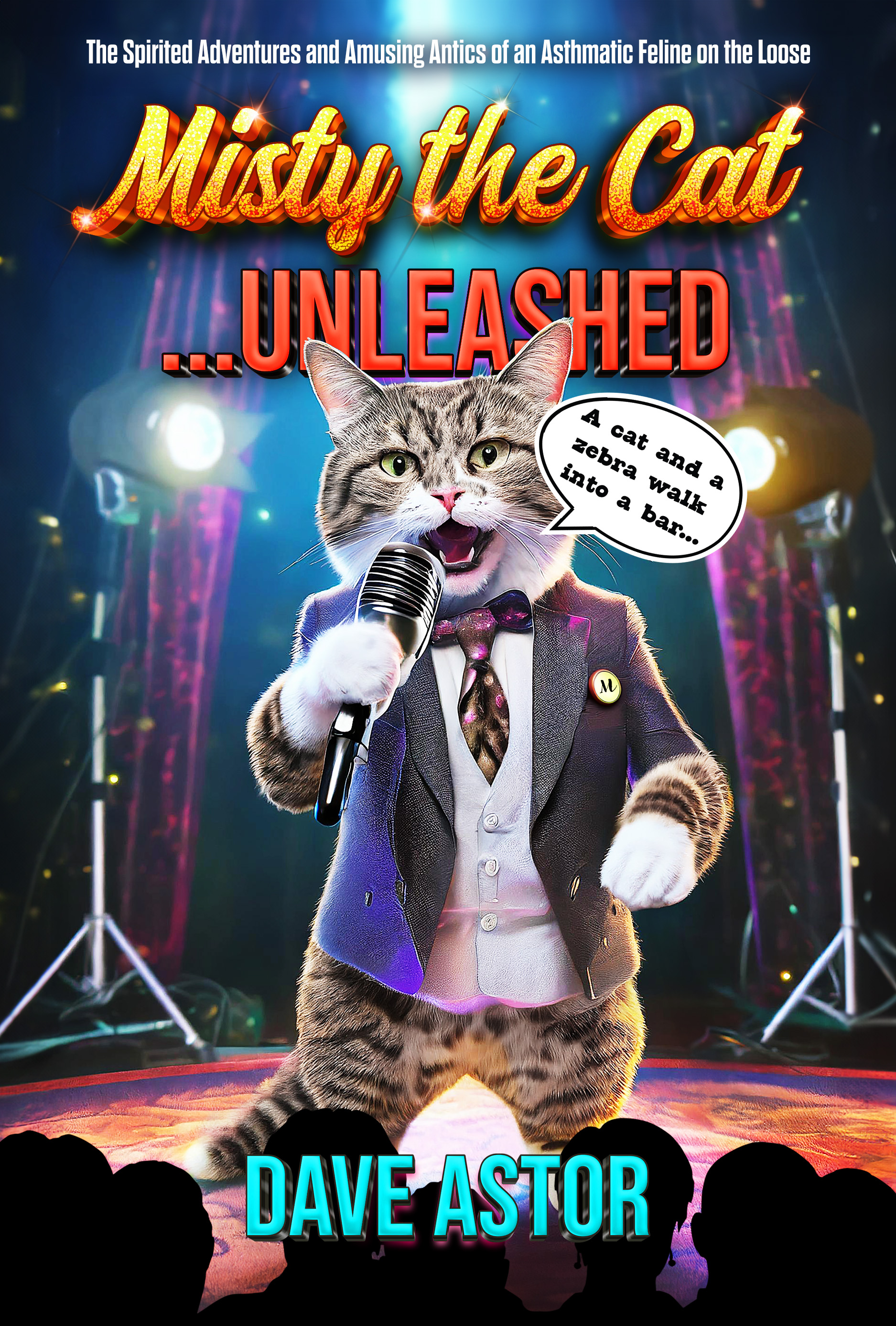
This 90-second promo video for the book features a talking cat: 🙂

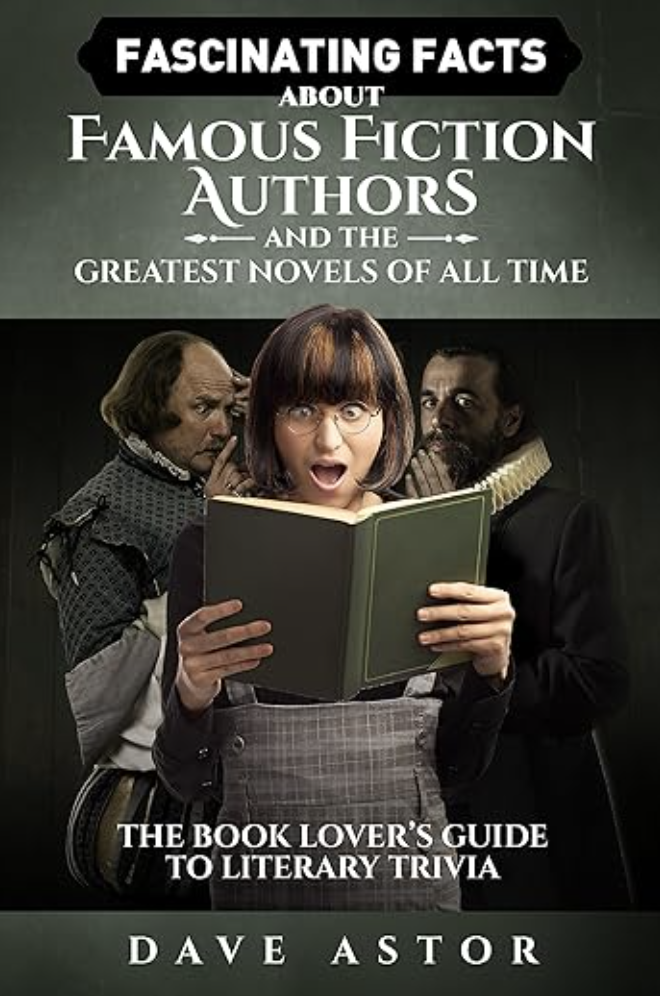
I’m also the author of a 2017 literary-trivia book

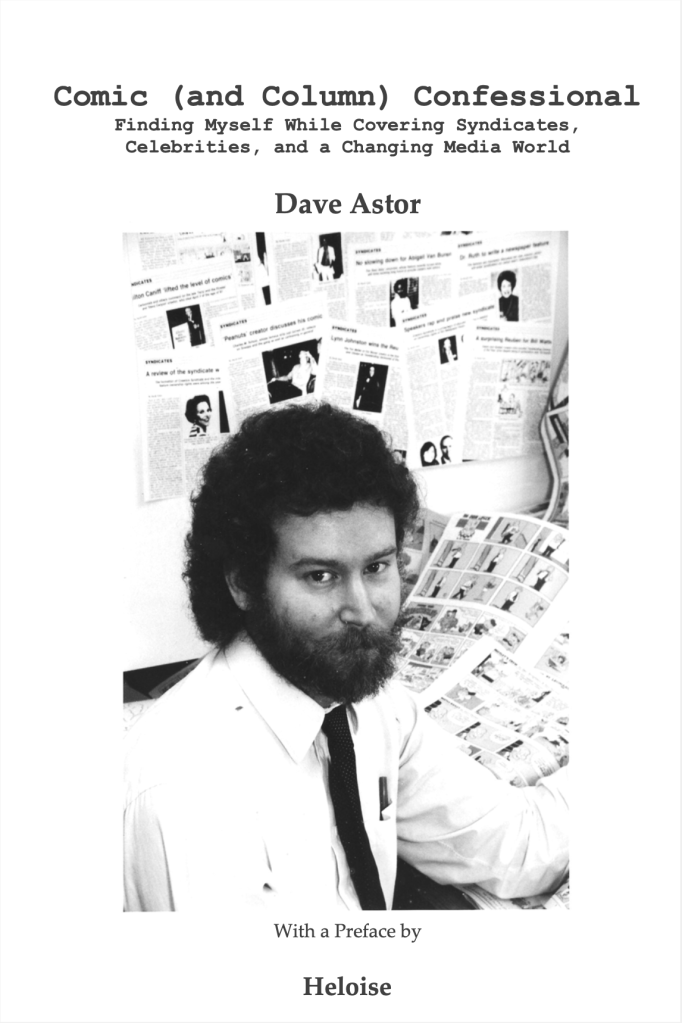
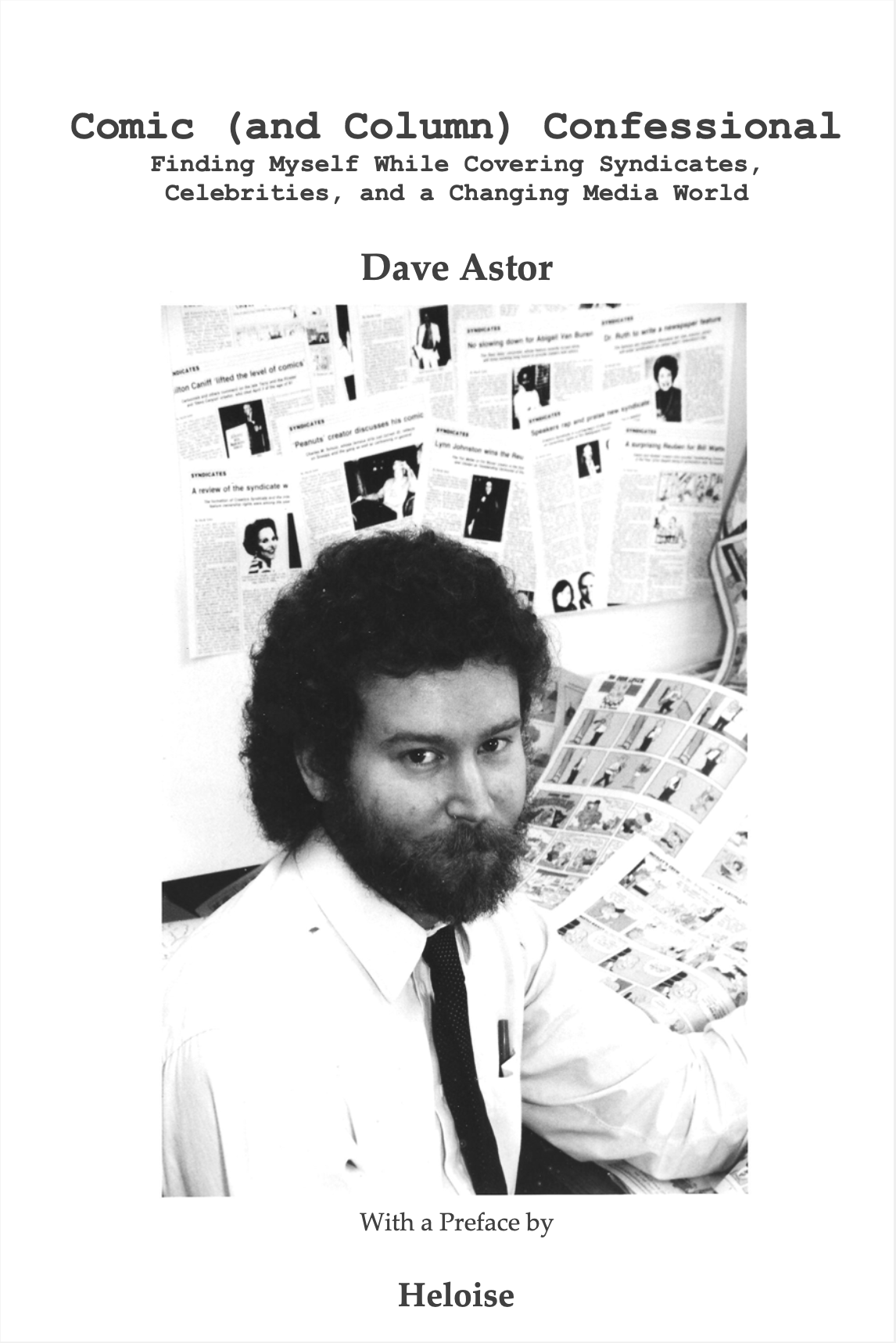
…and a 2012 memoir that focuses on cartooning and more, including many encounters with celebrities.
In addition to this weekly blog, I write the 2003-started/award-winning “Montclairvoyant” topical-humor column every Thursday for Montclair Local. The latest piece — about a close school budget vote, a delayed decision on a huge redevelopment project, a student anti-ICE march, and more; all threaded with a weird Tom Hanks movie theme 🙂 — is here.
Feline Post Includes Mentions of Jane Austen and ‘The Host’

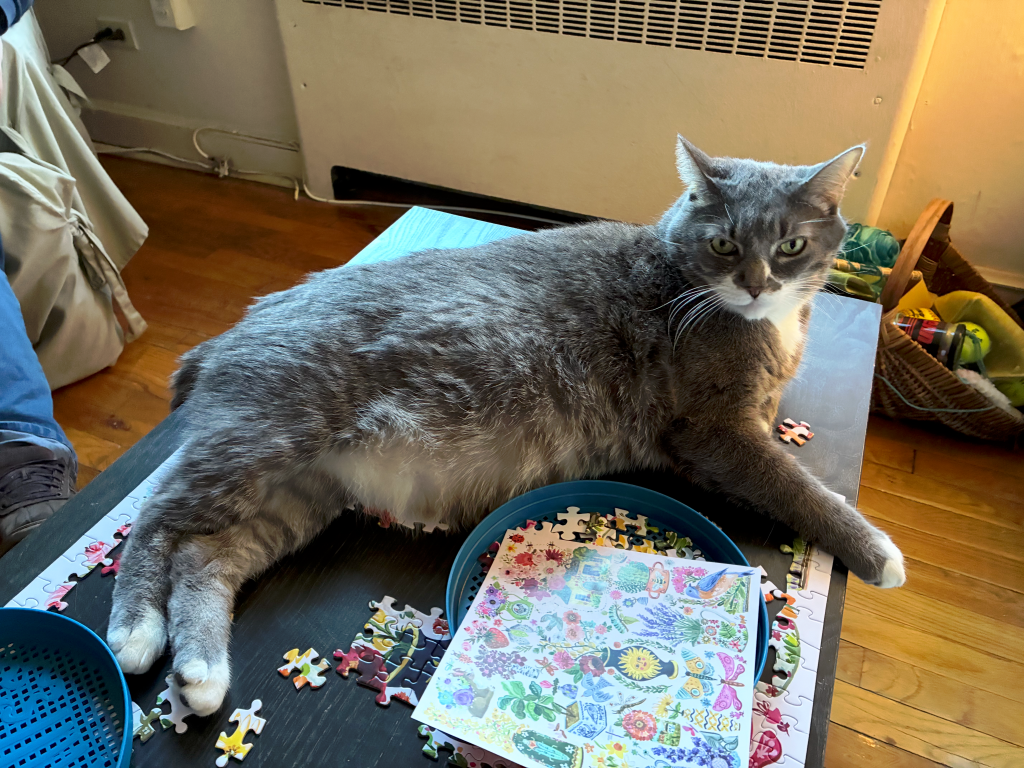
I, Misty the cat, say: “Putting together a guest blog post is like putting together a puzzle.” (Photo of my kitty self taken by my adult female human Laurel.)

Misty the cat here, returning for my every-two-month takeover of Dave’s blog — which I do by gunpoint, minus the gun. This is a particularly memorable time for me to post because tomorrow is the 8th anniversary of my adoption into my forever family, from whom I’ve received everything I could desire except a bed the size and shape of Buckingham Palace. King Chuck III has some ‘splaining to do.

And in nine days — December 16 — there’ll be a milestone moment for literature: the 250th anniversary of Jane Austen’s 1775 birth! Rebecca Budd, who comments here every week, has already posted about that anniversary in one of her great blogs. The year 1775 was also significant for being the start of the American Revolutionary War and for Apple’s rollout of the iMusket 9.

Back to Austen. I’m often (well, never) asked how I rank her six novels, and here’s my kitty answer: 1, 2, 3, 4, 5, 6. Oh, you want titles, too? 1) Persuasion. 2) Pride and Prejudice. 3) Sense and Sensibility. 4) Mansfield Park. 5) Emma. 6) Northanger Abbey. This is also Dave’s order of faves (rhyme alert!), which means we were both bribed by the same literary scholars. Austen’s early 19th-century books have aged well…partly because I keep them in my wine cellar. Actually, I don’t have a wine cellar. No cat does.

And today, December 7, is the 84th anniversary of the 1941 attack on Pearl Harbor, an event vividly depicted near the end of Herman Wouk’s compelling novel The Winds of War. If those winds had become strong enough, Wouk’s book would’ve been titled The Hurricanes of War — storms that fall alphabetically between Hurricane Violin and Hurricane Xylophone.

The Winds of War was followed by Wouk’s epic War and Remembrance — the title of which has the initials “WAR.” Coincidence? Well, Hurricane Coincidence falls alphabetically between Hurricane Bassoon and Hurricane Didgeridoo.

My current reading? I, Misty the cat, recently finished Twilight author Stephenie Meyer’s The Host, an excellent work of sci-fi that stars a being who lives inside a human body. So, no, the book is not a historical novel about Johnny Carson, who was not related to The Heart Is a Lonely Hunter author Carson McCullers, who was a top-notch writer but apparently didn’t know that a heart can’t hunt animals without a permit and that vegans prefer Fannie Flagg’s novel Fried Green Tomatoes at the Whistle Stop Cafe. Also, American frontiersman Kit Carson was not a feline like me.

Natty Bumppo did the frontiersman thing, too, in James Fenimore Cooper’s five “Leatherstocking” novels that included The Last of the Mohicans. Cooper was an American contemporary of aforementioned Englishwoman Jane Austen, and there are even rumors that they collaborated on a novel called The Last of the Emmas. So I’m puzzled (see photo) that we later had people such as actresses Emma Thompson and Emma Watson.

The latter of course played Hermione Granger in the Harry Potter movies based on the J.K. Rowling novels. Seven books, eight movies, and nine lives (experienced by cats like me). Plus there are 10 characters in Agatha Christie’s famed mystery novel And Then There Were None, whose plot focuses on the number of dry-food pellets left in my bowl after I finish eating. No mystery where those pellets went.

Which books do I want for Christmas? Charles Dickens’ A Christmas Carol, Fannie Flagg’s A Redbird Christmas, John Grisham’s Skipping Christmas, Betty Smith’s A Christmas Tree Grows in Brooklyn, Anthony Burgess’ A Christmas Orange, Fyodor Dostoevsky’s Christmas and Punishment, Aldous Huxley’s Brave New Christmas, Barbara Kingsolver’s Demon Christmashead, E.M. Forster’s A Passage to Christmas, Chinua Achebe’s Christmas Falls Apart

Dave will reply to comments as I either finish the puzzle I’m photographed with or swat every piece of that puzzle into January 2026.

I, Misty the cat, say: “There’s gotta be a sidewalk sale around here somewhere.”

Dave and my comedic 2024 book — the part-factual/part-fictional/not-a-children’s-work Misty the Cat…Unleashed — is described and can be purchased on Amazon in paperback or on Kindle. It’s feline-narrated! (And Amazon reviews are welcome. 🙂 )

This 90-second promo video for the book features a talking cat: 🙂

Dave is also the author of a 2017 literary-trivia book

…and a 2012 memoir that focuses on cartooning and more, including many encounters with celebrities.

In addition to this weekly blog, Dave writes the 2003-started/award-winning “Montclairvoyant” topical-humor column every Thursday for Montclair Local. The latest piece — from which Sir Walter Scott should remove himself from discussion of a referendum-halting court decision — is here.

The Ardor Order of Jane Austen

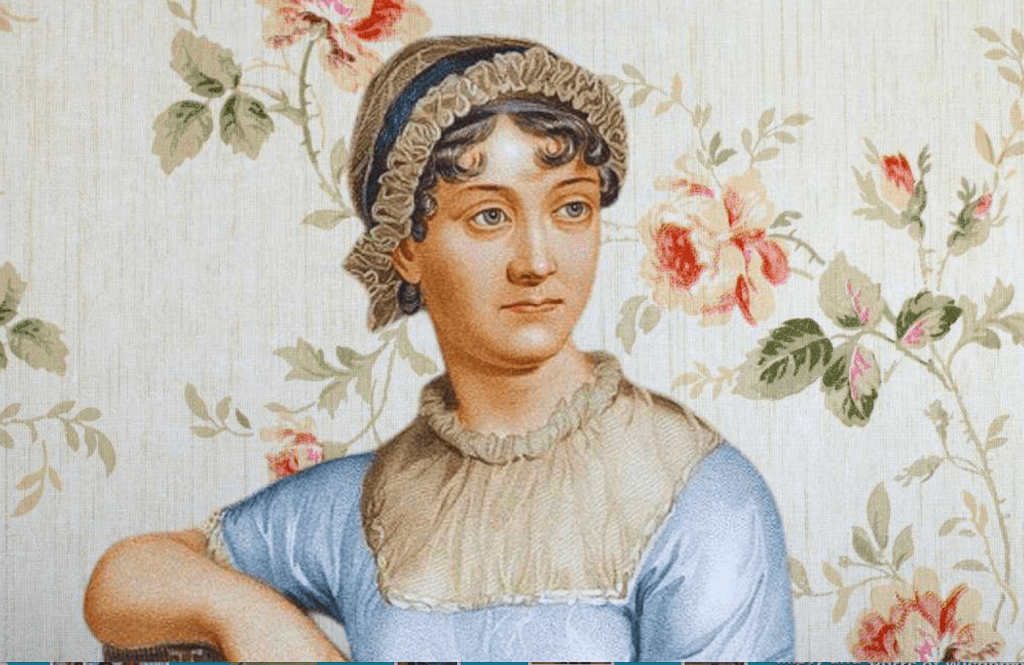
Fellow blogger Rebecca Budd noted in a post last week (see below) that January 28 was the 1813 publication date of Jane Austen’s classic novel Pride and Prejudice. Rebecca’s piece made me think about how I would rank the six books Austen (1775-1817) is most known for. So here I go with a post that will not end with a wedding, but with the Austen novel that is my favorite.

6. Northanger Abbey: A satire of Gothic fiction with both great moments and so-so moments. Though published posthumously, it was the first novel Austen fully completed — so the authorial growing pains are not surprising. The protagonist is Catherine Morland, whose reading of Gothic fiction feeds her rather overactive imagination.

5. Emma: Many readers would undoubtedly rank this well-crafted novel higher in Austen’s canon, but Emma Woodhouse’s meddlesome nature is rather annoying; she really does need to mind her own business. (I’m surprised Harriet Smith didn’t “unfriend” Emma on Facebook. 🙂 ) But, to her credit, Emma eventually does some growing up by the latter part of the novel.

4. Mansfield Park: The “poor relation” protagonist Fanny Price is sympathetic, but probably the most boring and least charismatic of Austen heroines. Still, the story line and how Fanny fares makes for interesting reading. Bonus: J.K. Rowling named a cat in her Harry Potter series after the Mrs. Norris character in Mansfield Park.

3. Sense and Sensibility: An absorbing look at the Dashwood sisters as they and their widowed mother find themselves in reduced economic circumstances. The first Austen novel published, in 1811.

2. Pride and Prejudice: The favorite Austen work of many, and the novel is indeed quite a read. Its characters of course include Elizabeth Bennet (one of five sisters) and Fitzwilliam Darcy as they navigate an initially challenging relationship. The title of this iconic book comes from a phrase in Fanny Burney’s 1782 novel Cecilia.

1. Persuasion: A concise novel featuring what I think is Austen’s most mature heroine: Anne Elliot. Her relationship with Captain Frederick Wentworth is at first thwarted, but she keeps on keeping on with life during the years of separation.

Your Austen favorites?

Misty the cat says: “‘Journey to the Center of the Earth’ starts with stepping off a porch.” Click on brief video here: https://www.youtube.com/shorts/T9c23Mm3eY4

My comedic 2024 book — the part-factual/part-fictional/not-a-children’s-work Misty the Cat…Unleashed — is described and can be purchased on Amazon in paperback or on Kindle. It’s feline-narrated! (And Misty says Amazon reviews are welcome. 🙂 )

This 90-second promo video for my book features a talking cat: 🙂

I’m also the author of a 2017 literary-trivia book...

…and a 2012 memoir that focuses on cartooning and more.

Also, I write the 2003-started/award-winning “Montclairvoyant” topical-humor column every Thursday for Montclair Local. The latest piece — inspired by a January jammed with local news — is here.