When I finished my fourth Val McDermid novel (Out of Bounds) last week, it occurred to me that I’ve read quite a lot over the years by Scottish writers — who include a number of names you’re sure to recognize.
McDermid (1955-) is a masterful crime author who has impressively created five different series, perhaps most famously the one starring dogged cold-case investigator Karen Pirie. Out of Bounds is the fourth of seven books featuring Pirie.
Then there’s perhaps the most famous detective writer of all: Edinburgh-born Arthur Conan Doyle (1859-1930), creator of the iconic Sherlock Holmes novels and short stories, not to mention The Lost World and other works. “Elementary” that he would be part of this post.
I can’t go further without mentioning the acclaimed Walter Scott (1771-1832), best known for Ivanhoe and Rob Roy but also the author of lesser-known-but-also-great novels such as Old Mortality and The Heart of Midlothian. A celebrated poet, too, earlier in his career.
Also, Robert Louis Stevenson (1850-1894), author of classics such as Treasure Island, Strange Case ofDr. Jekyll and Mr. Hyde, and Weir of Hermiston — the last of which would’ve been his masterpiece if he hadn’t died before finishing it.
Plus J.M. Barrie (1860-1937) of Peter Pan fame, Muriel Spark (1918-2006) of The Prime of Miss Jean Brodie renown, and Alistair MacLean (1922-1987) of Where Eagles Dare fame.
Among the Scottish authors I’ve yet to read but want to are Alexander McCall Smith (born in what is now Zimbabwe) and John Buchan (I did see the screen version of his The Thirty-nine Steps novel directed by Alfred Hitchcock).
Scottish poet Robert Burns (1759-1796) deserves a big mention, too.
Last but not least, there’s historical-romance author/WordPress blogger Shehanne Moore, an exceptional writer who frequently comments under WP posts here and elsewhere.
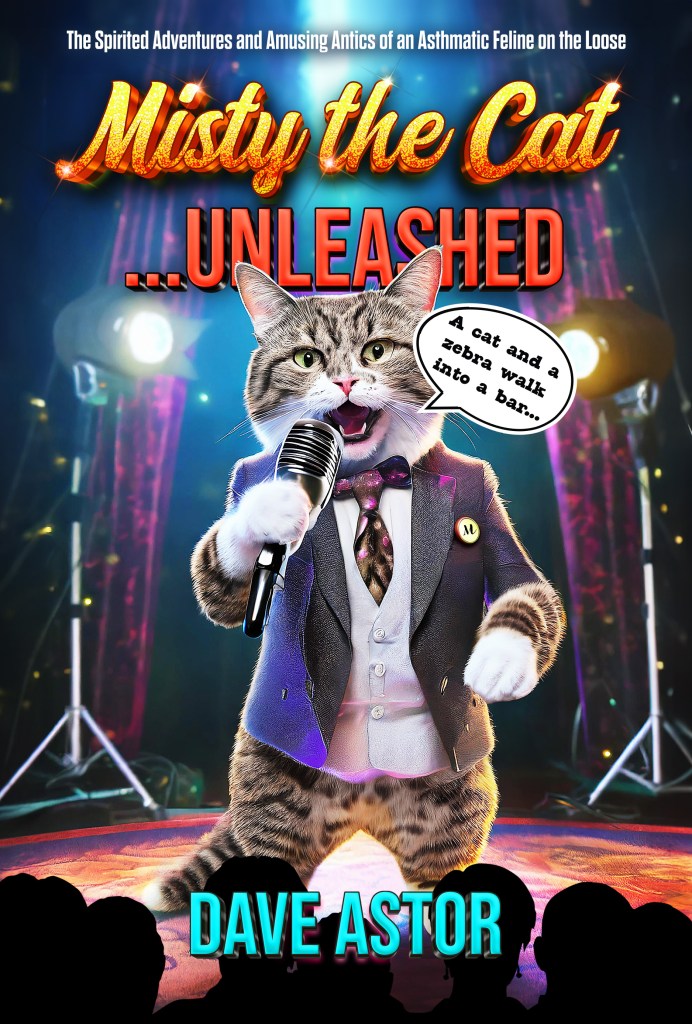
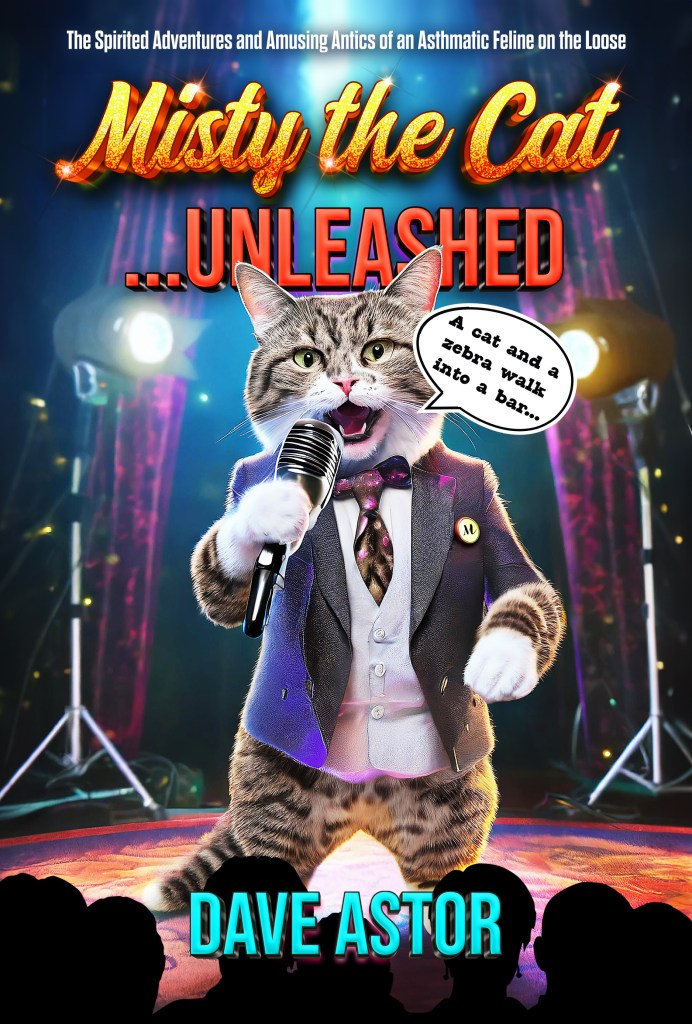
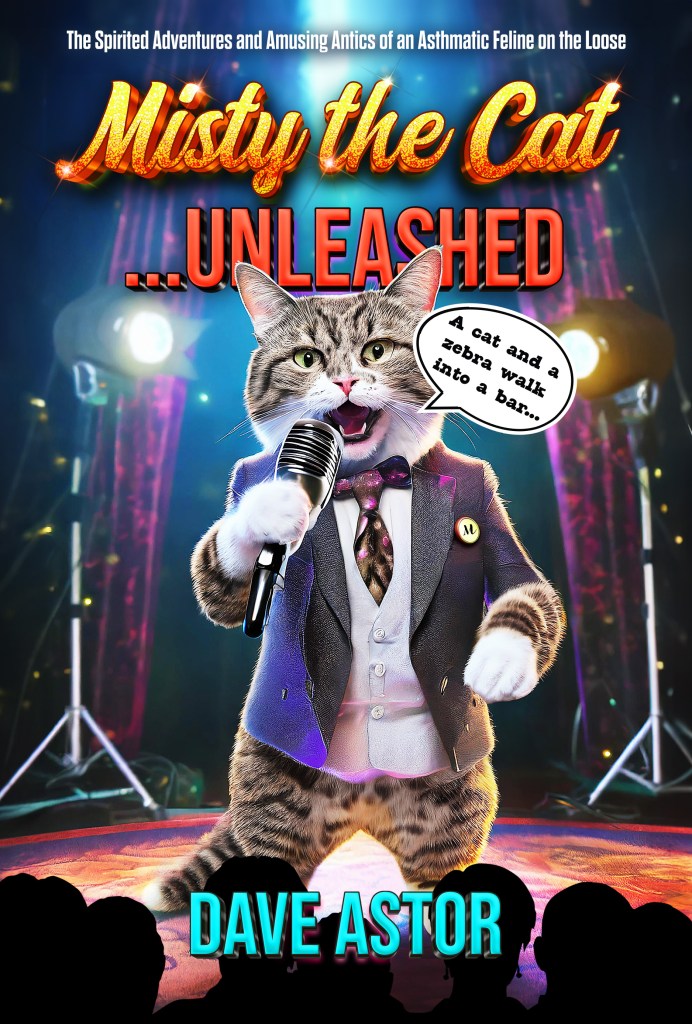
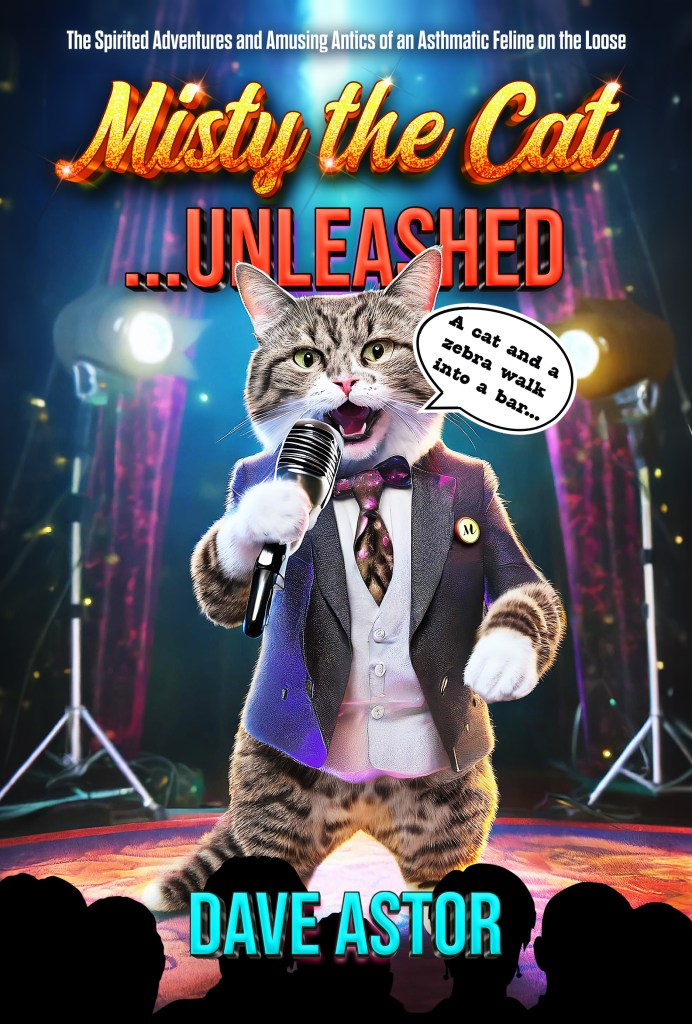
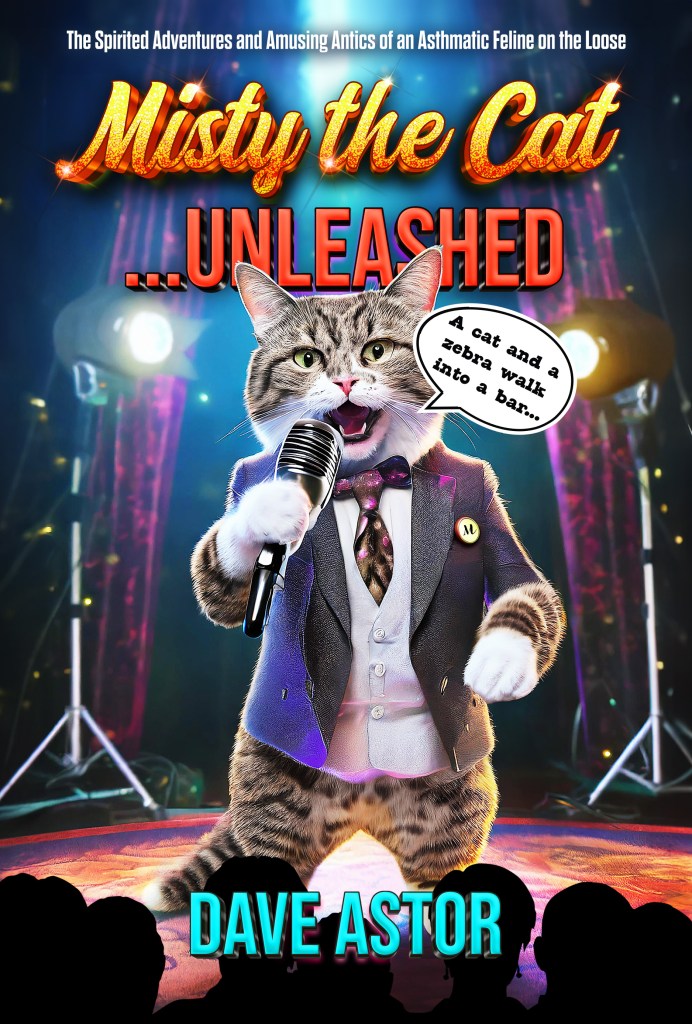
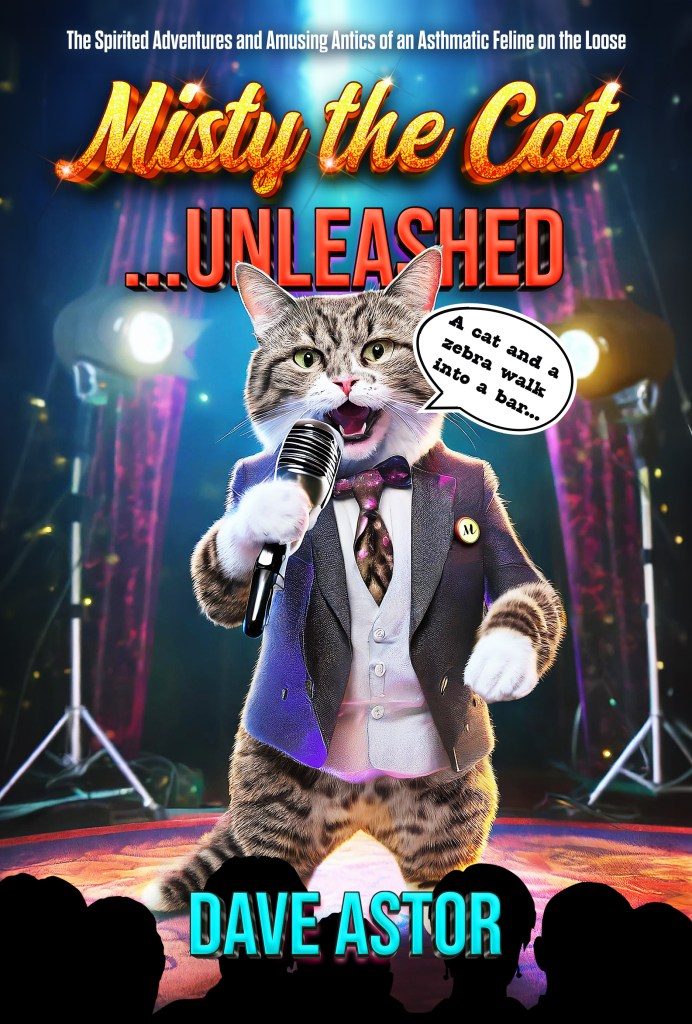
My comedic 2024 book — the part-factual/part-fictional/not-a-children’s-work Misty the Cat…Unleashed — is described and can be purchased on Amazon in paperback or on Kindle. It’s feline-narrated! (And Misty says Amazon reviews are welcome. 🙂 )
This 90-second promo video for my book features a talking cat: 🙂
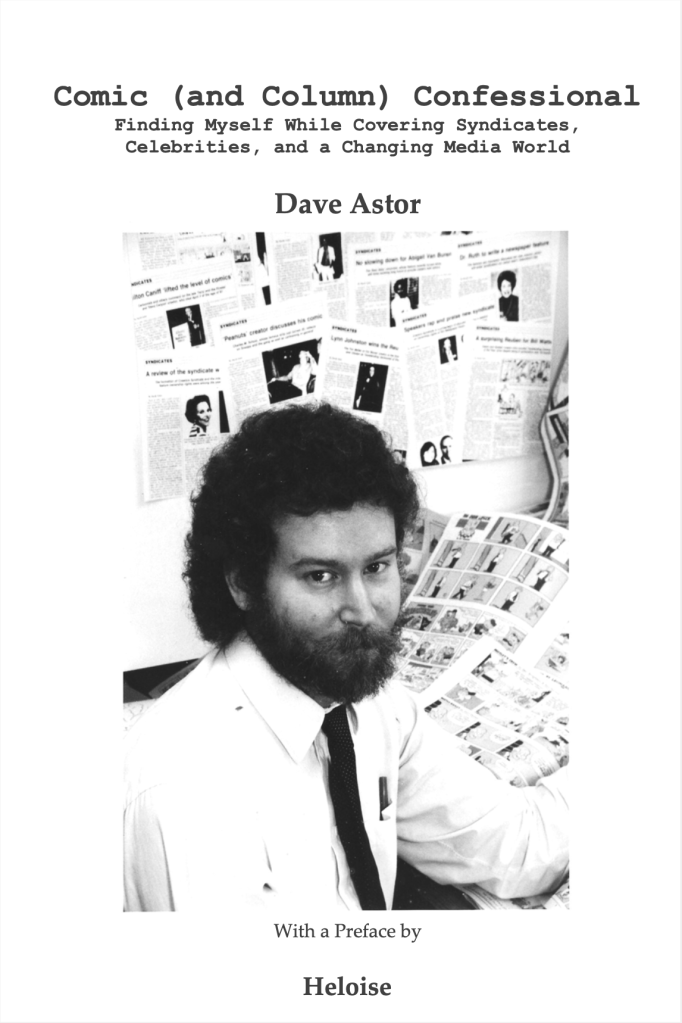
…and a 2012 memoir that focuses on cartooning and more.
In addition to this weekly blog, I write the 2003-started/award-winning “Montclairvoyant” topical-humor column every Thursday for Montclair Local. The latest piece — about Tesla buyer remorse in my liberal town — is here.
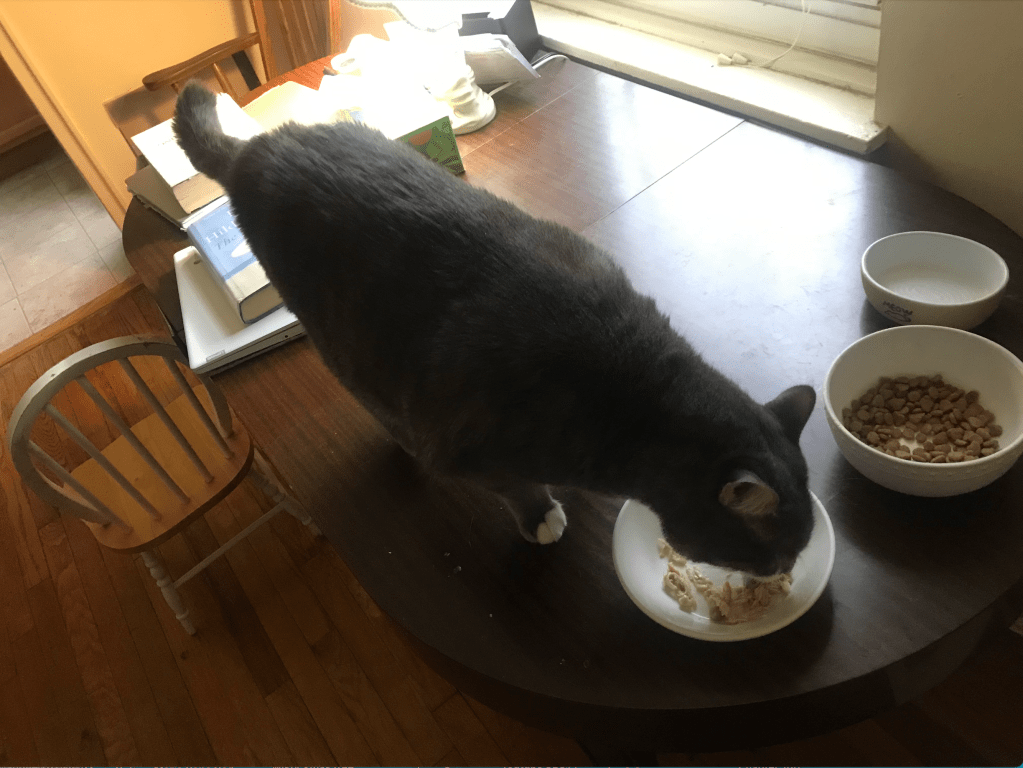
I, the feline Misty, realize most novelists celebrate their birthdays with cake. I eat cat food. (Photo by my human Dave, who has informed me that today is not my birthday.)
Hi! Misty the cat here. I haven’t guest-blogged for Dave since December 8, which was two months ago. It was also sort of a year ago: 2024! Four millennia ago, too, because it was 2024 BC (Blogging Cat). Time flies when you’re…swatting a clock off the mantelpiece.
Anyway, Dave can use the break because he recently had a nasty case of the flu as well as various family matters keeping him busy, including explaining to the ghost of his 17th-century ancestor why her on-the-mantelpiece antique clock is splattered across the floor. Or maybe that cheapo clock was purchased for a few bucks this century at Kmart. (“‘Attention, Kmart shoppers.’ Get the hell of here because our chain filed for bankruptcy seven years ago, in 2018.”)
But what topic should I, Misty the cat, discuss today? It occurred to me that authors have birthdays in all 12 months — except October because someone stole a briefcase with Bono’s notes and lyrics while he and the rest of U2 were recording their “October” album in 1981. Anyway, authors have birthdays in the other 11 months, except for those who have birthdays in October, so let’s discuss some novelists who were born in February — this month! (“I’m dreaming of a white…Presidents’ Day…with every Presidents’ Day card I write…”)
Born on February 1 (1918) was Muriel Spark! She’s best known for writing the 1930s-set novel The Prime of Miss Jean Brodie, whose title character was the first Amazon Prime customer.
Also born on February 1 (1901) was Langston Hughes, whose debut novel has a title — Not Without Laughter — that contains valuable advice for writing my blog posts. Heck, the only time I’m 100% serious is when my cat-treat container is empty and I consequently wear a mourning veil. Unlike someone marrying on the rebound who wears a basketball net for a veil.
Coming into the world on February 2 (1882) was James Joyce — who, if he had been a cat with nine lives, would’ve written “The Dead” nine times. Rather repetitive.
Ultraconservative icon Ayn Rand’s birthday was also on February 2 (1905). She decried government-run programs, yet hypocritically collected Social Security! Meanwhile, Atlas shrugged after his job as a book of maps was supplanted by GPS. “Turn right at the fountainhead.”
James Michener! Born on February 3 (1907). He wrote so many “doorstop” books that The Doors stopped…being a rock band. But not before one of my cat ancestors sang “Light My Fur” when one of those laser pointers was aimed at her.
Charles Dickens came to be on February 7 (1812). In his immortal words, “It was the best of cats, it was the best of cats,” because what other kinds of cats are there?
Sinclair Lewis was also born on February 7 (1885). He’s known for his 1920s run of excellent novels as well as for the iconic Lewis and Clark Expedition that involved setting a pick for Indiana Fever hoops superstar Caitlin Clark.
Another February 7 (1867) birthday was that of Little House on the Prairie series author Laura Ingalls Wilder. The diminutive nature of that house inspired the tiny green plastic houses used in Monopoly games.
Jules Verne? Born on February 8 (1828). Verne was a science-fiction pioneer, though he didn’t invent the genre. Sci-fi’s inventor was in fact my good friend Garfield the cat, who crafted a spaceship from lasagna and the rest was history.
Also a February 8 (1850) author was Kate Chopin, whose The Awakening novel shocked felines accustomed to napping 24 hours a day.
February 8 (1955) brought us John Grisham, too. His novel The Firm was great, but not quite an accurate representation of my jiggly belly.
Alice Walker was born on February 9 (1944). Given that me and other cats are partially color-blind, I have to take people’s word that Walker wrote The Color Purple.
February 10 (1890) was the birthday of Boris Pasternak, whose Doctor Zhivago is not about my vet. But my vet is welcome to change her name to Doctor Zhivago.
Toni Morrison was born on February 18 (1931). Her masterful work included Song of Solomon, whose initials remind me that I send out an SOS when my humans are gone for more than five seconds.
Amy Tan’s birthday is on February 19 (1952). Her books include The Kitchen God’s Wife, but religion continues to confuse me. What’s God doing in the kitchen? Does God really have a wife? If so, does that couple file a joint tax return? Who’s their CPA (Celestial Pair Accountant)?
The Heart Is a Lonely Hunter author Carson McCullers was also born on February 19 (1917). I know something about hunting, as I illustrate whenever I leave my apartment for my daily leashed walk. Let me know when chasing chipmunks becomes an Olympic sport.
David Foster Wallace, born on February 21 (1962), wrote Infinite Jest. If this post of mine became similarly infinite, could the WordPress blog platform handle that?
Anthony Burgess was born on February 25 (1917). Best known for A Clockwork Orange, but me and other cats aren’t into fruit. Our digestive systems are built for meat, and we don’t have the taste receptors to detect sweetness. Burgess could have written A Clockwork Tuna Melt, but noooo. Sheesh.
Victor Hugo! Born on February 26 (1802). Les Miserables is what happens when someone sticks a fruit platter in front of me.
I’ll end with John Steinbeck, who entered the world a century after Hugo (1902) on February 27. I don’t mean to harp on fruit, but The Grapes of Wrath…really? Steinbeck did also write East of Eden, which is definitely not east of an apple orchard.
Dave will reply to comments because I need to enter the contest for “Best Cat-Written Blog Post Focusing on Authors Born in February.” If I win a cash prize, maybe we can afford to turn up the heat in this damn apartment.
I, Misty the cat, say: “‘The Snows of Kilimanjaro’ have come to New Jersey.”
My (and Dave’s) comedic 2024 book — the part-factual/part-fictional/not-a-children’s-work Misty the Cat…Unleashed — is described and can be purchased on Amazon in paperback or on Kindle. It’s feline-narrated! (And I, Misty, say Amazon reviews are welcome. 🙂 )
This 90-second promo video for the book features a talking cat that looks sort of like me: 🙂
…and a 2012 memoir that focuses on cartooning and more.
In addition to his weekly blog, Dave writes the 2003-started/award-winning “Montclairvoyant” topical-humor column every Thursday for Montclair Local. The latest piece — about a plan for seven new pricey homes — is here.
With Donald Trump back in the White House, many (mostly non-white) immigrants are threatened with deportation and more. Not just “illegal” immigrants, but “legal” ones, too. Deportation is of course a cruel, messy, expensive, family-shattering process that might wreak havoc on the United States economy.
Immigrants bring many positives to their new country — hard work, diversity, doing jobs many native-born citizens won’t do, etc. And studies have shown that immigrants, whether “legal” or “illegal,” commit fewer crimes than their native-born peers.
Why do so many people want to move to the U.S. or other countries? They might be fleeing poverty or danger. They might be seeking opportunities not available to them in their nation of birth, or seeking to live amid different social mores. And “first world” nations have created conditions in less-powerful countries that increase immigration — including economically exploiting those “third world” countries, sanctioning them or backing their dictatorial leaders, and hurting them with the global climate change that energy-overusing “first world” populations largely cause.
Then there’s the scapegoat scenario — blaming immigrants (not to mention trans people) when the real problems in countries such as the U.S. are oligarchs, billionaires, too-powerful corporations, widening income inequality, etc.
I should add that any country needs some limitations on how many new citizens it lets in. Unfortunately, the over-the-top way Trump is going about things in the United States is not the smart or decent immigration approach — certainly not deserving to be a role model for the rest of the world.
Anyway, now that I’ve blathered on for five paragraphs, it’s time to mention novels with memorable immigrant protagonists. These characters are depicted expertly by their authors, and we can of course relate to these fictional creations for all kinds of reasons — including partly because many of us are descendants of immigrants, or have immigrants in our extended families, or are immigrants ourselves. (I’m the U.S. grandson of immigrants from Eastern Europe, and my adopted younger daughter is from Guatemala.)
Given that the U.S. is a “nation of immigrants,” a number of examples I’ll offer are novels I’ve read with characters who came to America from various countries. But there will be other countries of destination cited, too.
Characters who move to the U.S. are from Nigeria in Chimamanda Ngozi Adichie’s Americanah, from Afghanistan in Khaled Hosseini’s The Kite Runner, from India in Jhumpa Lahiri’s The Namesake, from China in Amy Tan’s The Joy Luck Club, from Vietnam in Viet Thanh Nguyen’s The Sympathizer, from the Dominican Republic in Junot Diaz’s The Brief Wondrous Life of Oscar Wao, from Iran in Andre Dubus III’s House of Sand and Fog, from Ireland in Colm Toibin’s Brooklyn, and from Greece in Jeffrey Eugenides’ Middlesex.
Among literature’s examples of immigration to countries other the U.S. are Nigeria to England in Bucha Emecheta’s Second Class Citizen, Bangladesh to England in Zadie Smith’s White Teeth, New Zealand to Australia in Colleen McCullough’s The Thorn Birds, and Morocco to France and back to Morocco in J.M.G. Le Clezio’s Desert, to cite a few examples from those I’ve read.
The immigration themes in these and other novels can be compelling in various ways: the drama of leaving one’s homeland for reasons (some mentioned earlier in this post) such as war, repression, threat of death, poverty, and wanting better opportunities; the culture shock involved in settling in a new place; how the immigrants — and their children and grandchildren — adapt to that new place; nostalgia for one’s former country; negative encounters with those native citizens who are anti-immigrant even though their ancestors might have been immigrants…
As readers get absorbed in all this drama, they also learn a lot about the places the characters left and move to. Learning can go down especially easy in fiction; I’ve read nonfiction books about various countries, but often better understand the history, customs, culture, and other aspects of those nations when reading novels with immigration themes.
By the way, two of Trump’s three wives — including current spouse Melania — were immigrants. And Usha, wife of Trump’s vice president JD Vance, is the daughter of immigrants.
Any immigration-themed novels you’d like to mention and discuss? Any general thoughts on this topic?
Misty the cat says: “There are at least three ‘King of Pain’ novels, but I’m the King of Pane.“
My comedic 2024 book — the part-factual/part-fictional/not-a-children’s-work Misty the Cat…Unleashed — is described and can be purchased on Amazon in paperback or on Kindle. It’s feline-narrated! (And Misty says Amazon reviews are welcome. 🙂 )
This 90-second promo video for my book features a talking cat: 🙂
In addition to this weekly blog, I write the 2003-started/award-winning “Montclairvoyant” topical-humor column every Thursday for Montclair Local. The latest piece — which has a passport theme — is here.
Martin Luther King Jr. (right) and Donald Trump (wrong).
Tomorrow, January 20, will see a mind-boggling juxtaposition of the good and the bad. It’s when the United States marks Martin Luther King Jr. Day to honor the renowned civil rights leader (actually born on January 15) and also when the reprehensible Donald Trump is again inaugurated as President of the United States.
Makes one think of excellent novels I’ve read that have very good and very bad characters and/or dizzying highs and dizzying lows.
Such as Fyodor Dostoevsky’s The Brothers Karamazov, in which one of the three brothers (Alyosha) is in the MLK category and another (Mitya) is closer to a Trump type.
Or Wilkie Collins’ The Woman in White, whose characters range from upstanding (such as Walter Hartright and Marian Halcombe) to evil (Percival Glyde and charismatic Count Fosco).
Or Henry James’ The Portrait of a Lady, which features the sympathetic Isabel Archer and the scheming Gilbert Osmond.
Or Charlotte Bronte’s Jane Eyre, whose title character deals with the lows of a painful orphan upbringing, an awful boarding school, romantic heartbreak, and homelessness. And the highs of finding some independence and that aforementioned romance.
Or Jane Austen’s Persuasion — in which its protagonist, Anne Elliot, faces romantic loss and romantic found.
Or George Eliot’s Silas Marner, whose title character suffers betrayal and later an unexpected event that turns his life around.
Or Harriet Beecher Stowe’s Uncle Tom’s Cabin, in which one character (Eliza) makes a harrowing escape from slavery and another (Tom himself) eventually succumbs to slavery’s awful yoke.
Or Robert Louis Stevenson’s Strange Case of Dr. Jekyll and Mr. Hyde. I don’t think I have to explain that one. 🙂
Good and bad, and highs and lows, are of course part and parcel of real life — and great fodder for making novels more dramatic. If anything, many fictional works enhance the roller-coastering of personalities, emotions, and events. Which Trump would know if he ever read a book.
Though my post concentrated on 19th-century literature, you’re welcome to name novels from any time period that fit today’s theme. 🙂
Misty the cat says: “I jump in windows to avoid Aldous Huxley’s ‘The Doors of Perception.'”
My comedic 2024 book — the part-factual/part-fictional/not-a-children’s-work Misty the Cat…Unleashed — is described and can be purchased on Amazon in paperback or on Kindle. It’s feline-narrated! (And Misty says Amazon reviews are welcome. 🙂 )
This 90-second promo video for my book features a talking cat: 🙂
In addition to this weekly blog, I write the 2003-started/award-winning “Montclairvoyant” topical-humor column every Thursday for Montclair Local. The latest piece — about more lawsuit news in my town and other topics — is here.
A toast to novels with significant anniversaries in 2025.
It’s time for my annual first-half-of-January post featuring novels with major round-number anniversaries. I’ll mostly look at novels that are turning 25 (published in 2000), 50 (from 1975), 75 (from 1950), and 100 (from 1925 — a century-ago year with a stellar 12 months of books). I’ll focus on novels I’ve read, and you’re welcome to mention ones you’ve read. 🙂
Where to begin? With Michael Chabon’s 2000-released The Amazing Adventures of Kavalier & Clay. It stars two male characters loosely based on Superman’s co-creators and other real-life cartoonists, and won the Pulitzer Prize for fiction.
Speaking of awards, 2000 also saw the publication of one of Margaret Atwood’s best: her Booker Prize-winning The Blind Assassin, starring two sisters and featuring a novel within that novel.
In the top tier of her output, too, was Barbara Kingsolver’s out-in-2000 Prodigal Summer, in which separate story lines expertly come together at the end.
There was Zadie Smith’s terrific debut novel White Teeth as well. That turn-of-the-millennium book mixes multicultural interactions, humor, and more.
The year 2000 also saw the publication of Harry Potter and the Goblet of Fire — the fourth in J.K. Rowling’s blockbuster wizard-world series, and the book that saw the author start to write quite-long-but-still-page-turning novels.
Lee Child’s fourth Jack Reacher novel, Running Blind, appeared in 2000, too — and it’s thrilling like the rest of the series, before and after.
John Grisham was his usual readable self with 2000’s The Brethren, about three ex-judges perpetrating a scam from jail.
And Rosamunde Pilcher’s final novel, the poignant Winter Solstice, came out 25 years ago, too.
Moving backwards to 1975, that was the year of Stephen King’s second novel: the gripping ‘Salem’s Lot. Wow — the still-prolific King’s career has passed the half-century mark!
Plus James Clavell’s very immersive Shogun, set in Japan circa-1600. And E.L. Doctorow’s Ragtime, mixing fictional and real people during the early 1900s. And Judith Rossner’s harrowing Looking for Mr. Goodbar, mixing sex and violence.
In 1950, memorable releases included Ray Bradbury’s short-stories-as-novel The Martian Chronicles, Isaac Asimov’s sci-fi classic I, Robot, Patricia Highsmith’s psychological nail-biter Strangers on a Train, and C.S. Lewis’ children’s fantasy The Lion, the Witch, and the Wardrobe, among others.
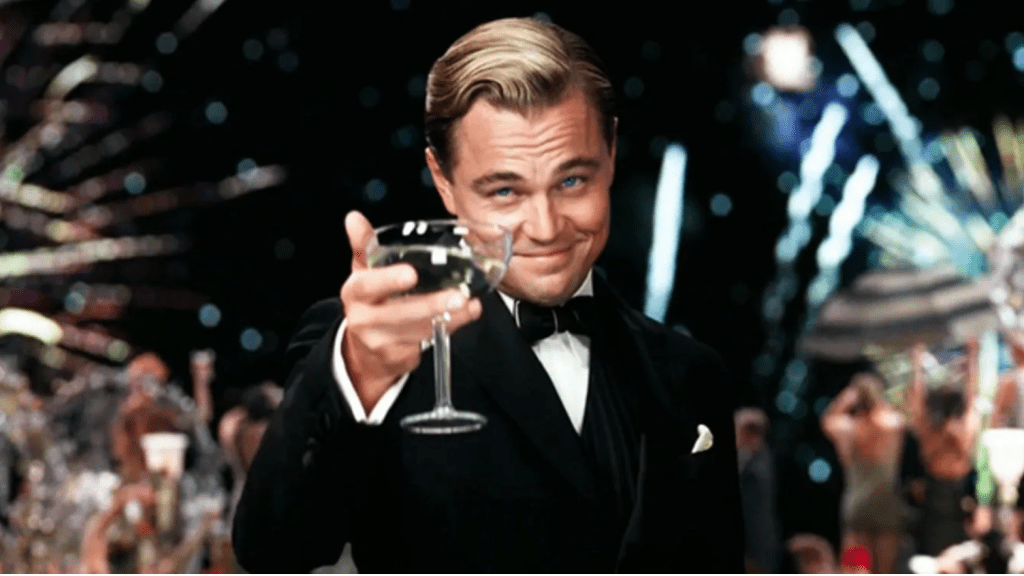
Turning to novels published in 1925 — 100 years ago! — we can only start with The Great Gatsby. (Leonardo DiCaprio is pictured atop this post in the 2013 movie version of F. Scott Fitzgerald’s iconic book.)
Other iconic or near-iconic titles published in 1925 included Virginia Woolf’s Mrs. Dalloway, Franz Kafka’s The Trial, Theodore Dreiser’s An American Tragedy, W. Somerset Maugham’s The Painted Veil, Sinclair Lewis’ Arrowsmith, and the second installment of L.M. Montgomery’s Emily trilogy. Plus one of Willa Cather’s lesser-known titles — The Professor’s House — and Georgette Heyer’s Simon the Coldheart.
I think the only novel I’ve read from 1875 — a century-and-a-half ago — was The Mysterious Island by Jules Verne. And nothing from 1825, 1775, and 1725, though I’ve read a number of books published not long before or after those years.
Misty the cat says: “Now that I’ve read ‘The Outsiders’ novel, it’s time to go inside.”
My comedic 2024 book — the part-factual/part-fictional/not-a-children’s-work Misty the Cat…Unleashed — is described and can be purchased on Amazon in paperback or on Kindle. It’s feline-narrated! (And Misty says Amazon reviews are welcome. 🙂 )
This 90-second promo video for my book features a talking cat: 🙂
In addition to this weekly blog, I write the 2003-started/award-winning “Montclairvoyant” topical-humor column every Thursday for Montclair Local. The latest piece — about another lawsuit in my town and a couple of contentious Council meetings — is here.
Now that the 10th-anniversary year of this blog has come and gone, I want to offer my VERY grateful thanks to all visitors and commenters. I love the conversations! 🙂
Last year, 2024, saw “Dave Astor on Literature” get by far its most annual views (56,862) and visitors (39,689). Also, the 52 posts (one every Sunday!) elicited 5,702 comments — averaging about 110 a week.
The “lucky 13” posts with the most comments last year:
1. “Faking a Look at a Presidential Book,” November 10, 185 comments.
2. “When Genres Are Happy Together,” November 24, 179 comments.
3. “Batman and Robin Aren’t the Only Dynamic Duo,” August 18, 167 comments.
4. “Expecting an A, Getting a B,” September 29, 150 comments.
5, “Gaslighting, Gaza, and Genocide,” May 5, 145 comments.
6. “Book Titles Get a New Look Thanks to Trump the Crook,” June 2, 140 comments.
7. “Misty the Cat…Unleashed Is Unleashed into the Book World,” June 16, 139 comments.
8. “Prose and Politics,” March 24, 137 comments.
9. “The Art of the Con,” March 17, 134 comments.
10. “Reading Painful Novels Can Be Worth the Pain,” January 14, 129 comments.
11. “From Russia With…Courage,” February 18, 127 comments.
12. “More Than One Ghost in This Post,” September 14, 124 comments.
13. “The Art of Depicting Large Families in Novels,” May 12, 123 comments.
My most-read post of 2024 was actually one I published in 2018: “Strong Female Characters in 19th-Century Fiction.” Not only the most-read piece in 2018 but in 2019, 2020, 2021, 2022, and 2023, too. Keeps popping up in online searches, I guess. 🙂
The countries that accounted for the most views of my blog in 2024? See the statistical image below. Readership came from 182 of the world’s 195 countries!
One final number: I read 54 novels last year.
Thank you all again! And back to actually discussing literature next week. 🙂
Misty the cat says: “Marcel Proust wrote In Search of Lost Car.”
My comedic 2024 book — the part-factual/part-fictional/not-a-children’s-work Misty the Cat…Unleashed — is described and can be purchased on Amazon in paperback or on Kindle. It’s feline-narrated! (And Misty says Amazon reviews are welcome. 🙂 )
This 90-second promo video for my book features a talking cat: 🙂
In addition to this weekly blog, I write the 2003-started/award-winning “Montclairvoyant” topical-humor column every Thursday for Montclair Local. The latest piece — about calls for a cursing councilor to resign, and more — is here.
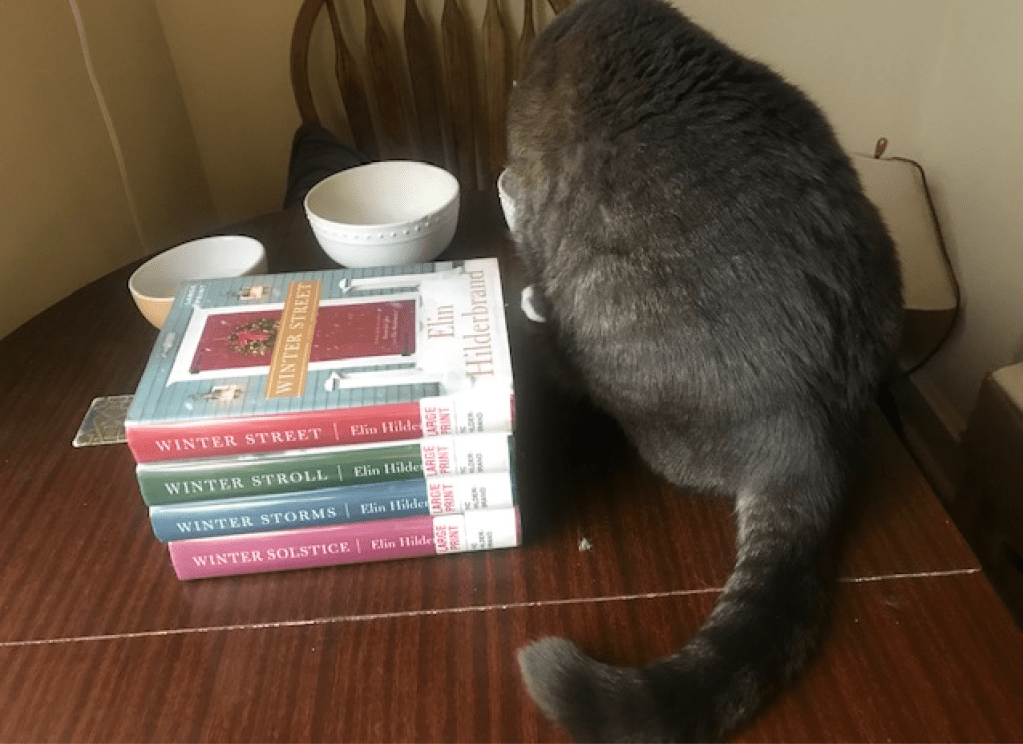
Misty the cat thinks these books have a BACK story. (Photo by me.)
It’s early winter in part of the world, so thoughts turn to novels with…the word “Winter” in the title. Okay, maybe most readers’ thoughts don’t turn to that, but I needed a blog topic this week. 🙂
I just finished reading Winter Street, the first of a four-book Elin Hilderbrand series that continues with Winter Stroll, Winter Storms, and Winter Solstice. The mostly Nantucket, Massachusetts-set Winter Street focuses on the Quinn family as it goes through a dramatic Christmas week that includes a marital separation, other relationship issues, an engagement, no word from a son fighting in Afghanistan, another son facing an insider-trading charge, etc. Yes, Christmas time is not always a 100% happy time. The book obviously deals with some heavy issues, yet often retains a light touch.
Another accomplished contemporary author, Kristin Hannah, wrote Winter Garden. Not on the level of her best novels such as The Nightingale, The Great Alone, The Four Winds, and Firefly Lane, but still pretty good. Winter Garden is about two very different sisters and their cold, mysterious mother — who’s originally from snowy Russia during the period of Stalin’s iron rule.
The late Rosamunde Pilcher’s final novel, Winter Solstice, is I think the second best of her many books — behind only her terrific The Shell Seekers. Winter Solstice (published before Hilderbrand’s novel of the same name) unfolds amid a cold-weather gathering of people from various generations.
Of course, there’s John Steinbeck’s also-final novel, The Winter of Our Discontent, which has the overarching theme of trying to maintain integrity in a corrupt society. It’s one of Steinbeck’s deeper books, though not as compelling as The Grapes of Wrath and East of Eden.
Among the “Winter”-titled novels I haven’t read are Isabel Allende’s In the Midst of Winter and Laura Ingalls Wilder’s The Long Winter (part of The Little House on the Prairie series). I should also mention George R.R. Martin’s The Winds of Winter — the lengthy, long-delayed, not-yet-finished sixth novel in his A Song of Ice and Fire series that started with A Game of Thrones.
Then there are plays such as Shakespeare’s The Winter’s Tale and James Goldman’s The Lion in Winter.
Any thoughts about, and/or examples of, this theme?
On yet another rainy winter morning, Misty the cat says: “I’d build an ark, but the lumber yard’s closed.”
My comedic 2024 book — the part-factual/part-fictional/not-a-children’s-work Misty the Cat…Unleashed — is described and can be purchased on Amazon in paperback or on Kindle. It’s feline-narrated! (And Misty says Amazon reviews are welcome. 🙂 )
This 90-second promo video for my book features a talking cat: 🙂
In addition to this weekly blog, I write the 2003-started/award-winning “Montclairvoyant” topical-humor column every Thursday for Montclair Local. The latest piece — which discusses an “F-bomb” controversy and much more via a poem co-starring Santa Claus — is here.
J.K. Rowling with the screen versions of her Harry Potter, Hermione Granger, Cormoran Strike, and Robin Ellacott characters (Everett/Getty/BBC).
It’s impressive enough when a novelist creates one successful series — as, say, Lee Child did with his Jack Reacher books and Sue Grafton did with her alphabet mysteries. But an author who creates two or more successful series? Wow!
Some writers produce multiple series consecutively — finishing one series before starting another. Other writers tack back and forth between different series. Either way, it takes some impressive and wide-ranging creative talent, and helps “serial” novelists stay fresh. Those authors can also feel good about readers staying with them as they offer something new.
Among the queens and kings of multiple series is J.K. Rowling. She of course penned the seven mega-popular Harry Potter books. Then, after writing The Casual Vacancy standalone novel, Rowling as “Robert Galbraith” launched her crime series starring private investigators Cormoran Strike and Robin Ellacott. I’m currently close to finishing the seventh installment — The Running Grave, in which Robin goes undercover to infiltrate a very problematic cult — and its 945 pages are full of the thrills, humor, suspense, poignancy, complications, excellent prose, and believable dialog Rowling always provides.
Walter Mosley is best-known for his detective series starring Easy Rawlins, who has now starred in 16 novels. But the author has interspersed those books with smaller series such as the King Oliver books and the Socrates Fortlow books. Mosley is always a great read, no matter who the protagonist is.
Val McDermid has gone the several-series route, too, including a compelling saga starring inspector Karen Pirie and another featuring journalist Allie Burns. Also not a clunker in the installments I’ve read.
Leaving contemporary fiction for a minute, L.M. Montgomery wrote Anne of Green Gables and its many sequels while also penning the semi-autobiographical Emily trilogy. (I consider a trilogy to be a series of sorts.)
Returning to a living author, Diana Gabaldon has gone the “sub-series” route by writing nine main Outlander novels (so far) and a number of offshoot books starring the Lord John character who’s a supporting player in the main novels.
Your thoughts about, and examples of, this theme?
Misty the cat says: “Snow means ‘Middlemarch’ author George Eliot wrote ‘Middledecember,’ too.”
My comedic 2024 book — the part-factual/part-fictional/not-a-children’s-work Misty the Cat…Unleashed — is described and can be purchased on Amazon in paperback or on Kindle. It’s feline-narrated! (And Misty says Amazon reviews are welcome. 🙂 )
This 90-second promo video for my book features a talking cat: 🙂
In addition to this weekly blog, I write the 2003-started/award-winning “Montclairvoyant” topical-humor column every Thursday for Montclair Local. The latest piece — which discusses what’s happening with my town’s animal shelter and much more — is here.
After Brian Thompson was shot and killed in New York City this month, millions of Americans from all parts of the ideological spectrum flooded social media to express little sympathy for him. That’s because he was the CEO of UnitedHealthcare, the massive company known for denying a huge number of legitimate medical-insurance claims in order to maximize its profits.
The result of those denials? Anguish for millions of patients and death for thousands of patients who (either individually or via employer plans) pay large monthly premiums for medical coverage — even as residents of every other developed country enjoy some form of much-more-humane national health insurance. And doctors with years of medical training and experience get their requests for needed tests and treatment for their patients denied by insurance bureaucrats with little or no medical expertise.
Meanwhile, Thompson — who was specifically targeted for assassination (the arrested suspect is Luigi Mangione) — raked in yearly compensation of $10.2 million.
Obviously, murder shouldn’t be celebrated, and this was an awful tragedy for Thompson and his family. But he and other execs at UnitedHealthcare and other private insurance providers are guilty of indirectly/continually causing tragic deaths — only their method is shooting down claims rather than shooting a gun.
As with many other situations, I was reminded of certain books I’ve read. There have been numerous nonfiction titles covering the cruel, pricey, unequal, inefficient U.S. medical system — which only works very well for the wealthy — but I’m a literature blogger and will thus focus on fiction in the remainder of this post. To me, the novel I’ve read that best expresses the fury “inspired” by the U.S. medical system is Lionel Shriver’s So Much for That. I highly recommend her 2010 book, despite much of it being a painful read. Somehow, Shriver manages to often make things entertaining, too.
And I thought of novels that have strong elements of vigilantism, which of course involves seeking justice by “illegal” means when such justice might not be achieved through “legal” channels. In the U.S., there have been various efforts by Senator Bernie Sanders and others urging “Medicare for All” to give Americans the type of health-insurance system every other “first world” nation has. But those efforts have been thwarted by a political class (virtually every Republican and most Democrats) as well as a mainstream media mostly bought off by campaign contributions and ad dollars from the profit-swollen companies (also including “Big Pharma”) benefiting from a privatized medical system. So, what are beleaguered citizens to do?
Among the novels with characters who take the law into their own hands for the “right” reasons (not necessarily medical-related reasons) are Louis Sachar’s Holes, John Steinbeck’s The Grapes of Wrath, Alexandre Dumas’ The Count of Monte Cristo, Lee Child’s Jack Reacher books, and Johnston McCulley’s The Curse of Capistrano featuring the protagonist who would also become the title character in Isabel Allende’s later Zorro. For those who haven’t read those novels, I’ll refrain from giving specifics in order not to spoil things.
As we know, there are also strains of vigilantism in many western novels (like Owen Wister’s The Virginian) and in comic books starring superheroes such as Batman.
Your thoughts about, and examples of, this topic?
As Christmas nears, Misty the cat says: “Ho Ho Ho means Harness off Harness off Harness off.”
My comedic 2024 book — the part-factual/part-fictional/not-a-children’s-work Misty the Cat…Unleashed — is described and can be purchased on Amazon in paperback or on Kindle. It’s feline-narrated! (And Misty says Amazon reviews are welcome. 🙂 )
This 90-second promo video for my book features a talking cat: 🙂
In addition to this weekly blog, I write the 2003-started/award-winning “Montclairvoyant” topical-humor column every Thursday for Montclair Local. The latest piece — which discusses a Mideast-related yet local police chaplain controversy — is here.
The Sun Also Rises on my kitty self. (Photo by Dave the biped.)
I, Misty the cat, have returned to write another guest post about “books, books, books.” Which sounds like a chicken saying “buk, buk, buk.” Why did the chicken cross The Road? To get to the other side of Cormac McCarthy’s 2006 novel.
Not funny was last month’s news that the late McCarthy had a relationship with a girl that started when she was 16 and he was 42. That’s sleazy Lolita territory, which reminds me that Vladimir Nabokov also authored Pale Fire about a blaze slathered with enough sunscreen to prevent it from getting burned. Not exactly an Elin Hilderbrand “beach read.” Nor was Andre Dubus III’s novel House of Sand and Fog, which I could’ve pierced with a beach umbrella if I had it in paperback rather than hardcover. I, the feline writing this post, live in the House of Broadband Blog. Actually an apartment, but the wifi is decent.
Late autumn isn’t swimming weather, but November 30 was the 150th anniversary of L.M. Montgomery’s birth. She of course wrote the iconic Anne of Green Gables, an exceptional YA novel. YA means Young Adult as well as Yowling Adult, which describes Dave after I grabbed his laptop to write this post. He’ll get over it, especially when I give him a newfangled quill pen and parchment paper to scribble this week’s shopping list. First seven items: cat food, cat chow, cat cuisine, cat edibles, cat victuals, cat nourishment, and cat sustenance.
Moving to my book list, I recently read Nelson DeMille for the first time — his novel The Quest. Quite exciting once I got over my first disappointment about the book’s tired trope of focusing on white visitors to a “third world” country — and my second disappointment that the quest was for a holy relic rather than a cat treat at peak freshness. A good chunk of DeMille’s story takes place in Ethiopia, where injera is a food staple. That pancake-like bread is slightly spongy, so a big-enough piece would make for an excellent cat bed. But my local pet store only sells cat beds with inedible cushioning; Goodnight Moon will never be the same.
Speaking of children’s books, The Cat in the Hat‘s title character is a rather slim kitty — certainly slimmer than me, a feline who starts his midnight snacking at noon. I’ve read that Dr. Seuss based his tall feline’s look on the Uncle Sam he had previously drawn in his political cartoons, which reminds me that I’m weighing a presidential run in 2028. To practice for my future time in the Oval Office, I occasionally walk in circles.
My favorite novels with at least some political themes, schemes, dreams, teams, screams, and memes? Among them are Robert Penn Warren’s All the King’s Men, George Orwell’s Nineteen Eighty-Four, J.K. Rowling’s The Casual Vacancy, Stephen King’s The Dead Zone, and Miguel de Cervantes’ Don Trumpote, co-starring Donald Trump’s loyal squire JD Vanza. Cervantes lived in Spain during the same circa-1600 era that James Clavell’s Japan-set novel Shogun unfolded. Little-known fact: Spain and Japan are walking distance from each other despite being 6,600 miles apart. Admittedly, the walk would take a year or two, even for a fast cat like me. The Inedible Journey without an injera cat bed.
Anyway, this month begins The Incredible Journey known as the march to the holiday season, meaning I might reread A Christmas Carol by Charles Dickens, who invented the CD when he initialed a document. There’s also Fannie Flagg’s excellent A Redbird Christmas, John Grisham’s so-so Skipping Christmas, and the classic song “I’m Dreaming of a White Pearl Harbor Day” — which you can hear on a CD player that Dickens also invented.
Yesterday, December 7, was Pearl Harbor Day. Today, December 8, is the seventh anniversary of when I was adopted into my current home! That was in 2017, the year Aaron Judge hit 52 home runs as a rookie. Or was it 52 apartment runs as a rookie? No idea what his living arrangements were back then, or why Edith Wharton wrote The House of Mirth rather than The Yurt of Mirth. Maybe because her protagonist Lily Bart didn’t live in Mongolia?
Getting back to the festive season, my Misty the Cat…Unleashed book would make a great holiday gift this month for the kitty lovers in your life. I co-wrote it with my human peep Dave, sort of like how Woodward and Bernstein co-wrote All the President’s Cats about the Watergate scandal, Richard Nixon, and his 1974 resignation — with no mention of cats. Surprisingly, Nixon didn’t blog about any of this at the time.
Dave will reply to comments, because I’m in serious pre-winter training to vigorously shred the wrapping paper on holiday gifts.
Misty the cat says: “Today’s my 7th adoption anniversary. I appreciate the celebratory lights.”
Dave’s comedic 2024 book — the part-factual/part-fictional/not-a-children’s-work Misty the Cat…Unleashed — is described and can be purchased on Amazon in paperback or on Kindle. It’s feline-narrated! (And I, Misty, say Amazon reviews are welcome. 🙂 )
This 90-second promo video for Dave’s book features a talking cat: 🙂
In addition to this weekly blog, Dave writes the 2003-started/award-winning “Montclairvoyant” topical-humor column every Thursday for Montclair Local. The latest piece — which includes a “Twelve Days of Christmas” theme — is here.