All of March, Not ‘Middlemarch’

March is my birthday month, so I thought I’d list and discuss famous March-born authors I’ve read at least one book by.

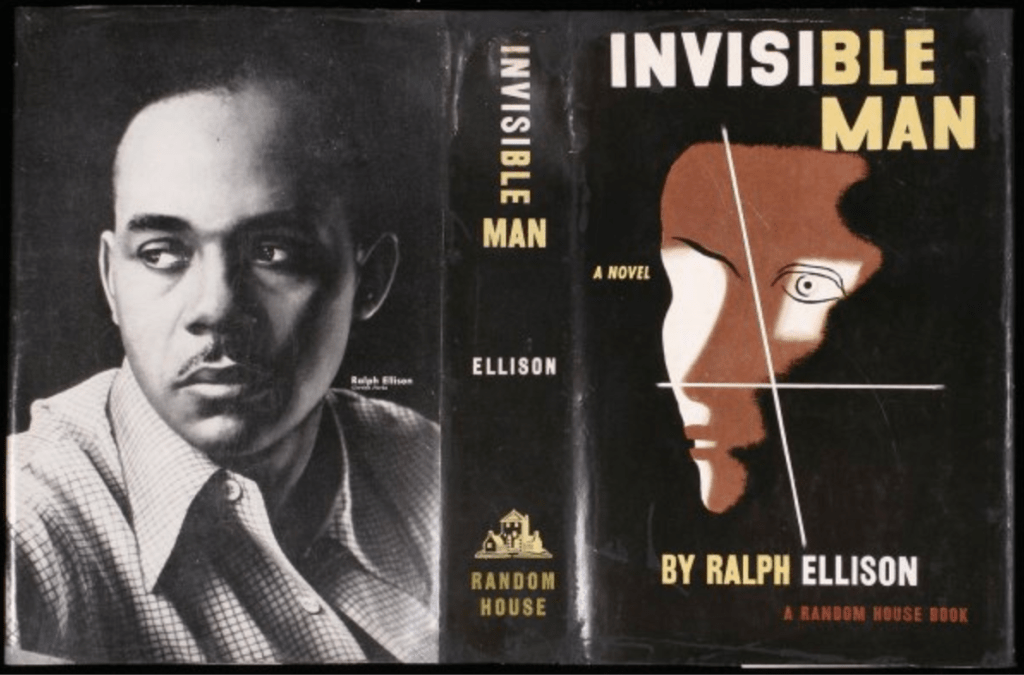
March 1: Ralph Ellison (1913-1994). He of course wrote Invisible Man, which says more about racism and other aspects of United States life than most other novels have ever done.

March 2: John Irving (1942-). I’ve read four of his novels, with The Cider House Rules my favorite. He’s really skilled at combining the quirky and the profound, with social commentary also a big part of the mix.

March 2: Peter Straub (1943-2022). His intricate Ghost Story was quite good but could have been somewhat shorter.

March 4: Khaled Hosseini (1965-). His debut novel The Kite Runner is very compelling, although one loses a lot of sympathy for protagonist Amir after his nasty act of betrayal.

March 6: Gabriel Garcia Marquez (1927-2014). I’ve read five of his novels — One Hundred Years of Solitude is obviously his best — and he was masterful at mixing magic realism, political elements, pathos, romance, and more.

March 8: Jeffrey Eugenides (1960-). His Middlesex novel memorably depicts an intersex character while also having plenty to say about family dynamics, the immigrant experience, etc.

March 11: Douglas Adams (1952-2001). His The Hitchhiker’s Guide to the Galaxy is an enjoyable read, though I think somewhat overrated.

March 12: Jack Kerouac (1922-1969). I also think On the Road is overrated, but it does say a lot about wanderlust, The Beat Generation, and the culture of its time.

March 13: Viet Thanh Nguyen (1971-). His novel The Sympathizer and its sequel The Committed — both starring an unnamed part-Vietnamese spy — offer an impressive page-turning amalgam of war commentary, multiculturalism, humor, and more.

March 13: Tad Williams (1957-). His Tailchaser’s Song is an epic fantasy novel starring…cats.

March 18: John Updike (1932-2009). The only novel of his I’ve read is Rabbit, Run, and, while I admired the writing, I was not a big fan of the book’s brew of white-male angst and misogyny.

March 19: Philip Roth (1933-2018). This author can also be annoying amid the great writing chops, but the neurotic Portnoy’s Complaint is funny as hell.

March 20: Lois Lowry (1937-). Her young-adult dystopian novel The Giver is quite good, and its sequels aren’t bad, either.

March 20: Louis Sachar (1954-). His eccentric Holes is one of the better YA novels I’ve read, including its feminist and antiracist aspects.

March 22: Louis L’Amour (1908-1988). He’s best known for western novels, but his Soviet Union-set Last of the Breed is pretty exciting, too.

March 22: James Patterson (1947-). Tried just one of his novels; wasn’t a fan. Also not a fan of his “factory” approach of using a team of co-authors to churn out book after book.

March 23: Julia Glass (1956-). I’ve read her very good Three Junes, which, as the title implies, has an interesting/interrelated three-part format.

March 25: Flannery O’Connor (1925-1964). She’s best-known for chilling short stories such as “A Good Man Is Hard to Find,” but also wrote the intriguing novel Wise Blood.

March 27: Julia Alvarez (1950-). Her novel In the Time of the Butterflies is a gripping piece of historical fiction about sisters bravely opposing the former Dominican Republic dictatorship.

March 28: Russell Banks (1940-2023). I’ve only read his Rule of the Bone, a gritty look at characters living in the underbelly of the U.S. and Jamaica.

March 28: Mario Vargas Llosa (1936-2025): His offbeat Aunt Julia and the Scriptwriter definitely held my interest.

March 31: Nikolai Gogol (1809-1852). His novel Dead Souls is an eye-opener, and his short story “The Overcoat” is a classic tale that influenced great Russian writers later in the 19th century. (Some sources say Gogol was born on April 1.)

March 31: Marge Piercy (1936-). Her Woman on the Edge of Time is an original combination of social justice and science fiction writing.

March 31: Judith Rossner (1935-2005). Her Looking for Mr. Goodbar was quite a sensation in its 1970s time.

Notable March-born writers I’ve read who are known for work other than novels include children’s book author Dr. Seuss, playwright Tennessee Williams, and poets Robert Frost and Elizabeth Barrett Browning, among others.

Any thoughts on this post, or examples of other March-born writers you’ve read?

As he runs in the direction of NYC, Misty asks: “How can cats live in ‘the city that never sleeps’?”

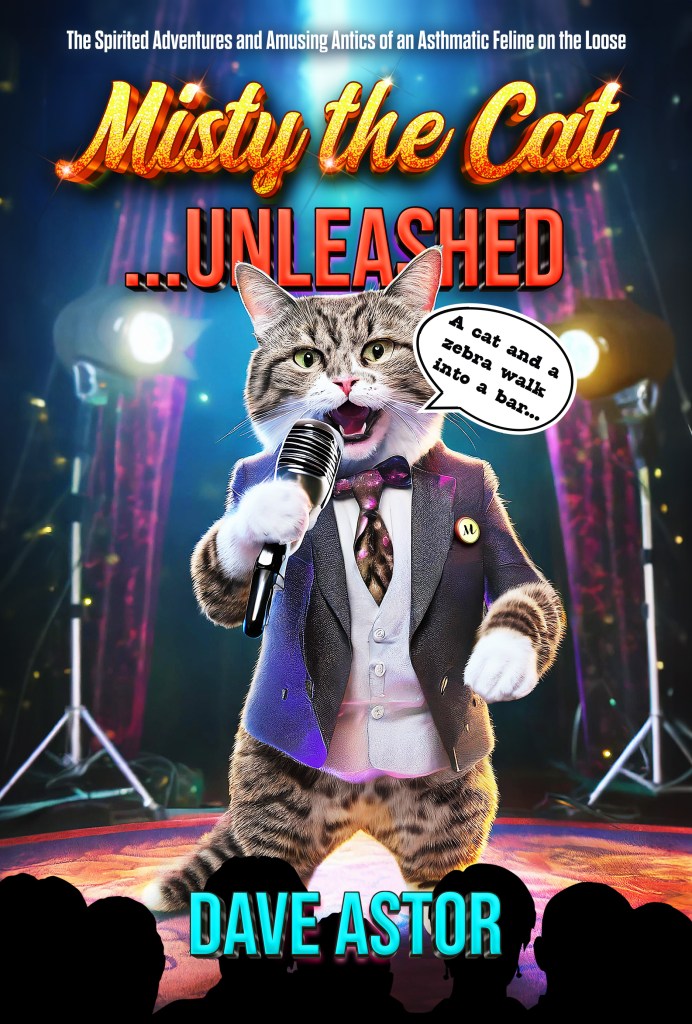
My comedic 2024 book — the part-factual/part-fictional/not-a-children’s-work Misty the Cat…Unleashed — is described and can be purchased on Amazon in paperback or on Kindle. It’s feline-narrated! (And Amazon reviews are welcome. 🙂 )
This 90-second promo video for the book features a talking cat: 🙂

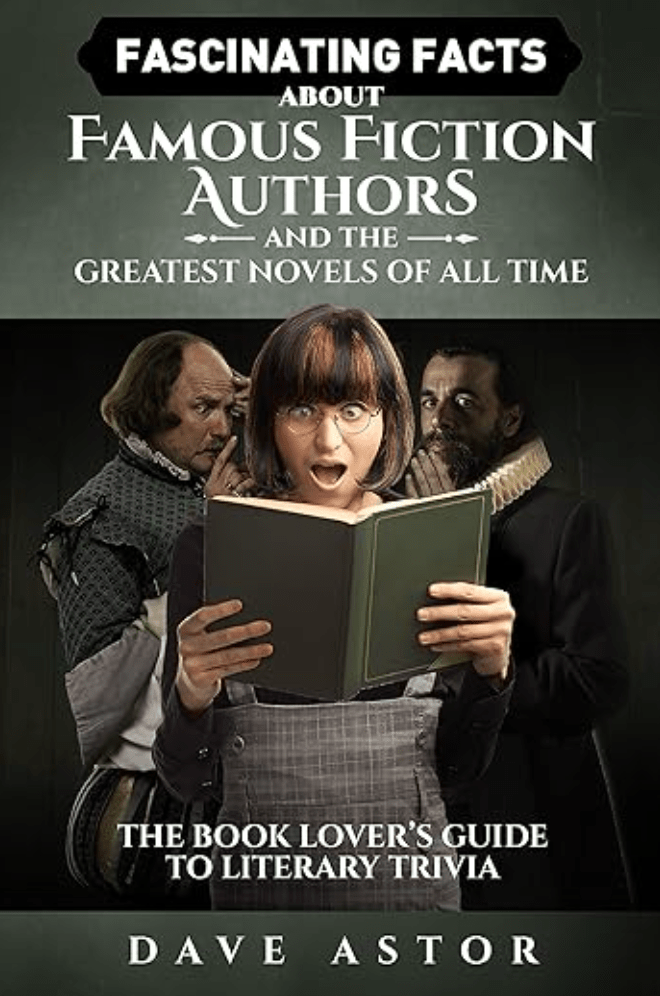
I’m also the author of a 2017 literary-trivia book

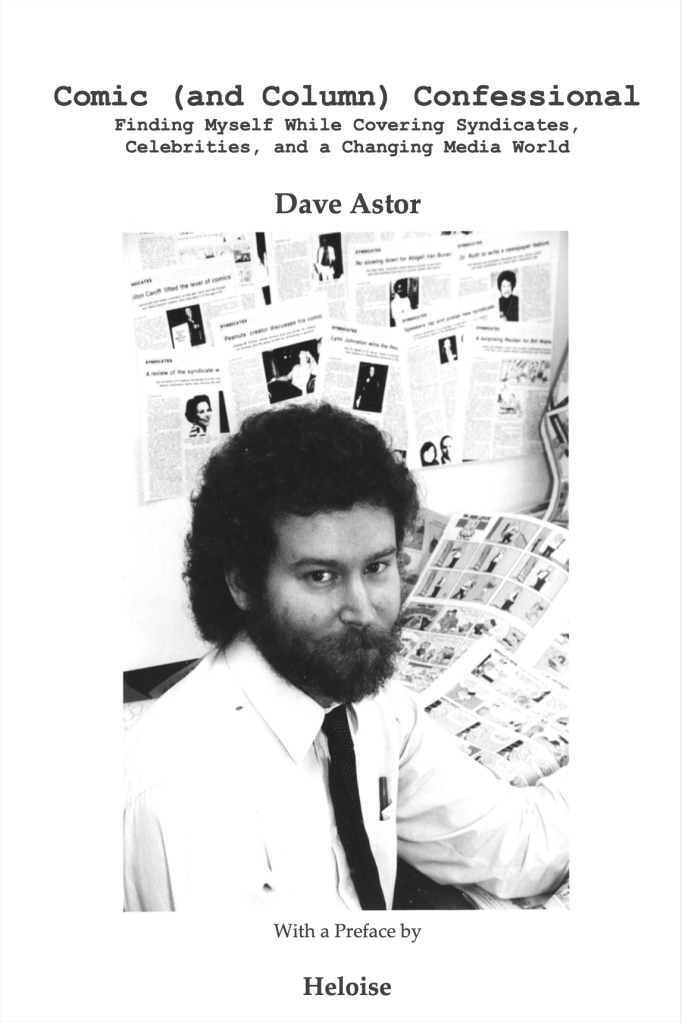
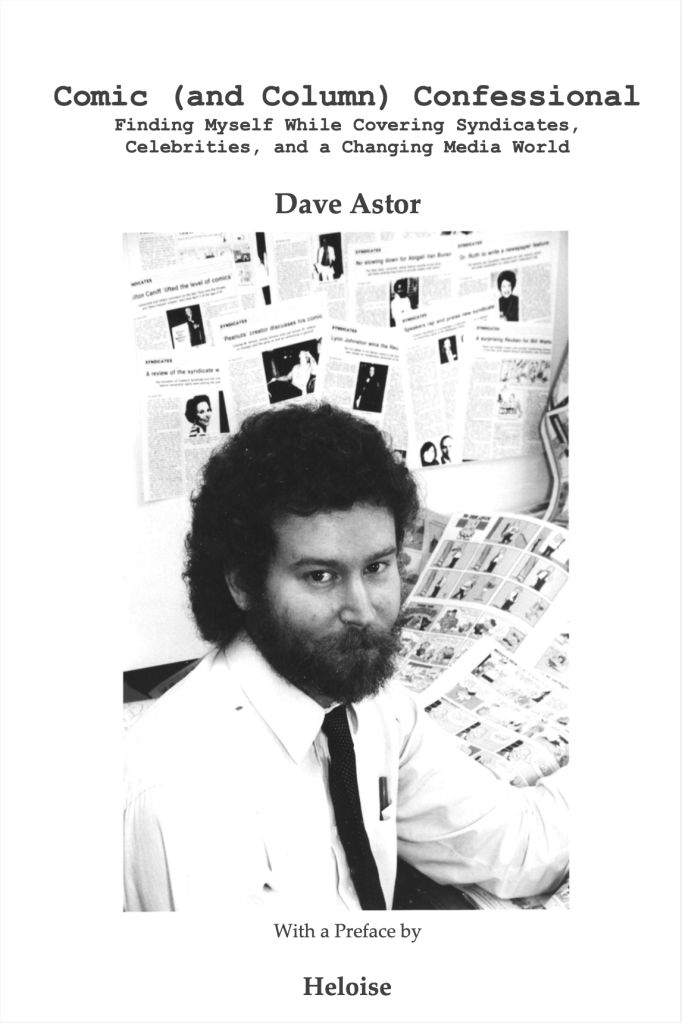
…and a 2012 memoir that focuses on cartooning and more, including many encounters with celebrities.
In addition to this weekly blog, I write the 2003-started/award-winning “Montclairvoyant” topical-humor column every Thursday for Montclair Local. The latest piece — containing commentary on a big snowstorm and all kinds of controversial news in my town — is here.

Formidable Fiction Is ‘Furmidable’ to a Feline

I, Misty the cat, might be the first kitty to write a blog post while asleep. (Photo by my human Dave.)

Last week, Dave blogged about the appeal of escapist fiction as a diversion from the dire 2025 political climate faced by people, cats, and blue-footed booby birds who migrated from red-footed states. This week, as I, Misty the cat, do the every-two-month feline takeover of Dave’s blog, I’ll discuss a few of the many challenging novels I’ve read amid the escapist stuff, if only to keep up my paw strength as I swatted those weighty books off the table.

Currently, Dave and I are in the middle of Orfeo by Richard Powers, who later wrote the acclaimed environmental tree saga The Overstory — a novel not about me hovering over a short story. Orfeo is a book featuring a rather complex musical motif as well as sudden swings between the present and past, yet it’s still quite readable in its way. How did I, Misty the cat, learn a word like “motif”? In The Idiot’s Guide to Pretentious Vocabulary.

Some other challenging novels? James Joyce’s Ulysses comes to mind, but I haven’t read it because of my lack of interest in American Civil War general Ulysses S. Grant. There’s also Marcel Proust’s many-volume In Search of Lost Time, of which I managed to finish the initial Swann’s Way book. Here’s what I discovered: gorgeous language, kind of a slog to get through, and a swan and blue-footed booby will both eat a madeleine if it’s slathered in A1 steak sauce.

Plenty of food for thought (but no madeleine) in Toni Morrison’s Beloved, set after the American Civil War in which the aforementioned Grant waged battle against alliterative author names like James Joyce. I also liked Morrison’s The Bluest Eye, even though my cat eyes are green. Everything is not all about me! 99.9% about me? Sure, but not 100%.

Then there’s late-career Henry James. Those novels contain plenty of long and convoluted sentences, but, yes, Long and Convoluted would make a great name for a rock band. Dave and my feline self did enjoy James’ late-career novel The Ambassadors, which was about the Ambassador cars from India and the United States meeting cute before asking James to write The Turn of the Ignition. Or maybe that novel was about an American’s trip to Paris to try to bring back a young man to the family business. The Family Business would be a so-so name for a rock band.

An early-career novel by Eleanor Catton, published when the author was still in her 20s, is also quite ambitious. That would be The Luminaries, which combined a plot about the 1860s New Zealand gold rush with an astrological motif. (I’m a Sagittarius cat.) There’s that fancy word “motif” again, which I was moved to reuse after reading The Idiot’s Guide to Repeating One’s Self in a Blog Post.

I liked Virginia Woolf’s Mrs. Dalloway a lot despite it not being the easiest of reads. The whole book unfolds in a day, which makes me wonder if it’s a multigenerational saga unfolding across several centuries. Let me think about that.

There’s also Leo Tolstoy’s War and Peace, about the yin and yang of my relationship with the chipmunk I often see during my daily leashed walks. Given its tiny size, the chipmunk only reads one-page novels, and gets its musical fix solely by watching NPR “Tiny Desk Concerts” — including excellent ones featuring Taylor Swift and Chappell Roan. It’s a small world after all…

Speaking of Russian novels, Fyodor Dostoevsky’s tome The Brothers Karamazov is a challenge, too, with many chapters that are wonderful and some chapters that sort of drag. But when it’s good it’s GOOD. The Sisters Karamazov didn’t leave as much of an impression on my feline self because that book doesn’t exist. The Second-Cousins-Once-Removed Karamazov? A real banger. Which reminds me to bang on my food bowl because it feels like I haven’t been served my chow since the 19th century in Russia. It’s been almost five minutes!

Gabriel Garcia Marquez’s sweeping One Hundred Years of Solitude echoed my angst when I was once forced to endure One Hundred Nanoseconds of Solitude. Fortunately, I also read The Idiot’s Guide to Being Alone for Under a Minute.

Dave told me he twice tried William Faulkner’s The Sound and the Fury but couldn’t get past the first few chapters, unlike that author’s more readable Light in August and As I Lay Dying. I tried The Sound and the Fury myself, and went into a reading coma. Or maybe it was a food coma “as I lay digesting” too many cat treats.

Comments will be answered by Dave as I read The Idiot’s Guide to Recovering from Digesting Too Many Cat Treats.

I, Misty the cat, say: “I see the ghost, but where’s Mrs. Muir?”

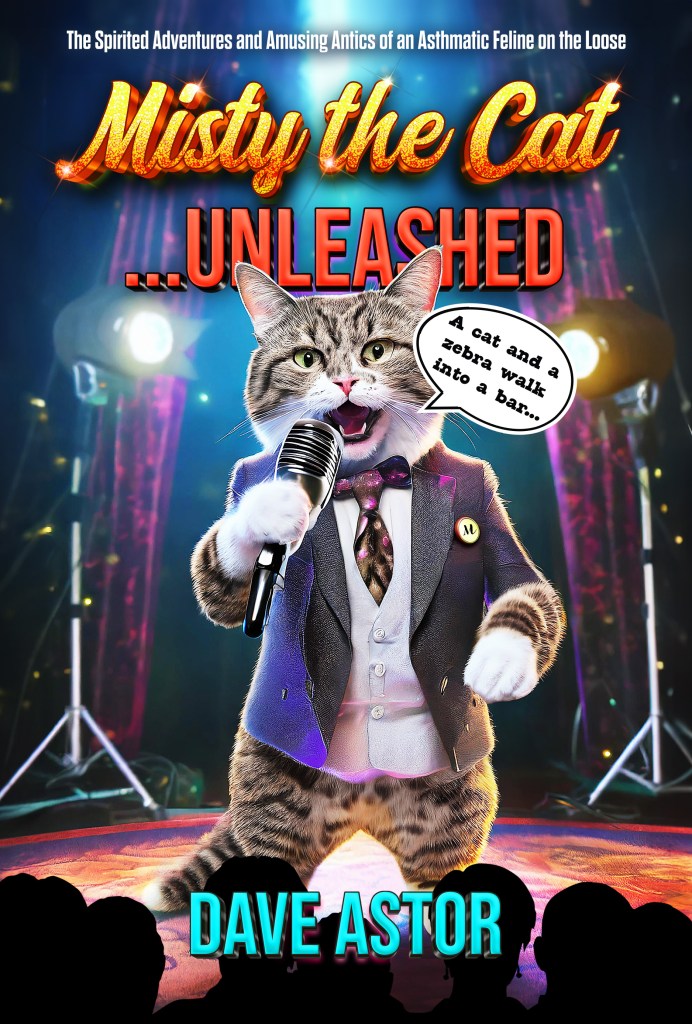
Dave and I’s comedic 2024 book — the part-factual/part-fictional/not-a-children’s-work Misty the Cat…Unleashed — is described and can be purchased on Amazon in paperback or on Kindle. It’s feline-narrated! (And Amazon reviews are welcome. 🙂 )

This 90-second promo video for the book features a talking cat: 🙂

Dave is also the author of a 2017 literary-trivia book

…and a 2012 memoir that focuses on cartooning and more, and includes many encounters with celebrities.

In addition to this weekly blog, Dave writes the 2003-started/award-winning “Montclairvoyant” topical-humor column every Thursday for Montclair Local. The latest piece — about a huge school budget deficit that grew even larger — is here.