Reimagination Actualization

Four years ago, I blogged about fiction that uses previous fiction as a jumping-off point — and perhaps reimagines well-known characters. This post is sort of a sequel to that post, taking a somewhat different angle and including several novels I’ve read since 2021.

In general, I’m not a huge fan of fiction that’s heavily inspired by a famous work; I’d rather writers be more original than that. Still, there have been some excellent novels that offer insights into the previous work and might be great in their own right.

My latest encounter with this reimagining phenomenon was Queen Macbeth, Val McDermid’s 2024 novella that takes a fascinating approach to characters in Shakespeare’s iconic Macbeth play. The book is excellent, giving Lady Macbeth a more positive (and more historically accurate) persona as a compelling plot unfolds in two different timelines.

McDermid’s book reminded me a bit of Margaret Atwood’s 2005 novella The Penelopiad (mentioned in my 2021 post) that gives Penelope a bigger and more feminist role than she had in Homer’s ancient Odyssey poem.

There’s also Demon Copperhead, Barbara Kingsolver’s 2022 tour de force that gives Charles Dickens’ 1850 classic David Copperfield a modern spin in America’s Appalachian region during the opioid epidemic.

Kristin Hannah’s gripping 2021 novel The Four Winds was obviously inspired by John Steinbeck’s The Grapes of Wrath (1939), but it’s still plenty original and differs in featuring a female protagonist. (The title character in Demon Copperhead is male.)

Zadie Smith has described the structure/focus of her novel On Beauty (2005) as an homage to E.M. Forster’s Howards End (1910).

In her also-published-in-2005 novel March, Geraldine Brooks takes the father from Louisa May Alcott’s 1868-released Little Women and gives him his own story.

I haven’t read it yet, but Percival Everett’s acclaimed James (2024) reimagines Mark Twain’s Adventures of Huckleberry Finn (1884) from the perspective of the escaped slave Jim.

In my 2021 post, I mentioned the 1966 novel Wide Sargasso Sea, in which Jean Rhys gives three-dimensionality to the “madwoman in the attic” of Charlotte Bronte’s novel Jane Eyre; Rhys’ creation is in effect a prequel to Bronte’s 1847 book. I also discussed the novel (by Gregory Maguire) and the play Wicked, which sympathetically portray the Wicked Witch from L. Frank Baum’s The Wonderful Wizard of Oz novel (1900) and The Wizard of Oz movie (1939).

Mentioned as well in that post were Isabel Allende’s 2005 novel Zorro, Jasper Fforde’s 2001 novel The Eyre Affair, and Seth Grahame-Smith’s 2009 Jane Austen parody Pride and Prejudice and Zombies — the last of which I haven’t felt the “Persuasion” to read.

Comments about, and examples of, this theme?

Misty the cat says: “My right turn has nothing to do with politics.”

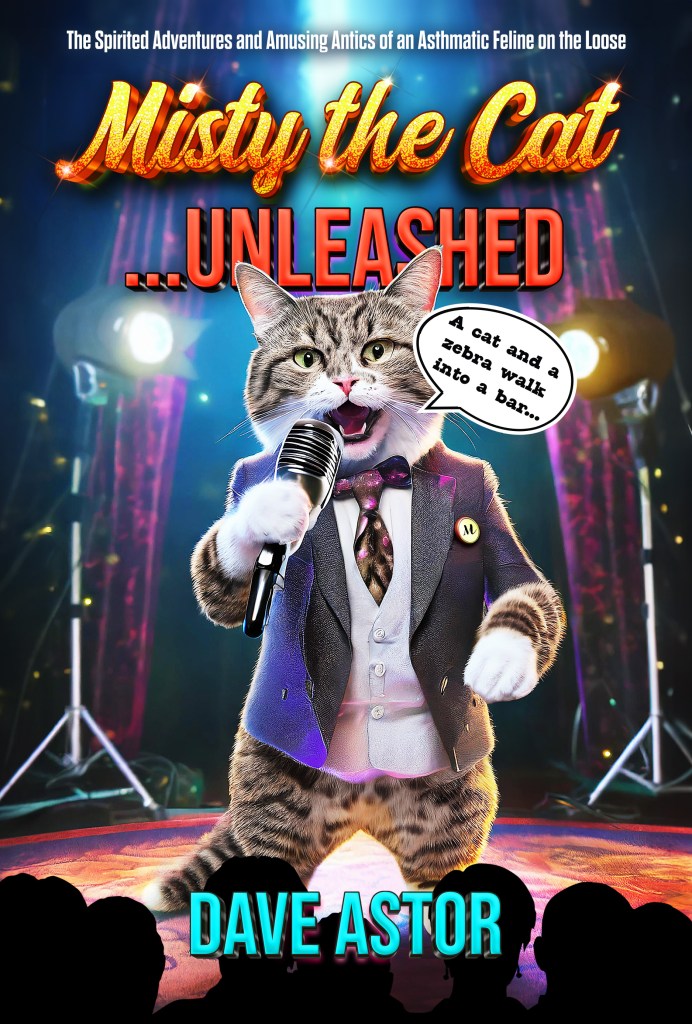
My comedic 2024 book — the part-factual/part-fictional/not-a-children’s-work Misty the Cat…Unleashed — is described and can be purchased on Amazon in paperback or on Kindle. It’s feline-narrated! (And Misty says Amazon reviews are welcome. 🙂 )
This 90-second promo video for the book features a talking cat: 🙂

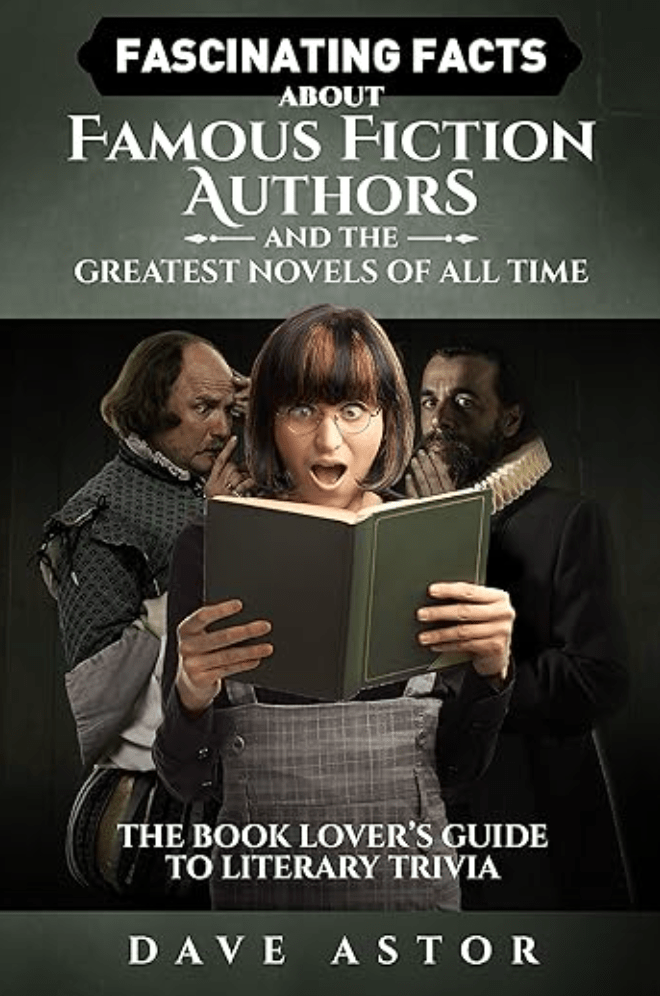
I’m also the author of a 2017 literary-trivia book

…and a 2012 memoir that focuses on cartooning and more.

In addition to this weekly blog, I write the 2003-started/award-winning “Montclairvoyant” topical-humor column every Thursday for Montclair Local. The latest piece — about a badly maintained lower-income apartment building, a change in venue for a senior center, and more — is here.

The Plot (or Lack of) Thickens

Last week I was reading Jean-Paul Sartre’s Nausea, and my brain was queasy with mixed feelings. The novel is intellectual, philosophical, existential — clearly a great mind was at work there. But I was at times bored along with being impressed, and found myself putting the book down every few pages. Then I started to skim it.

Why the partial boredom? Well, the protagonist sat in cafes, watched people, walked down the street, moped, thought, overthought, etc. There was no dang plot, or very little of one. And a plot-less novel — no matter how well-written and thought-provoking — is going to have a harder time holding a reader’s interest.

Now a brief poetic interlude, sung to the tune of “If I Only Had the Nerve” from The Wizard of Oz:

There are followers or leaders
Who were bound to become readers
They like literature a lot

But they could change that habit
Flee as fast as a rabbit
From a novel with no plot

I’m afraid there’s no denying
If I did I would be lyin’
To adults or to a tot

Authors could show their prowess
(With a touch pad, not a mowess)
If they only had a plot

Oh we’d be in our stride
Book fans to the core
Oh we’d read the way we never read before
And then we’d read
And read some more

If many an authorsaurus
Wrote works that were more for us
More book sales to be got

Yes, we’d gladly read their fiction
And our brains would have less friction
If they only had a plot

I’m exaggerating a bit, because there are a number of novels with little or no plot that I like a lot. It helps if that sort of book has humor (as with, say, John Steinbeck’s episodic Tortilla Flat and Cannery Row), but even plot-challenged books with a scarcity of laughs can merit our admiration and deep respect. The aforementioned Nausea is one of them, as is Evan Connell’s exceptional Mrs. Bridge, which I finished this afternoon (more on that novel in next week’s post).

Yet…a plot is usually needed to activate another “p” word: page-turning.

Take any of Lee Child’s Jack Reacher novels, such as The Killing Floor and 61 Hours. How will the bad guys be defeated? How much damage will they do before that happens? How much damage will Reacher do to them? How will Jack’s latest romance begin, and end? We’re on the edge of our seats.

But a novel doesn’t have to be a thriller or a mystery or another kind of genre fiction to propel the reader along. It can be literary fiction, or a popular/literary hybrid like Alexandre Dumas’ The Count of Monte Cristo. Will Edmond Dantes escape from prison? Well, it’s pretty obvious he will. But how exactly will he exact his epic revenge on the various people who framed him?

Other classics are also full of plot lines, even as they can be brainy, too. For instance, we wonder what will happen to Crime and Punishment‘s double-murderer Raskolnikov even as we are awed by how Fyodor Dostoyevsky wrestles with all the important questions: psychological motivations, guilt, nonconformity, and more. Nearly as propulsive and thought-provoking is Richard Wright’s Native Son, which also stars a murderer whose fate we very much wonder about. Or Harper Lee’s To Kill a Mockingbird, in which an innocent man is put on trial. The last two novels have the added dimension of gruesome racism.

A fictional crime doesn’t have to involve real or alleged physical violence, of course. Donna Tartt keeps the suspense going for hundreds of pages after her protagonist takes and hides a priceless painting in The Goldfinch.

Another compelling plot line focuses on whether characters will survive a war (Ernest Hemingway’s For Whom the Bell Tolls, Erich Maria Remarque’s A Time to Love and a Time to Die, etc.) or survive a hostage scenario (Ann Patchett’s Bel Canto) or survive other life-threatening situations. It’s hard to top death, or the threat of death, for drama.

And will courageous political activists — such as those in Julia Alvarez’s In the Time of the Butterflies — survive opposing a despotic government?

Then of course there is the age-old and frequently fascinating plot line involving relationships, married or otherwise. Will two people get together or not? Will they stay together or not? How lovey-dovey or stormy is the relationship? So many examples: Charlotte Bronte’s Jane Eyre, George Eliot’s Daniel Deronda, Henry James’ The Portrait of a Lady, D.H. Lawrence’s Sons and Lovers, W. Somerset Maugham’s Of Human Bondage, Edith Wharton’s The Age of Innocence, L.M. Montgomery’s The Blue Castle, and thousands of other novels.

And there are all kinds of other plot variations, including whether characters will finally achieve a non-romantic goal — as with the protagonist in Lionel Shriver’s So Much for That, or Dorothy, The Scarecrow, The Tin Woodman, and The Cowardly Lion in L. Frank Baum’s The Wonderful Wizard of Oz.

How important is a plot to you when reading fiction? Do you like some novels that mostly lack a plot? If so, which ones? Also, what are some of your favorite books with compelling plots?

That’s a lot of questions, but at least I didn’t post a second Wizard of Oz parody…

(The box for submitting comments is below already-posted comments, but your new comment will appear at the top of the comments area — unless you’re replying to someone else.)

I’ve finished and am now rewriting/polishing a book called Fascinating Facts About Famous Fiction Writers, but am still selling Comic (and Column) Confessional — my often-funny memoir that recalls 25 years of covering and meeting cartoonists such as Charles Schulz (“Peanuts”) and Bill Watterson (“Calvin and Hobbes”), columnists such as “Dear Abby” and Ann Landers, and other notables such as Coretta Scott King, Walter Cronkite, and various authors. The book also talks about the malpractice death of my first daughter, my remarriage, and life in Montclair, N.J. — where I write the award-winning weekly “Montclairvoyant” humor column for The Montclair Times. You can email me at dastor@earthlink.net to buy a discounted, inscribed copy of the book, which contains a preface by “Hints” columnist Heloise and back-cover blurbs by people such as “The Far Side” cartoonist Gary Larson.Â