
Four years ago, I blogged about fiction that uses previous fiction as a jumping-off point — and perhaps reimagines well-known characters. This post is sort of a sequel to that post, taking a somewhat different angle and including several novels I’ve read since 2021.
In general, I’m not a huge fan of fiction that’s heavily inspired by a famous work; I’d rather writers be more original than that. Still, there have been some excellent novels that offer insights into the previous work and might be great in their own right.
My latest encounter with this reimagining phenomenon was Queen Macbeth, Val McDermid’s 2024 novella that takes a fascinating approach to characters in Shakespeare’s iconic Macbeth play. The book is excellent, giving Lady Macbeth a more positive (and more historically accurate) persona as a compelling plot unfolds in two different timelines.
McDermid’s book reminded me a bit of Margaret Atwood’s 2005 novella The Penelopiad (mentioned in my 2021 post) that gives Penelope a bigger and more feminist role than she had in Homer’s ancient Odyssey poem.
There’s also Demon Copperhead, Barbara Kingsolver’s 2022 tour de force that gives Charles Dickens’ 1850 classic David Copperfield a modern spin in America’s Appalachian region during the opioid epidemic.
Kristin Hannah’s gripping 2021 novel The Four Winds was obviously inspired by John Steinbeck’s The Grapes of Wrath (1939), but it’s still plenty original and differs in featuring a female protagonist. (The title character in Demon Copperhead is male.)
Zadie Smith has described the structure/focus of her novel On Beauty (2005) as an homage to E.M. Forster’s Howards End (1910).
In her also-published-in-2005 novel March, Geraldine Brooks takes the father from Louisa May Alcott’s 1868-released Little Women and gives him his own story.
I haven’t read it yet, but Percival Everett’s acclaimed James (2024) reimagines Mark Twain’s Adventures of Huckleberry Finn (1884) from the perspective of the escaped slave Jim.
In my 2021 post, I mentioned the 1966 novel Wide Sargasso Sea, in which Jean Rhys gives three-dimensionality to the “madwoman in the attic” of Charlotte Bronte’s novel Jane Eyre; Rhys’ creation is in effect a prequel to Bronte’s 1847 book. I also discussed the novel (by Gregory Maguire) and the play Wicked, which sympathetically portray the Wicked Witch from L. Frank Baum’s The Wonderful Wizard of Oz novel (1900) and The Wizard of Oz movie (1939).
Mentioned as well in that post were Isabel Allende’s 2005 novel Zorro, Jasper Fforde’s 2001 novel The Eyre Affair, and Seth Grahame-Smith’s 2009 Jane Austen parody Pride and Prejudice and Zombies — the last of which I haven’t felt the “Persuasion” to read.
Comments about, and examples of, this theme?
Misty the cat says: “My right turn has nothing to do with politics.”
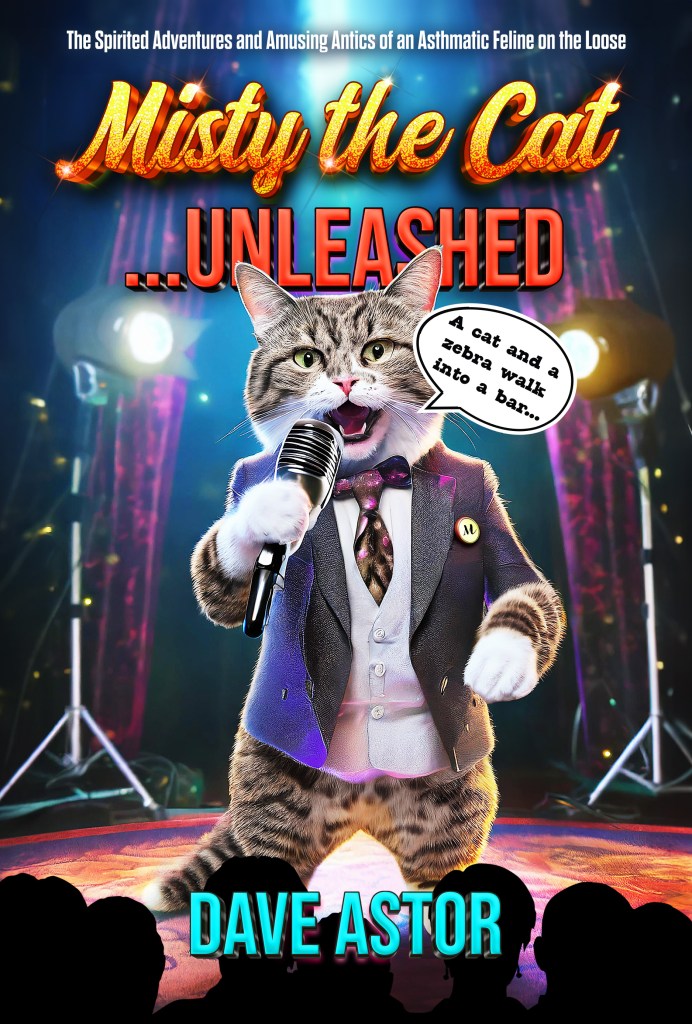
My comedic 2024 book — the part-factual/part-fictional/not-a-children’s-work Misty the Cat…Unleashed — is described and can be purchased on Amazon in paperback or on Kindle. It’s feline-narrated! (And Misty says Amazon reviews are welcome. 🙂 )
This 90-second promo video for the book features a talking cat: 🙂
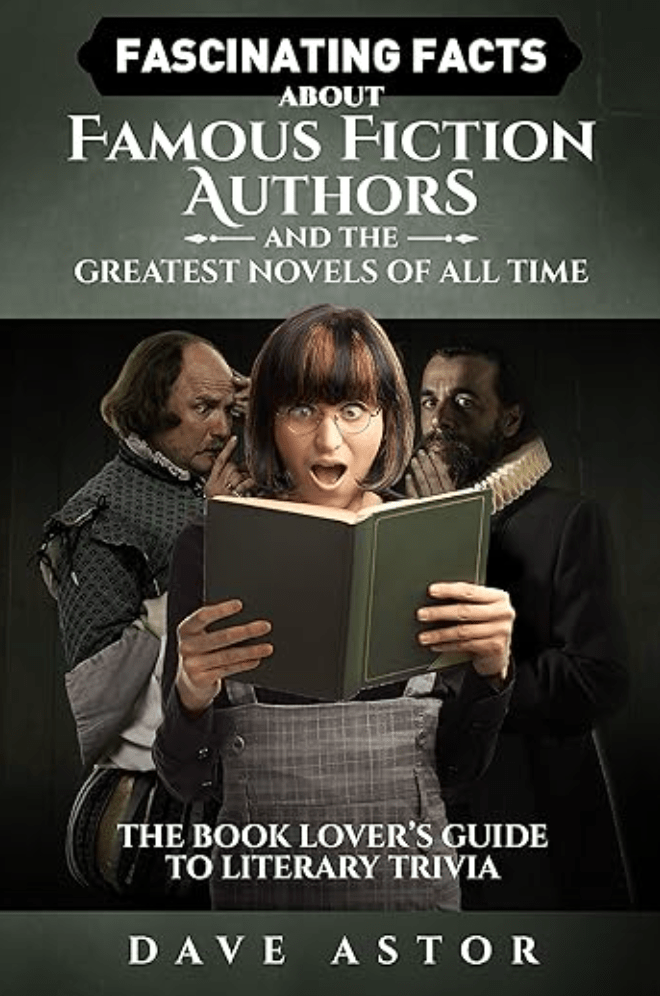
I’m also the author of a 2017 literary-trivia book…
…and a 2012 memoir that focuses on cartooning and more.

In addition to this weekly blog, I write the 2003-started/award-winning “Montclairvoyant” topical-humor column every Thursday for Montclair Local. The latest piece — about a badly maintained lower-income apartment building, a change in venue for a senior center, and more — is here.
 Dave Astor on Literature
Interesting post
LikeLiked by 2 people
Thank you! 🙂
LikeLike
Orthodox Judaism just as meshugah over the mitzva of Moshiach as the Av tuma avoda zara Xtian church.
_MASHIACH: The Night Watchman
ArtScroll Staff·The Official ArtScroll Blog·Aug 11, 2025
Adapted from: Yearning for Redemption by Rabbi Daniel Glatstein
The following verse (Tehillim 130:6) requires explanation: נַפְשִׁי לַה’ מִשֹּׁמְרִים לַבֹּקֶר שֹׁמְרִים לַבֹּקֶר.,
_____________________
______________________
Mitzva of Moshiach requires making הבדלה just as does shabbat observance separates מלאכה מן עבודה. Both this and that, Av tohor time-oriented Torah commandments! This Av type of commandment requires k’vanna. תולדות secondary – positive and negative and halachot mitzvot – do not require k’vanna. This represents a chiddush, a huge מאי נפקא מינא. T’NaCH\Talmud common law requires precedents. Rabbi Yishmael’s 13 middot refers to precedents as בניני אבות. To ascertain the k’vanna of tohor time-oriented commandments requires the wisdom how to correctly interpret prophetic mussar from the T’NaCH\Aggadah & Midrashim. The latter, specifically the T’NaCH Primary Sources, they determine the k’vanna of all Torah time-oriented commandments. Just that simple. No fancy dance’n. Prophets function as the police-enforcement teeth of the Great and Small Sanhedrin common law courts, within the borders of the oath sworn Cohen lands. Sworn by an oath brit between HaShem and the Avot as the eternal inheritance of the chosen Cohen People.
The Yom Tov of ר”ה, יום הזכרון specifically remembers the t’shuva consequent to the Golden Calf. HaShem annulled His vow to make from Moshe’s עולם הבא children the chosen Cohen people! Moshe caused HaShem to remember the oaths sworn to Avraham, Yitzak and Yaacov. Hence the k’vanna of ברכת כהנים, and also likewise the k’vanna of קריא שמע תפילה דאורייתא. The last word אחד, does not refer to monotheism. Monotheism profanes the 2nd Sinai commandment. The 10 plagues judged the Gods of Egypt. Therefore, the word אחד the Yidden remember the oaths sworn by the Avot themselves wherein they cut a brit alliance to create from nothing (תמיד מעשה בראשית) the chosen Cohen people through Av tohor time-oriented commandments like shabbat & Moshiach. All generations merit to sanctify tohor time-oriented commandments. The idea that Jews wait for the coming of the Moshiach – this narishkeit defines Xtianity!
LikeLiked by 1 person
What an interesting and thought-provoking post, Dave. As I read through the comments, I couldn’t think of anything until I remembered Wicked. I read the book first, loved it, saw the play, then the movie. I think all were well done. The book caused me to reset my thinking as to what we think of as good and evil. Besides, I would love it if our animals could really talk and be professors in a university.
LikeLiked by 3 people
Thank you very much, Marsha! 🙂 “Wicked” is indeed a great example of reimagining a character. Really impressive how it makes readers/viewers see the (supposedly) Wicked Witch very differently. “…caused me to reset my thinking as to what we think of as good and evil” — excellent observation!
And I totally agree about animals in academia. 🙂
LikeLiked by 1 person
🙂 Woof!
LikeLiked by 1 person
🙂 😂
LikeLiked by 1 person
Hi Dave
I read last year Jo Nesbøs ‘Macbeth’. It was part of the Hogarth’s Press Shakespeare Project (2015-2018) with authors publishing like J. Winterson, A. Tylor, M. Atwood, T. Chevalier and Nesbø.
Happy weekend
The Fab Four of Cley
🙂 🙂 🙂 🙂
LikeLiked by 2 people
Thank you, Klausbernd! Those are some powerhouse authors there. 🙂
A Happy Weekend to you as well!
LikeLiked by 1 person
Dear Dave
We have to admit we like to read these ‘powerhouse authors’. They are these authors for a reason.
The Fab Four of Cley
🙂 🙂 🙂 🙂
LikeLiked by 1 person
Very true, Klausbernd! 🙂
LikeLiked by 1 person
Hi Dave, another interesting topic for a post. Like you, I’m not a big fan of re-writes of previously published and famous books. Jane Austen and Arthur Conan Doyle’s works seem to particularly attract re-writes. I can’t think of any books I’ve read in this line although my son, Gregory, read the Young Sherlock Holmes books. If I can gather the courage, I’ll read Demon Copperhead. I found the Dickens version very tragic.
LikeLiked by 2 people
Thank you, Robbie! Yes, Jane Austen and Arthur Conan Doyle seem to be reimagine catnip for some writers (who undoubtedly feel their reimaginings of those iconic authors’ works might get more sales than more-original works).
“Demon Copperhead” is indeed a read that takes a lot out of a person. I found that brilliant novel totally worth my time, but it contains a lot more depressing than uplifting content.
LikeLike
I will read Demon Copperhead during a holiday period. Thanks, Dave
LikeLiked by 1 person
Sounds like a good plan, Robbie. 🙂
LikeLike
💐
LikeLiked by 1 person
🙂
LikeLike
I can’t think of a book at the moment, Dave, but I’ve read The Four Winds and Demon Copperhead waits in the lineup to be read in the near future. 🙂
LikeLiked by 2 people
Thank you, Lauren! “The Four Winds” is excellent — as are virtually every other Kristin Hannah novel I’ve read (about a dozen). She’s a tremendous author. And “Demon Copperhead” is really compelling.
LikeLiked by 1 person
I agree, David, and Demon Copperhead intrigued me. I have a few more books to read, then will dive into that one. 🙂
LikeLiked by 1 person
I hear you, Lauren, about having books waiting in a large queue. 🙂
LikeLiked by 1 person
A good problem to have though 😃
LikeLiked by 1 person
Yes! 🙂
LikeLiked by 1 person
I have recently been reading some of Robert Howard’s works other than his sword and sorcery rather his works of horror. I didn’t know he wrote these, but I remember reading Stephen King’s commentary on Howard’s wikipedia page. Although King really complimented Howard’s horror story re Pigeons From Hell, he lambasted Howard for what he felt was Howard’s pastiching of Lovecraft since Lovecraft’s friendship with Howard became a thing. So I guess writers don’t often write an original whenever they feel inspired by other writers. Although I wonder if they are simply finding their way before they find their voice and/or experimenting with something inside them they are to a degree repressing. After all, what’s done in the dark will come out in the light…so there’s that.
wikipedia: From Stephen King’s critique:
On Howard in particular, he wrote:
An exception to this, in King’s opinion (again from Danse Macabre), was the author’s Southern Gothic horror story “Pigeons From Hell”. King referred to this work as “one of the finest horror stories of our century.
Nice theme Dave. Susi
LikeLiked by 2 people
Thank you, Susi! Very interesting details regarding Robert Howard, H.P. Lovecraft, and Stephen King — as well as their work and the question of originality. I’ve read plenty of King and Lovecraft, but never Howard.
And, yes, the early-career work of authors might be somewhat derivative until they find their voice. A perfectly natural and understandable practice unless it lasts too long. 🙂
LikeLike
Dave, I’ve only read two of the novels you’ve mentioned: Wide Sargasso Sea and Demon Copperhead. In my view, there’s value in revisiting powerful stories that were set in a different time and place. While the inspired novel may “offer insights into the previous work,” as you suggest, it also offers us an opportunity to perceive how little human behavior/relationships may have changed over the years.
LikeLiked by 2 people
Thank you, Rosaliene! An excellent observation that there’s a lot of value in seeing how things human have retained some major similarities over the centuries even as technology and other things change.
LikeLiked by 1 person
A couple of thoughts from me. There’s a relatively recent book called ‘Death Comes To Pemberley’ – marvellous. It says: In a pitch-perfect recreation of the world of Pride and Prejudice, P.D. James elegantly fuses her lifelong passion for the work of Jane Austen with her talent for writing detective fiction. I can’t really do better than that!
I also thought about this particular book which I really enjoyed. It’s called ‘Burning Your Boats’ by Angela Carter, and these were short stories, many of which were retelling fairy tales. She was an English novelist, short story writer and poet, and all great. I would say you should try to get this, Dave (maybe).
LikeLiked by 2 people
Thank you, Chris! I’ve read P.D. James once and liked her writing, but shied away from trying “Death Comes To Pemberley.” Maybe I should reconsider after seeing your enthusiastic recommendation…
Retelling fairy tales…that’s a great idea!
LikeLiked by 1 person
Enchanting
LikeLiked by 2 people
Thank you, Swamigalkodi Astrology!
LikeLike
Please do read “James.” It’s so good!
LikeLiked by 2 people
Thank you, Marie! I will definitely get to “James” one of these days. Will look to see if it’s at my local library during my next visit (in September). Glad you liked it a lot!
LikeLiked by 1 person
An interesting topic, as usual, Dave, but one that caught me a bit on the hop. I’ve never been much of a one for ‘fan fiction’, and I hated ‘Wild Sargasso Sea’. Having said that, I’ve written two books iwhich take ‘flat’ figures from paintings and give them an up-to-date story – so I’m guilty as charged. One of them led on to other books of my own devising, however, so I can’t regret the inspiration they gave. In defence of it all – mine and others – I’d have to say that all themes/tropes etc have come down the ages and been remodelled many times on the way; so there’s very little that can be called truly original. Thanks for this one, however, and have a good week. 🙂
LikeLiked by 2 people
Thank you, Laura! Writing books at least partly inspired by paintings, as you’ve done, is fascinating! Other excellent examples in that realm are Donna Tartt’s “The Goldfinch” and Tracy Chevalier’s “Girl With a Pearl Earring,” to name a couple.
I had mixed feelings about “Wide Sargasso Sea.” Very rich writing, and the “madwoman in the attic” gets some respect, but “Jane Eyre” is a much more compulsive read and has plenty of nuance, too.
Last but not least, you’re right that few works are totally original. Almost everything has been done before in some way, shape, or form.
Have a good week, too!
LikeLiked by 1 person
Thank you, Dave. I appreciate it. I just found ‘Wide Sargasso Sea’ weird; could have been my mood at the time, or maybe it just wasn’t me. Maybe I’ll have a re-read – when I’ve finished my eternal TBR pile. 🙂
LikeLiked by 1 person
Mood can definitely affect one’s reading experience, Laura. Not sure “Wide Sargasso Sea” is worth a reread — my number-of-times-read tally so far is “Jane Eyre,” five times; “Wide Sargasso Sea,” once.
LikeLiked by 1 person
Sounds about the same tally as mine! 😂
LikeLiked by 2 people
Seems we both made wise reading/rereading choices. 🙂
LikeLiked by 1 person
😊😊😊
LikeLiked by 1 person
🙂
LikeLiked by 1 person
Fascinating post!
I haven’t read any complete revisited novels, just poems and short stories, and I really liked them for the different angle from which they narrate things.
LikeLiked by 2 people
Thank you, Luisa! You’re right that poems and short stories can be reimagined, too. 🙂 I think Allen Ginsberg’s “Howl” was inspired by Walt Whitman’s “Leaves of Grass,” though those century-apart poems of course also have a lot of differences.
LikeLiked by 1 person
Thanks a lot for this kind and wonderful reply, dear Dave 🙏💖🙏
LikeLiked by 1 person
You’re very welcome, Luisa! 🙂
LikeLiked by 1 person
Thank you very much, Dave, for mentioning all these great books, which you have made come up to my mind. The last I read in this section and which made me think of Charles Dickens’ David Copperfield is Demon Copperhead, which touched me very much because I felt it as very close to me. Four Winds by Kristin Hannah also seems to be an interesting idea!
LikeLiked by 2 people
Thank you, Martina! I remember you reading “Demon Copperfield” — such an impressive novel, and it was inspiring to see Barbara Kingsolver writing one of her best books more than 30 years into her career.
LikeLiked by 1 person
My compliments to Barbara Kingsolver and thanks to you, Dave, for your kind answer!
LikeLiked by 1 person
🙂
LikeLike
HI Martina, I remember you mentioning Demon Copperhead before. I have it on my list. I need to be in the right mood to read a novel based on David Copperfield which I thought was a terribly sad novel. These books can be difficult to read as they are so emotional.
LikeLiked by 2 people
It’s very good, dear Roberta, to hear about your feelings concerning the above mentioned book and I just would like to add that there are also some really positive points in it!:)
LikeLiked by 1 person
Thanks, Martina, that is good to know.
LikeLiked by 2 people
Cool post, Dave. I had no idea that Kristin Hannah’s novel The Four Winds was inspired by John Steinbeck’s The Grapes of Wrath — maybe I should’ve known? I have yet to read either book, but will do so; that way I can look out for one influencing the other (and their differences, too!). 📚
LikeLiked by 3 people
Thank you, Ada! Definitely some similarities amid the differences between “The Grapes of Wrath” and “The Four Winds” — each of which has characters going west during the Dust Bowl/Great Depression 1930s and facing some major difficulties.
“The Grapes of Wrath” is one of my very favorite novels, and I liked “The Four Winds” a LOT, too. Far from upbeat books, but they both have their inspiring moments.
LikeLiked by 1 person
Yet another fascinating post, Dave! I haven’t read anything based or inspired by another work/book. Like you, ‘reimagination actualization ‘ wouldn’t typically be my type of thing! However, anything by Val McDermid would be excellent! I have a copy of ‘On Beauty’ by Zadie Smith waiting to be read! The other books you have listed sound fantastic! Thanks Dave.
Have a great week!
LikeLiked by 3 people
Thank you, Sharon!
I have never read a Val McDermid novel that I didn’t like a lot, and have now gotten to about 10 of her books during the past year or so. She’s a great author!
When I read “On Beauty” a number of years ago, I had no idea that “Howards End” had been an influence on it because…I have never read “Howards End.” 🙂
Have a great week, too!
LikeLiked by 1 person
I absolutely agree with you on Val McDermid, Dave. She is up there as one of my favourite authors! She’s quite witty as well! Dave, do you remember what you thought of ‘On Beauty’? Interestingly, ‘Howard’s End’ has been on my TBR pile for years, certainly since I enjoy the film so much.
Thank you for your reply and best wishes. ☺️
LikeLiked by 1 person
I share your feelings about Val McDermid, Sharon — now also one of my favorite authors. And she can indeed be quite witty, along with being a great storyteller, a creator of memorable three-dimensional characters, etc.!
I liked “On Beauty” a lot amid content that at times was quite depressing. But lots of humor, too, as well as interesting comment on academia. My favorite Zadie Smith novel is “White Teeth,” but I thought “On Beauty” was almost as good.
LikeLiked by 1 person
Thank you so much for your thoughts on ‘On Beauty ‘. When I eventually get around to reading it I will let you know. Indeed Dave, ‘White Teeth’ , very original, very good!
Yes, Val McDermid, is all those things! You know you are going to be in for a good read, with any of her novels!! Ps: my local library has a good selection of her books. I get the jitters whenever I visit the crime section!! Too many books! Only one pair of eyes!!! Thank again, Dave. 😀😄
LikeLiked by 1 person
“White Teeth” was quite a debut novel!
Glad your local library has a good Val McDermid selection. 🙂 Same with mine — maybe 30 of her books there.
Yes, too many books to ever read them all, whether in the crime section or elsewhere. 😦
LikeLiked by 1 person
True and true! Thanks once again! 😊😃
LikeLiked by 1 person
You’re very welcome, Sharon, and thank YOU! 🙂
LikeLiked by 1 person
☺️😸😃
LikeLiked by 1 person
🙂
LikeLiked by 1 person
A great theme and I do remember your other post. I am a fan of stories like Wild Sargasso Sea, ones that take an existing character and tell their story–as imagined by the author of course.. a sort of prequel if you like. And of course if an author wants to pick up their own character for a sequel that’s fine by me. But I am less sure re books written years after by some other authoI, as in the sequel to Wuthering Heights where Heathcliff seeks to become the very fellah who would have won Cathy’s devotion (which I thought he’d already done albeit in a warped way). Or here’s Rhett Buterl reunited with Scarlet, when Margaret Mitchell made it plain that that wasn’t going to happen in a million years. Putting aside literature, I saw a film recently about the Brontes focusing on the events that inspired Wuthering Heights, or rather many of the scenes in it, so there’s also that kind of things that a book can spawn
LikeLiked by 4 people
Thank you, Shehanne! I didn’t know there had been a “Wuthering Heights” sequel. I have heard of “Scarlet,” though I’ve never read it. It can indeed be fraught when novels are reimagined even as the deceased authors might have disliked the very idea of that and would have also disliked their characters doing things they never wanted them to do.
And you brought up a great angle I didn’t mention — authors doing other works with their own characters, and perhaps even reimagining them to some extent as those characters grow older and have different experiences.
LikeLiked by 1 person
Yeah Arrow books were proud to present some ‘great white hope’ that didn’t exactly set the proverbial heather alight…. https://www.amazon.co.uk/Heathcliff-Wuthering-Heights-Lin-Haire-Sargeant/dp/009919371X#:~:text=Heathcliff:%20The%20Sequel%20to%20Wuthering,Lin%20Haire%2DSargeant I am sire Bronte was biirling in her grave.
LikeLiked by 1 person
Thanks for the link, Shehanne! The year 1993 went downhill a bit with that. 🙂 And, as you humorously said, Emily Bronte got some exercise.
I did like Kate Bush’s rather quirky “Wuthering Heights” song from the 1970s.
LikeLiked by 1 person
Oh that was epic. I see that ahem writer of that Heathcliff book in nothing being sacred mode, turned her attentions to little Women….
LikeLiked by 1 person
Yes, a very memorable song, Shehanne. Kate Bush’s voice in it is otherworldly high.
Yikes — that author has a thing for reimagining classics! A new kind of addiction? 🤔
LikeLiked by 1 person
Yes, there are those who can’t leave well alone. There’s also another couple of books about Heathcliff, about the missing years. I nearly missed those…..
LikeLiked by 1 person
Plus the “Heathcliff” comic… (But that Heathcliff was a cat. 🙂 )
LikeLiked by 1 person
I forgot that one. A brill strip
LikeLiked by 1 person
mind you Cathy’s full name was CATherine
LikeLiked by 1 person
Ha! 😂 Emily Bronte named her well. 🙂
LikeLike
Oh, there’s so much more! Just to mention here (and recommended): The Hours (1998) by Michael Cunningham, which was made into an Oscar-winning movie a couple of years after the novel was published. But those interested and not having done so already will read the book first, of course. The Hours is a masterful novel whose protagonists, style and composition are a prolonged tribute to one of the greatest writers that ever lived, Virgina Woolf. Just the booktitle reveals the connection to her works – cf. The Years, The Waves. This is renforced by the writing style Cunningham chose for this novel. Pivotal to the narrative is Virginia Woolf’s novel Mrs. Dalloway. Obviously, all Vriginia Woolf works, and the essayistic A Room of One’s Own, Quentin Bell’s biography of Virginia Woolf, and Frances Spalding’s biography of Woolf’s sister (the painter) Vanessa Bell shall be read first to fully appreciate Cunningham’s novel. Another novel I might mention to honor the theme: Glahn, by Norwegian author Knut Faldbakken. Glahn repurposes the novel Pan (1894) by Knut Hamsun, or rather its main character, Lieutenant Glahn, whose personality is contextualized and ruthlessly demystified in the setting of a modern-society psychiatric institution.
LikeLiked by 4 people
Thank you, Dingenom! “The Hours” is a terrific mention, and your take on it is very well said! I haven’t read the novel (yet), but saw and really liked the movie. (When there’s a screen adaptation of a novel, it’s usually the opposite for me; more often I read the book but never see the screen adaptation. 🙂 )
“The Hours” must have be really good to have won the 1999 Pulitzer Prize for fiction over one of that year’s finalists: Barbara Kingsolver’s superb”The Poisonwood Bible.”
LikeLiked by 1 person
Dave, I always enjoy your book lists and the way you connect literature across time—it’s like walking through a library where past and present are in quiet conversation. This is a great post to read after my blog break
Your thoughts on reimagined fiction prompted a lot a thought for me today. I’m often drawn to these retellings not just for the reinterpretation of characters, but for what they say about us—how we’re still grappling with the same themes: power, justice, voice, memory. I haven’t yet read Queen Macbeth, but it’s now firmly on my list.
Sometimes I think retellings are less about originality and more about asking, “Whose story haven’t we heard yet?” Thank you for continuing to ask those questions. I think that Ursula K. Le Guin says it best:
“The story—from Rumpelstiltskin to War and Peace—is one of the basic tools invented by the mind of man for the purpose of understanding.”
Here’s a story that might fit in. Recently, I read a modern translation of Beowulf by Maria Dahvana Headley. Her version opens with the line: “Bro! Tell me we still know how to speak of kings!” That one sentence reframed the entire story for me. It wasn’t just bold—it reflected our time and language, reminding me that the stories we retell continue to shape how we see power, identity, and legacy today.
I’ll be checking back on your previous posts! I missed meeting up with you and the community while I was away.
LikeLiked by 5 people
Thank you, Rebecca, and welcome back from being away! You were missed by many. 🙂
You make a number of great points! Retellings of great literature can indeed reflect the different culture, norms, etc., of a more recent time — even as certain human emotions and other things don’t change THAT much over the centuries, as you note.
“Queen Macbeth” is quite short — well under 200 small-sized pages — but packs a lot into that space.
And, yes, modern language in a retelling of an older work can pack a punch!
LikeLiked by 1 person
Thank you so much, Dave—it’s lovely to be back, and your words mean a great deal! I always appreciate the way you draw connections between literary time and timeless human emotion. There’s something comforting in knowing that while our language and context evolve, the core of what we wrestle with—ambition, regret, love, justice—remains deeply human.
I just placed a hold on Queen Macbeth through the Vancouver Public Library—there’s a three-week wait. (I know it will be worth the wait)! I’m really looking forward to seeing how Val McDermid reshapes the familiar narrative. A short book with lasting impact is always a treasure. Thanks again for your thoughtful post. As ALWAYS you open new reading paths for me.
LikeLiked by 2 people
I appreciate the kind words, Rebecca, and it is indeed comforting that various aspects of being human don’t change that much even as the world changes in various ways.
Great that “Queen Macbeth” is in your future! Please let me know what you think of it! I know you’ve spotlighted Shakespeare and his writing at times in your blog posts. 🙂
LikeLiked by 1 person
I recently read and mentioned in a blog post a book called My Dear Watson by L.A. Fields. It’s a reimagining of the Holmes/Watson relationship narrated by Watson’s second wife (who is barely mentioned in one of Doyle’s stories).
At risk of self-promoting I’ll mention my novel, The Friendship of Mortals, which is based on H.P. Lovecraft’s set of stories called “Herbert West, Reanimator.”
LikeLiked by 2 people
Thank you, Audrey! Great Holmes/Watson-related example of this theme! It can be interesting when a minor and/or supporting character is reimagined into a more prominent role, as also in “The Penelopiad,” “March,” and “Wide Sargasso Sea” works mentioned in my post.
Self-promotion is fine! 🙂 H.P. Lovecraft is excellent fodder to base a new work on.
LikeLiked by 1 person
I do like this theme, Dave but I think I’ve only ever read one book that fits. Time After Time by Karl Alexander (there are several books with that title). This novel has the Time Machine’s inventor chasing Jack the Ripper. I wasn’t a big fan of the book, but it was better than the movie.
LikeLiked by 3 people
Thank you, Dan! “Time After Time” is a very apt example! I also had mixed feelings about that novel; usually I love even good-not-great time-travel books, but felt that one was so-so.
LikeLiked by 1 person
I’ve heard a number of good things about a lot of these books, but I haven’t read any of them. I saw the stage version of “Wicked” with my daughter and we both enjoyed it (she liked the book, lots better than Oz I think). I feel like there have been a number of retellings of King Arthur. “The Once and Future King” is a favorite of mine. My daughter liked “The Mists of Avalon” but I have not read it. There’s also the musical “Camelot”. I also really liked John Gardner’s “Grendel” which is a retelling of Beowulf. (K)
LikeLiked by 3 people
Thank you, Kerfe! Great mentions! King Arthur has definitely inspired a number of fictional works. We also saw “Wicked” (the Broadway production back in 2021) and thought it was terrific.
LikeLiked by 2 people
The only other example I can think of is the alternative last chapter I wrote for Wuthering Heights in grad school: “Heathcliff in a Godless Universe.”
LikeLiked by 5 people
Thank you, Liz! Writing an alternative last chapter for “Wuthering Heights” in grad school? Nice! And an impressive chapter title. I imagine you made the (Nelly) Dean’s List. 🙂
LikeLiked by 2 people
It was supposed to be literary criticism. If I remember correctly, the prof’s response was, “Oh, you writers.”
LikeLiked by 1 person
Ha! 😂 But maybe the prof was a writer, too? 🙂
LikeLiked by 1 person
No, she was a scholar.
LikeLiked by 1 person
Scholars of course usually do some writing, but I guess they’re not necessarily writers per se. 🙂
LikeLiked by 1 person
True, but fiction and poetry are another animal altogether. They lack gravitas.
LikeLiked by 1 person
Meaning a scholar is more comfortable with nonfiction research and writing, and might be disdainful of some other kinds of writing?
LikeLiked by 1 person
Exactly. What would really irk me was the message that we fiction writers and poets dabbled with our little stories and little poems, but they meant nothing until the lit crit people got their grubby paws on them and deconstructed them into meaninglessness. (Oops, is my resentment showing? I should be over by now!)
LikeLiked by 1 person
Novelists, poets, and other fiction writers do very important work — work that can often be harder to create than nonfiction. And of course many fiction writers do plenty of research. Finally, over-the-top analyses of fiction writing can be VERY annoying.
Your resentment is totally legit!
LikeLiked by 1 person
Thank you for validating my resentment, Dave!
LikeLiked by 1 person
You’re welcome, Liz! 🙂
LikeLiked by 1 person
Hello Dave,
Gee, I can’t think of a book I’ve read that fits into this.
I’ve thought of reading Hamnet by Maggie O’Farrell.
It’s about Shakespeare’s life pre writing Hamlet, and fictionalizing that the death of his son , Hamnet at 11 years, was the writers inspiration to write the play Hamlet.
Still, this is borrowing more from a writers life, than an actual work, other than a play on Hamlet.
Hmm – “play on Hamlet” – I may have inadvertently written a literary based joke.
LikeLiked by 3 people
Thank you, Resa! This is a topic where there are probably not a huge number of examples. 🙂
“Hamnet” sounds interesting; I had not been familiar with that work. There are definitely some fiction books inspired by a writer’s life; Colm Toibin’s novel “The Master,” which focuses on Henry James, is among them.
“…a play on Hamlet” — ha ha! 😂
LikeLiked by 2 people
Thank you! It is a challenging topic.
I’ll have to look up The Master!
To 😂 or not to 😂
LikeLiked by 2 people
…that is the question. 😂
LikeLiked by 1 person
HUMOUR!!!!! 💖
LikeLiked by 1 person
🙂
LikeLiked by 1 person