
In early 2016, I wrote about semi-autobiographical novels. Now that nearly 10 years have passed, I suppose it would be semi-okay to write about those books again — mentioning semi-autobiographical novels I’ve read since then or had read before then but didn’t mention in that previous post. So, with this semi-decent first paragraph nearly done, here goes:
As I wrote in ’16, semi-autobiographical novels “can be the best of both worlds for authors and their readers. That mix of memoir and fiction takes facts and embellishes them and/or dramatizes them and/or smooths them into more coherent form. A partly autobiographical approach also allows authors to potentially pen very heartfelt books — after all, they lived the emotions — and perhaps provides those writers with some mental therapy, too.” I also wrote that a semi-autobiographical novel is often, but of course not always, a debut novel — at least partly because that kind of book might be easier to write; the author can use aspects of her or his own past.
Back here in late 2025, I just read The Cat’s Table by Michael Ondaatje, whose 2011 coming-of-age novel was inspired to an extent by the author’s life and a ship voyage he took as a boy from his native Sri Lanka to rejoin his mother in England after his parents had separated several years earlier. A boy named…hmm…Michael. The Cat’s Table is another compelling book by The English Patient author, who went on to live in Canada.
Another semi-autobiographical/coming-of-age novel (those two things often go together) is Betty Smith’s 1943 bestseller A Tree Grows in Brooklyn — about a brainy girl (Francie) growing up in an impoverished urban family.
Then there’s Little Women by Louisa May Alcott, who loosely based her classic 1868-69 novel on herself and her three sisters.
A few decades earlier, Mary Shelley’s apocalyptic 1826 novel The Last Man featured three principal characters based on herself, her late husband Percy Bysshe Shelley, and their friend and fellow writer Lord Byron.
Aldous Huxley also used famous people as models for characters in his 1928 novel Point Counter Point — including himself, Nancy Cunard, D.H. Lawrence, and Katherine Mansfield.
The characters in Harper Lee’s To Kill a Mockingbird (1960) are somewhat modeled on the author’s father (attorney Atticus Finch in the novel), herself (Scout in the book) and Lee’s childhood friend Truman Capote (fictionally named Dill).
Kurt Vonnegut’s horrific World War II experiences were fuel for his sci-fi-infused 1969 novel Slaughterhouse-Five, and Jack Kerouac’s travel experiences provided fodder for his On the Road (1957).
Some of the semi-autobiographical novels mentioned in my 2016 post include James Baldwin’s Go Tell It on the Mountain, Ray Bradbury’s Dandelion Wine, Charlotte Bronte’s Villette, Rita Mae Brown’s Rubyfruit Jungle, Charles Bukowski’s Hollywood, Willa Cather’s My Antonia, Colette’s The Vagabond, Charles Dickens’ David Copperfield, E.L. Doctorow’s World’s Fair, Fyodor Dostoevsky’s The House of the Dead, George Eliot’s The Mill on the Floss, Nathaniel Hawthorne’s The Blithedale Romance, Zora Neale Hurston’s Their Eyes Were Watching God, Jack London’s Martin Eden, W. Somerset Maugham’s Of Human Bondage, Herman Melville’s Typee, L.M. Montgomery’s Emily trilogy, Sylvia Plath’s The Bell Jar, Erich Maria Remarque’s All Quiet on the Western Front, John Steinbeck’s East of Eden, and Amy Tan’s The Joy Luck Club.
Your thoughts about, and examples of, this topic?
Misty the cat says: “When Christmas-tree lights reflect off the window, it’s a pane in the grass.”
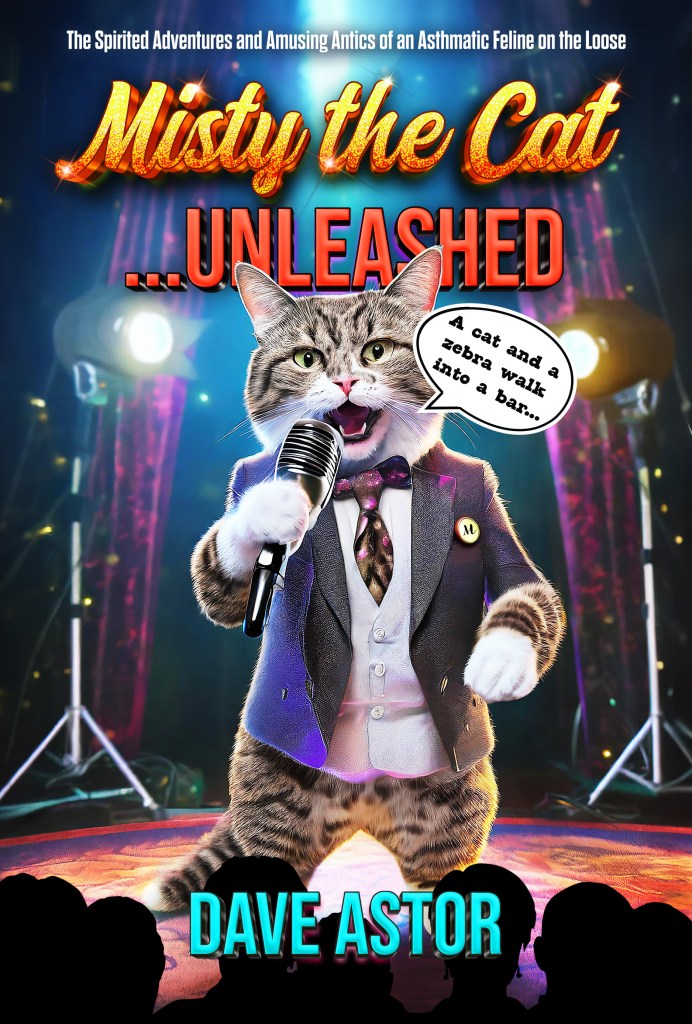
My comedic 2024 book — the part-factual/part-fictional/not-a-children’s-work Misty the Cat…Unleashed — is described and can be purchased on Amazon in paperback or on Kindle. It’s feline-narrated! (And Amazon reviews are welcome. 🙂 )
This 90-second promo video for the book features a talking cat: 🙂
I’m also the author of a 2017 literary-trivia book…

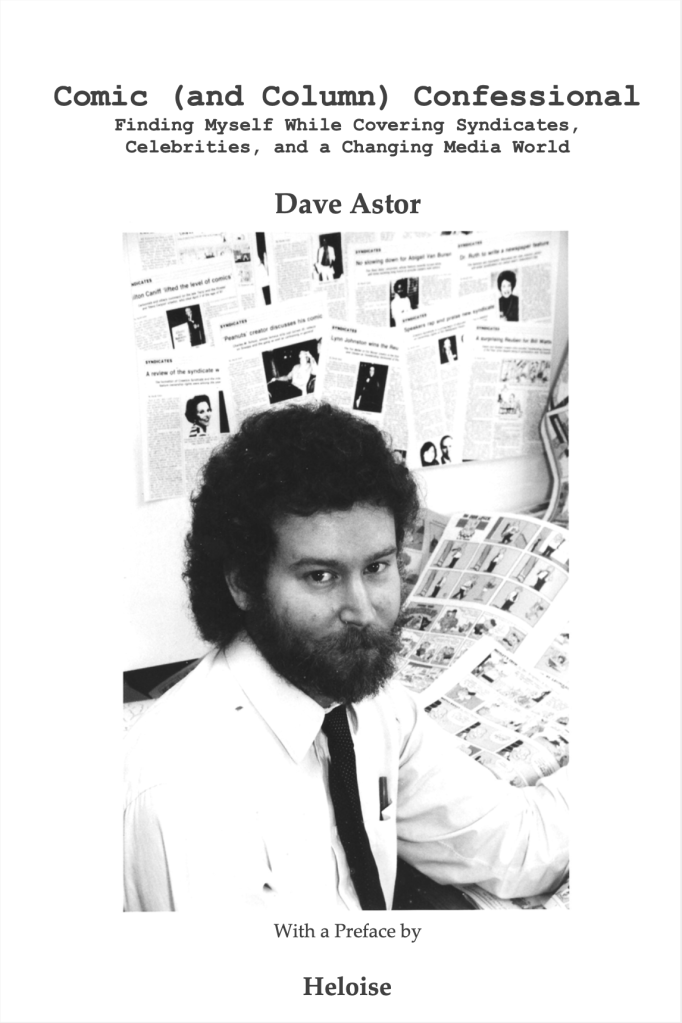
…and a 2012 memoir that focuses on cartooning and more, including many encounters with celebrities.
In addition to this weekly blog, I write the 2003-started/award-winning “Montclairvoyant” topical-humor column every Thursday for Montclair Local. The latest piece — which contains a tale of two meetings — is here.
 Dave Astor on Literature
Why do lawyers write courtroom dramas, MD’s write medical thrillers, Librarians take a library as center point around which their plot develops, ex-soldiers write military fiction? Because they’re hesitant to leave familiar grounds. The true challenge for a writer is to develop an angle on a subject that has his interest but lays outside the scope of his acquired professional luggage. And to weave some interesting, compelling, and well written prose from it. It’s called “widening your horizon” and to stop being self-absorbed. Maybe I’m overreacting a little bit on this subject, but I’ve really got it with all those wannabe writers who want to start out a literary career by writing an autobiography. I have little sympathy for Knausgaard who smeared out all the details of his personal life (including those of his family and friends) over six volume (called something like “Mein Kampf”) and who ended up with a divorce, family feuds, and a couple of libel law suits. If it takes that to become a literary sensation, I pass.
LikeLiked by 1 person
Thank you, Shaharee! Great observation about people in certain fields often writing novels “set” in those fields. Which makes it especially interesting when someone like, say, John Grisham, writes a novel that’s not a legal thriller. I can definitely see authors focusing their first or second novels on “what they know,” but it’s nice when they widen their horizons in at least some books after that.
LikeLike
Howdy, Dave!
— Your thoughts about, and examples of, this topic? —
Examples are easy. They include these fruits of varying vintages:
— Pierre Boulle’s The Bridge Over the River Kwai,
— Richard Brautigan’s So the Wind Won’t Blow It All Away,
— Ernest Hemingway’s The Sun Also Rises,
— Jack Kerouac’s The Dharma Bums* and
— Jerzy Kosinski’s The Hermit of 69th Street.
Thoughts are harder. For example, the first thing I think whenever I think of The Hermit of 69th Street is: “I think this thing is the longest suicide note in the history of the world.”
It breaks your heart.
Happy New Year, anyway.
J.J. McGrath (Alias MugRuith1)
*On the Road is great; The Dharma Bums is greater.
LikeLiked by 1 person
Thank you, J.J., for that excellent list! I just put “The Darma Bums” on my list, if my local library has it. “The Hermit of 69th Street” sounds very intense. “The Bridge Over the River Kwai” — one of those novels better known for its movie version! I wasn’t a huge fan of “The Sun Also Rises,” but did love Hemingway’s later “For Whom the Bell Tolls.”
LikeLike
— Thank you, J.J., for that excellent list! —
Ditto! And yours is a wee bit more fulsome than mine! I do not play the New Year’s Resolutions game, but I do hope to read Joseph Heller’s Portrait of an Artist, as an Old Man in the semiautobiographical area during the next 12 months.
— I just put “The Dharma Bums” on my list, if my local library has it. —
Nice!
— “The Hermit of 69th Street” sounds very intense. —
Indeed. With footnotes. Can you imagine Being There with footnotes?
— “The Bridge Over the River Kwai” — one of those novels better known for its movie version! —
As a committed whistler in my eighth decade, I do appreciate that film’s theme song. Alec Guinness, Sessue Hayakawa and William Holden all are pretty good, too.
— I wasn’t a huge fan of “The Sun Also Rises,” but did love Hemingway’s later “For Whom the Bell Tolls.” —
Sounds about right . . .
LikeLiked by 1 person
Thanks for the follow-up comment, J.J.!
I had no idea Joseph Heller wrote a book of that title.
Footnotes in a novel? (The Hermit of 69th Street.) Unusual. Shades of Junot Diaz’s The Brief Wondrous Life of Oscar Wao.
Wishing you a great 2026!
LikeLike
— I had no idea Joseph Heller wrote a book of that title. —
Portrait of an Artist, as an Old Man was published posthumously in 2000, so we were most likely distracted by the cacophony of the Dot-Com Crash as it reverberated throughout Silicon Alley and points south.
— Footnotes in a novel? (The Hermit of 69th Street.) Unusual. —
If Jorge Luis Borges employs footnotes in a short story, then Borges is just being Borges. If Jerzy Kosinski employs footnotes in a novel, then something is rotten in the state of Poland. Personally, I read Kosinski’s extensive use of them in The Hermit of 69th Street as a preemptive strike against anyone who might accuse him of plagiarism — again. Palpable is the paranoia permeating the piece.
— Shades of Junot Diaz’s The Brief Wondrous Life of Oscar Wao. —
Thanks again for recommending that one (either here or at the Huffy Post)! Happily, I read Diaz’s footnotes not as Kosinskiesque but as Borgesian. ¡Ningún problema!
— Wishing you a great 2026! —
Ditto!
LikeLiked by 1 person
Yes, many things on one’s mind in 2000.
Interesting what Jerzy Kosinski’s motives might have been.
Borgesian and Dominican Republican. 🙂
LikeLike
Happy impending New Year, Dave!
So, you mentioned Bukowski. I believe his book Ham on Rye is semi autobiographical.
Fear and Loathing (Hunter Thompson) is also semi autobiographical.
Let’s not forget David Copperfield by the great Dickens, and Portrait of the Artist as a Young Man by James Joyce!
HNY!! 🥳🕊🥂
LikeLiked by 1 person
Thank you, Resa, for all those excellent examples! As indicated by your Charles Bukowski mention, some authors definitely wrote more than one semi-autobiographical book during their careers.
Happy New Year to you, too!
LikeLiked by 1 person
Yes, some people have more than one person story to lean on. Dickens is another example of that. 🥳
LikeLiked by 1 person
True about Dickens, Resa!
LikeLiked by 1 person
We learn a lot of honest history of his time and place, from his stories. It’s an example of how factual fiction can be.
LikeLiked by 1 person
Yes! Dickens was finely attuned to things like poverty, having experienced that himself as a child.
LikeLiked by 1 person
Hi Dave, it is interesting how many authors write books which include elements of their lives. I’ve read a few of the books you’ve mentioned here but I’m struggling to think of examples. Boy: Stories of Childhood by Roald Dahl is autobiographical. Commando by South African Denys Reitz is also largely autobiographical. All Quiet on the Western Front is semi autobiographical. Rider Haggard’s books also included experiences from his life. I can’t think of others at the moment.
LikeLiked by 2 people
Thank you, Robbie! I appreciate those examples of semi-autobiographical works! Remarque’s WWI experiences as a soldier and his WWII experiences as a German exile certainly had an impact on several of his novels. Re H. Rider Haggard, I’m thinking of his “She” novel and assuming he never met a 2,000-year-old woman in real life. But who knows? 🙂
LikeLiked by 2 people
Haha, no he didn’t but he experienced life in various parts of Africa so those are the parts that are from his own experiences and are realistic and detailed. king Solomon’s mines is the same. The setting is very realistic.
LikeLiked by 1 person
Definitely, Robbie! When reading “She,” it was clear that Haggard knew Africa well.
LikeLiked by 1 person
🧡
LikeLiked by 1 person
🙂
LikeLiked by 1 person
I want to try this! I wrote a memoir and it’s great for people who really like memoirs, but I think sometimes it’s more powerful if you write it in story format. They will see the story for what it is rather than seeing it as the author telling their story.
Like Louisa May Alcott’s Little Women which is an autobiography.
LikeLiked by 1 person
Thank you, Sara! When you’ve written a memoir and written novels, as you’ve done, a semi-autobiographical novel sounds like a good “genre” to try next. 🙂 And, yes, a story format is a compelling format.
I read “Little Women” many years ago, and somehow didn’t know how semi-autobiographical it was until I was researching this blog post. 🙂
LikeLiked by 1 person
Nice haha! It is interesting to know if a story was semi autobiographical. I’m curious about the one written by Mary Shelley, too! She ran with some wild creative people.
LikeLiked by 1 person
That is indeed interesting, Sara!
Mary Shelley’s “The Last Man” is very compelling — and is actually set in the late 21st century. The character inspired by Shelley is a male in the novel, but he’s a gender-switched version of the author. I found the book to be as good as Shelley’s earlier “Frankenstein.” Yes, she was part of an amazing circle of creative people.
LikeLiked by 1 person
That is so cool! I’d like to read it since she seemed so interesting. Frankenstein is such a sad story and it makes you imagine the Gothic conditions of that time period. It would be cool to read about the male switch of herself.
LikeLiked by 1 person
Mary Shelley’s writing was indeed often sad — influenced by her difficult life (including the early deaths of her husband and three of her four children 😦 ).
LikeLiked by 1 person
Yes very disturbing! I saw he passed in his late 20s and she lost all her children. I can see where some of those themes come from in Frankenstein.
LikeLiked by 1 person
*three of her children
LikeLiked by 1 person
Yes, childhood mortality could be awful back then, and Percy Bysshe Shelley’s death was kind of a fluke (boat sinking). 😦
LikeLiked by 1 person
I didn’t realize that is how he died! Wow. That’s terrible. I thought it was from alcohol poisoning. I was wrong about that.
LikeLiked by 1 person
Either is a terrible way to go.
LikeLiked by 1 person
Very true.
LikeLiked by 1 person
Please, accept my profound gratitude for the invaluable resources.
LikeLiked by 2 people
You’re welcome — and thank you for the kind comment! 🙂
LikeLike
Interesting isn’t it? I believe quite a number of authors would write about themselves, even though it might be unconsciously. Or maybe using other people whom you know, but using them in a slightly different way. I certainly have done that. Anyway, just a thought.
Saying ‘hi’ to Misty, you’re a very good author, we all know that… more about what’s going on soon, I imagine. So, Happy New Year – there will be a ‘bong’ twelve times – will you be able to see that?
LikeLiked by 1 person
Thank you, Chris! I agree! Authors can place semi-autobiographical elements in their writing subconsciously, and many use disguised or somewhat-disguised people they know as characters.
Misty appreciates the kind praise, and, as I also mentioned in another reply here (to Dan Antion), Misty will watch the New Year’s Eve ball drop in Times Square and then swat it, which is not easy to do through a TV screen…
Happy New Year, too, to you and yours — including Luna the cat! 🙂
LikeLiked by 1 person
A big grin for the end of the year, and a lovely new one will appear. I wonder if me and my Luna will be able to stay up until 12 o’clock?
LikeLiked by 1 person
Staying up until midnight is worth the attempt. 🙂 I don’t always quite make it myself, but Misty has done it. 🙂
LikeLiked by 1 person
Hi Dave!
This is a very interesting post! I tend to find that if a novel is semi-autobiographical it seems to have a stronger impact! I’m not sure if that makes any sense!!! ☺ The book feels more authentic.
As always, you have listed some great books, although I have not read any of them!! ‘To Kill A Mockingbird’ is certainly on my list, however.
Thanks Dave for giving me lots of books to think about over the holidays!!
With all good wishes,
Sharon
LikeLiked by 1 person
Thank you, Sharon! Many semi-autobiographical novels do have a pretty strong impact; I agree that they can feel more authentic. Of course, there are also many great novels that don’t have a lot of autobiographical elements. 🙂
You’re in for a treat (and heartache) if you end up reading “To Kill a Mockingbird.” Definitely deserves to be the classic that it is.
Holidays and thinking about books is a nice combination. 🙂
LikeLiked by 1 person
Hi Dave!
Thank you for your reply! I agree! Good fiction doesn’t have to be semi-autobiographical to be a great read! And as we both know, there are so many good books out there! 😊
Heartache?! ‘To Kill A Mockingbird’!! I’m groaning right now Dave!!! I’ll let you know if get around to reading it.😬
One thing about the winter and the holidays, it makes you want to curl up and read good books!!
Thanks again, Dave.
Sharon
LikeLiked by 1 person
Thanks for your follow-up comment, Sharon!
Well, “To Kill a Mockingbird” is both heartache-inducing and very inspiring. Not a total downer, but it’s pretty direct about racism in the 1930s American South.
Yes! Reading a novel during a cold winter day is not a bad thing at all. 🙂
LikeLiked by 1 person
You are welcome, Dave!
Thank you for all your feedback! Very appreciated!
Wishing you a wonderful day!
With best wishes for a Happy New Year! 🙋
LikeLiked by 1 person
You’re welcome, Sharon, and thank you! Wishing you a great week and a Happy New Year, too!
LikeLiked by 1 person
Thank you! ☺
LikeLiked by 1 person
🙂
LikeLiked by 1 person
Look Homeward Angel by Wolfe and Prince Of Tides by Conroy. I’m sure there are quite a few novels by other authors; however, I got stuck in the south and I can’t get out. Yikes. Happy Holidays to you and yours Dave. Susi
LikeLiked by 1 person
Thank you, Susi! Two excellent examples! And getting “stuck in the south” — 😂 — is not a bad thing, especially given that it’s warmer than the north in late December. 🙂
Happy Holidays to you and yours, too!
LikeLike
I’ve noticed writing that draws on the author’s lived experience is more authentic than purely fictional writing. It’s inevitable that we writers incorporate elements from our own lives into our invented stories. The trick is to create an engaging plot enhanced by personal experience, even when we don’t cross the line into autobiographical fiction.
Think about the future academics who will write theses and articles about which parts of our books are based on our real lives. (Assuming we achieve posthumous fame, of course!) 😀
LikeLiked by 2 people
Thank you, Audrey! It makes total sense that an author’s lived experience is more authentic than purely fictional writing, and melding the two together as seamlessly as possible can obviously have very nice results.
And, yes, studying how much of a novel is semi-autobiographical is catnip for literary scholars. 🙂
LikeLiked by 1 person
Such an interesting topic, and I suspect that many authors’ books are semi-autobiographical, but they just don’t make that fact widely known. I believe that many of Adriana Trigiani’s novels are semi-autobiographical, in that they are based on family stories.
LikeLiked by 1 person
Thank you, Becky! I think you’re right to suspect that many novels have semi-autobiographical elements even if that’s often not known. And I appreciate the mention of Adriana Trigiani, who I haven’t read. Looked for info on her online, and can see that she’s a very prolific author!
LikeLiked by 1 person
Yes, very pleasant reading! Her Big Stone Gap series is based on where she grew up in Virginia. Her other books are based on family stories.
LikeLiked by 1 person
Sounds excellent, Becky!
LikeLiked by 1 person
Great topic, a comprehensive list and some good chatter, Dave. You picked off the ones I thought I might add, but I enjoyed thinking about the ones I hadn’t thought of (and the ones I haven’t read). I hope Misty has New Year’s Eve plans figure out.
LikeLiked by 2 people
Thank you, Dan! Definitely lots of semi-autobiographical novels, and I was glad to see many mentioned in the comments section. 🙂
Ha! 😂 (Misty’s New Year’s Eve plans.) He’ll watch the ball drop in Times Square and then swat it. Not easy to do through a TV screen…
LikeLiked by 2 people
Excellent post Dave. i need to go away and think re this, seeing as you’ve pinched all the best ones!!! Apart from the book written about a certain cat…..Misty I think the name is. Of course we know Misty really wrote it…ahem..
LikeLiked by 2 people
Thank you, Shehanne! I did name too many novels. 🙂
Ha! 😂 Your Misty mention. 🙂 He was originally going to name his part-fiction memoir “A Cat Tree Grows in Brooklyn,” but his combination perch/scratch pole was not manufactured there…
LikeLiked by 1 person
Nah you never named too many, It is a great post. Since |I can’t think of any to add to the discussiion what I will say is I think that probably most writers bring something, a memory, a person, a place, a whatever, to a story. It is not semi autobiographical like the ones you’ve mentioned but there’s bits of themselves that they do bring.
LikeLiked by 2 people
You’re absolutely right, Shehanne, that even when novels are not semi-autobiographical per se all of them have some direct or indirect parts of the authors brought to them. After all, the content is of course emerging from the authors’ brains and keyboarding fingers.
LikeLiked by 2 people
What a terrific, generous list, Dave—and beautifully framed. You capture exactly why semi-autobiographical novels resonate so deeply: that alchemy of lived emotion and crafted story. The Cat’s Table is a perfect recent example, and I love how you connect it back to that idea of memory shaped into meaning.
One that comes to mind for me is Karl Ove Knausgård’s My Struggle (blurring the line almost beyond recognition), and on a quieter note, Elena Ferrante’s Neapolitan novels, which feel intensely personal even as they resist clear autobiography. These books often linger longest because, as you say, the authors have truly lived the feelings—and we sense it on every page.
Many thanks, dear Dave for always sharing such insightful posts. 😃💕
LikeLiked by 2 people
Thank you, Carolyn! Glad you liked the post — and I appreciate your comment and the examples in it! Plus the elegantly expressed line “that alchemy of lived emotion and crafted story” and your description of Elena Ferrante’s Neapolitan novels as “intensely personal even as they resist clear autobiography.” I’ve only read one Ferrante book: the pre-Neapolitan “The Lost Daughter.”
LikeLiked by 1 person
Thank you, Dave! That idea of lived experience transforming on the page is very close to my heart; in Molly Marple Mystery, I drew on many of my own experiences and let them evolve into story. The Lost Daughter is such a haunting entry point to Ferrante — intimate and elusive all at once. Your post was a joy to read.
LikeLiked by 2 people
Continuing to draw on at least some of your own experiences when moving from memoir to novel seems like a wise thing to have done, Carolyn. 🙂
I might need to read more Elena Ferrante…
LikeLiked by 1 person
A great topic as usual Dave; I must have read at least half of the books you mention above, and the other half I’ll get to. ‘Go Tell It On the Mountain’ has been on my list for a while; time I did something about that. Off the top of my head I can think of ‘Big Brother’ by our favourite, Lionel Shriver, and Orwell’s ‘Down and Out in Paris and London’, which I read a very long time ago. Aside from those I’ll have to sleep on it and see what I can come up with. In common with many other authors I weave incidents from my own life into my writing, which as you note can serve as therapy. Many thanks for the post and if I think of any more I’ll be back. 🙂
LikeLiked by 1 person
Thank you, Laura! Great that you weave autobiographical content into your books, as many authors do.
“Go Tell It on the Mountain” is an excellent (debut) novel, and “Big Brother” is of course memorable — complete with that surprise ending we’ve previously discussed. I haven’t read the Orwell book you mentioned.
LikeLiked by 1 person
It was his first full-length book, and he actually went and lived in both places in the manner of a homeless person. It’s usually described as semi-autobiographical, I think because he wasn’t living that way all the time. Rather he’d go of on a ‘tramping’ journey for a while, then go back to normal, then off on a tramp again – but the book reads like a continuous action. It’s a long time since I read it, but it’s Orwell going all the way in realistic research.
LikeLiked by 1 person
Thanks for that interesting information, Laura! Orwell was often on “the front lines,” and is always worth reading.
LikeLiked by 1 person
I think Rebecca makes a good point that fiction can carry emotional truths that feel lived rather than invented, even when the plot of the novel is not autobiographical.
LikeLiked by 2 people
Thank you, Liz! I agree about Rebecca’s excellent point. A skilled author can definitely do that.
LikeLiked by 2 people
You’re welcome, Dave!
LikeLiked by 1 person
🙂
LikeLiked by 1 person
Another wonderful topic, Dave. I always appreciate how your posts open doors to reflection rather than closing them with conclusions. Your discussion made me think of Lucy Maud Montgomery, who drew deeply from her lived experience without ever writing straight autobiography. Emily of New Moon in particular feels like a quietly personal work and not a record of events, but an expression of an inner life shaped by place, imagination, loss, and the longing to write. Even Anne of Green Gables, though not autobiographical in circumstance, carries emotional truths that feel lived rather than invented.
What stays with me about semi-autobiographical novels is not the accuracy of facts, but the authenticity of feeling. When writers reshape their own experiences into story, they often give us something truer than memoir. A way of understanding how a life felt rather than simply how it unfolded. And of course, I have to leave one of my most favourite LMM quotes: Isn’t it nice to think that tomorrow is a new day with no mistakes in it yet?” Looking forward to many conversations waiting for us in 2026!!!
LikeLiked by 4 people
Thank you, Rebecca! L.M. Montgomery’s three “Emily” novels offer a perfect blend of fact and fiction. A reader can tell that the books are partly based on “lived experience,” as you note. And, yes, novels such as “Anne of Green Gables” can feel a little autobiographical even if they’re not quite. For one thing, I’m sure Montgomery was quite a brainy, precocious teen in her time — as was Anne Shirley.
Your comment’s two paragraphs are both eloquent and I love that Montgomery quote you cited! I can just picture Anne saying it. 🙂
LikeLiked by 3 people
Wow! Love this post, Dave! An author friend introduced me recently to the term “auto fiction” – autobiographical fiction – a term I’d never heard before but you’ve provided excellent examples. Always learning from you. Many thanks! 🥰
LikeLiked by 2 people
Thank you, Vicki! I had never heard of the term “auto fiction,” either, until seeing your comment. It’s definitely a more compact phrase than “semi-autobiographical fiction,” and I assume few people would think “auto fiction” is about cars. 🙂
LikeLiked by 2 people
That was my first thought, too! Stories about cars! Maybe it’s just a trendy title — passing fancy? Your post is a keeper, Dave. Thank you again. 🥰
LikeLiked by 2 people
Yes, Vicki, that term does have a trendy feel to it.
And now I’m thinking that “On the Road” is both “auto fiction” and “semi-autobiographical fiction.” 🙂 🚗
I appreciate your follow-up comment!
LikeLiked by 2 people
LOL — indeed. Good example! 😉😉😉
LikeLiked by 2 people
🙂
LikeLiked by 1 person
Louis Golding’s Magnolia Street, partly because, with one of my cousins, i’m working on a handwritten memoir of 1930 – 39, describing life during the Depression – Unlike Golding’s opposite sides of Magnolia street, the Judaeo-Christian, UK born or European refugees of our family’s neighbourhood lived next door to each other. Other side of the family lived in Leeds.
Chilling, intense, unforgettable, Frost in May is an autobiographical novel in which the nuns of the convent school to which nine year old ‘ convert’ Nanda is sent to know that they must break her will. ‘No character is any good in this world unless that will has been broken completely. ‘
According to the author, Antonia White, the nuns of the Convent of the Five Wounds – near London, did their best to break hers.
LikeLiked by 2 people
Thank you, Esther, for those really interesting examples! The memoir you’re working on sounds fascinating, and “Frost in May” indeed sounds chilling. Some aspects of organized religion are very disturbing. 😦
LikeLiked by 1 person
I’ve read some of the semi-autobiographical novels that you’ve mentioned. I agree that they can be very heartfelt stories. My semi-autobiographical, second novel was, indeed, therapeutic as well as self-revelatory for me, especially as it covered a period of my life that I had buried until then. I cannot speak for other authors of the genre, but I found it challenging to write since I had to create characters that were far removed from the real-life individuals and who could not be easily identified to avoid any controversy.
LikeLiked by 2 people
Thank you, Rosaliene! I hear you; in a way writing a semi-autobiographical novel is easier, because the material is so well known to the author, but in a way it can be harder because one has to disguise some of the material — as you note. And, as you also note, writing a semi-autobiographical novel can be self-revelatory and therapeutic — even as it also can be traumatic to relive certain memories.
LikeLiked by 2 people
Your closing remarks are so true, Dave.
LikeLiked by 1 person
Thank you, Rosaliene!
LikeLiked by 1 person
I think a semi-autobiographical novel is a helpful way to start writing.
LikeLiked by 2 people
Thank you, Luisa! It does seem like a very good approach to take with a first novel. 🙂
LikeLiked by 2 people
You’re more than welcome, dear Dave!
It’s always my pleasure
LikeLiked by 2 people
Many thanks again, Luisa! 🙂
LikeLiked by 2 people
Thank you to Darlene Foster for recommending Michael Ondaatje! (I had only read his “The English Patient” a number of years ago.)
LikeLiked by 3 people
I’m pleased you read and enjoyed another of his books. I really enjoyed his memoir Running in the Family too. https://www.goodreads.com/book/show/5941.Running_in_the_Family Thanks for the great list of semi -autobiographical books. I think many authors use some parts of their lives in their books, I know I do.
LikeLiked by 4 people
Thank you for the comment, Darlene! I thought “The Cat’s Table” was really good, and am now reading Ondaajte’s “Warlight” novel (quite intriguing so far). I’m not surprised that his “Running in the Family” memoir is excellent as well! And, yes, many authors use some parts of their lives in their books — whether deliberately or subconsciously. 🙂
LikeLiked by 4 people
I haven’t read Warlight yet. Must put it on the TBR list.
LikeLiked by 3 people
I randomly chose a couple of his books during my last library visit. 🙂
LikeLiked by 3 people