Last week, I wrote about some of literature’s comedic or part-comedic novels. This week, I’ll flip that to discuss some of the saddest novels. Given that I covered this topic in a post eight years ago, I’ll focus on novels I’ve read since then — whether those books were published before or after 2018.
Of course, sad novels are not always 100% bleak; they perhaps contain some happier moments and/or semi-optimistic endings. But they’re downbeat overall.
Kristin Hannah’s excellent fiction can certainly leave a reader shaken. For instance, her 1970s-set novel The Great Alone (2018) is a depressing look at a Vietnam War veteran living in the Alaskan wilderness and how his post-traumatic stress wreaks havoc on himself, his wife, and their teen daughter.
Elin Hilderbrand’s also-excellent fiction is considered somewhat “lighter” than Hannah’s, but she does often wrestle with major personal and societal issues. One of Hilderbrand’s more melancholy novels is 28 Summers (2020), about a cancer-stricken woman who had a longtime one-weekend-a-year affair with her soulmate while she and him lived separate family lives the rest of the time. A superb book amid the sorrow.
In-between the two above novels arrived Colson Whitehead’s partly 1960s-set The Nickel Boys (2019), a heartbreaking look at abuse in a Florida reform school and at racism in general. Whitehead’s earlier The Underground Railroad (2016) — which unfolds in 19th-century slavery times — is another very good novel that will leave readers morose. Both Whitehead books won the Pulitzer Prize for fiction.
Barbara Kingsolver’s later Pulitzer winner Demon Copperhead isn’t all dispiriting, but the scourge of opioid addiction and the poverty depicted in the 2022 novel leave readers dejected even as they’re impressed with the author’s modern reimagining of Charles Dickens’ David Copperfield.
Moving to some older novels I’ve read since 2018, we have Michael Crichton’s 1990 sci-fi thriller Jurassic Park in which the hubris of using DNA to recreate living dinosaurs in the 20th century results in lots of destruction by those out-of-their-element dinos.
Twenty-five years earlier, there was John Edward Williams’ 1965 Stoner novel about a farm-raised boy who becomes an English professor but lives a personal life marked by an unhappy marriage and other disappointments. Again, a really good novel amid the sorrow.
Another 1965 release was James Leo Herlihy’s Midnight Cowboy (better known for the 1969 movie adaptation) about a naive Texan’s odyssey in New York City and the discouraging experiences of he and his down-and-out, ill-fated friend.
In 1957 came Nevil Shute’s On the Beach, about Australians waiting to die from a deadly wave of nuclear war-caused radiation heading their way. Almost any apocalyptic/dystopian novel would be eligible for this post.
Thomas Mann’s Death in Venice (1912) is exquisitely written and set in one of the most beautiful cities on the planet, but the plot is full of unrequited obsession — and then comes the cholera outbreak.
In 1833, Alexander Pushkin’s novel-in-verse Eugene Onegin was published after appearing in serial form between 1825 and 1832. A depressingly brilliant work filled with boredom, arrogance, selfishness, an ill-fated duel, a missed romantic opportunity, and more.
Among the sad novels I mentioned in my 2018 post were Andre Dubus III’s House of Sand and Fog (1999), Arundhati Roy’s The God of Small Things (1997), Toni Morrison’s Beloved (1987), Giuseppe Tomasi di Lampedusa’s The Leopard (1958), Erich Maria Remarque’s Spark of Life (1952), George Orwell’s Nineteen Eighty-Four (1949), Edith Wharton’s The House of Mirth (1905), Thomas Hardy’s Jude the Obscure (1895), Emile Zola’s Germinal (1885), George Eliot’s The Mill on the Floss (1860), Mary Shelley’s The Last Man (1826), and Sir Walter Scott’s The Bride of Lammermoor (1819).
Your thoughts on this post, and examples of sad novels you’ve read?
Misty the cat says: “I was gonna give Dave this tree for his birthday but it’s stuck in the ground.”
My comedic 2024 book — the part-factual/part-fictional/not-a-children’s-work Misty the Cat…Unleashed — is described and can be purchased on Amazon in paperback or on Kindle. It’s feline-narrated! (And Amazon reviews are welcome. 🙂 )
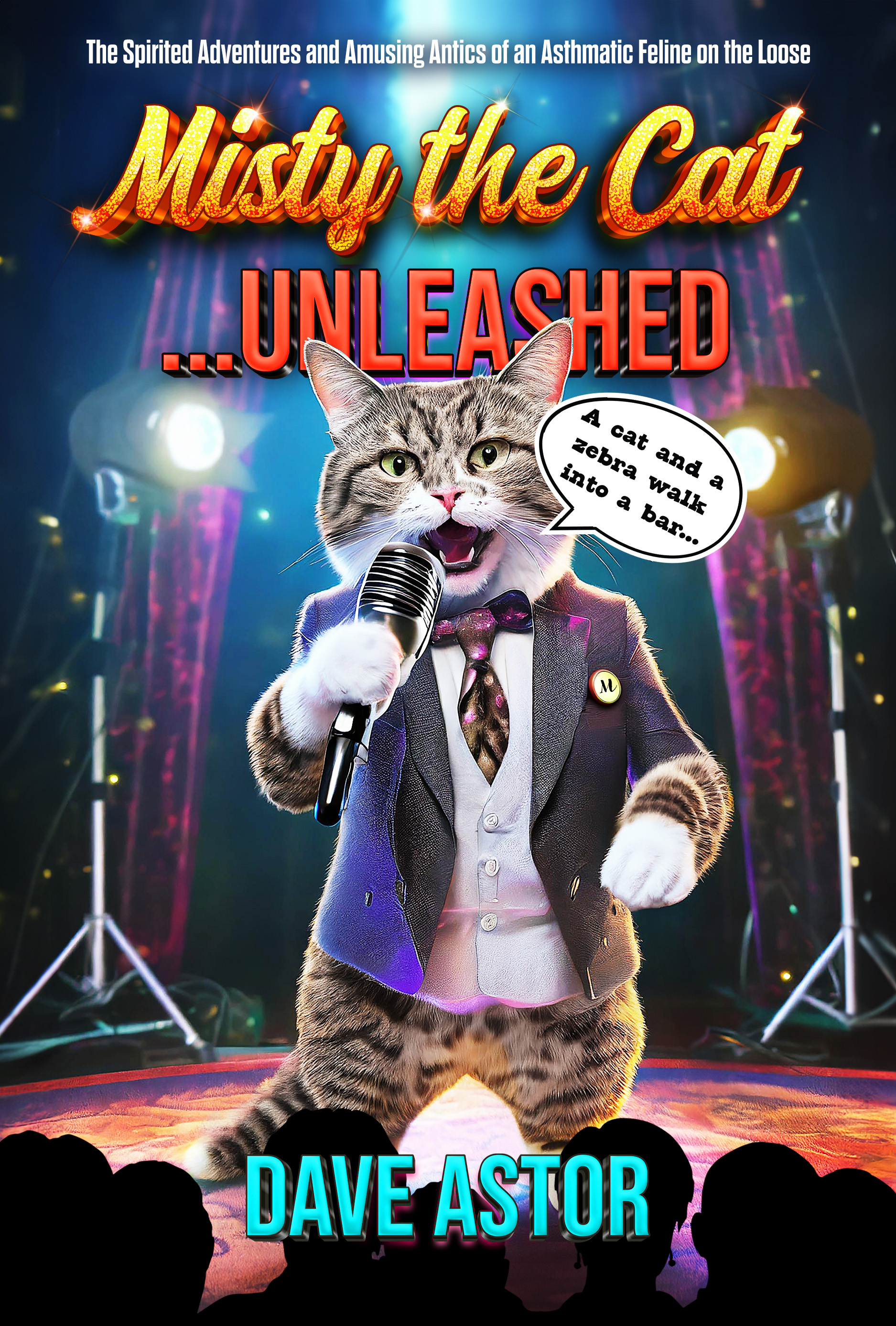
This 90-second promo video for the book features a talking cat: 🙂
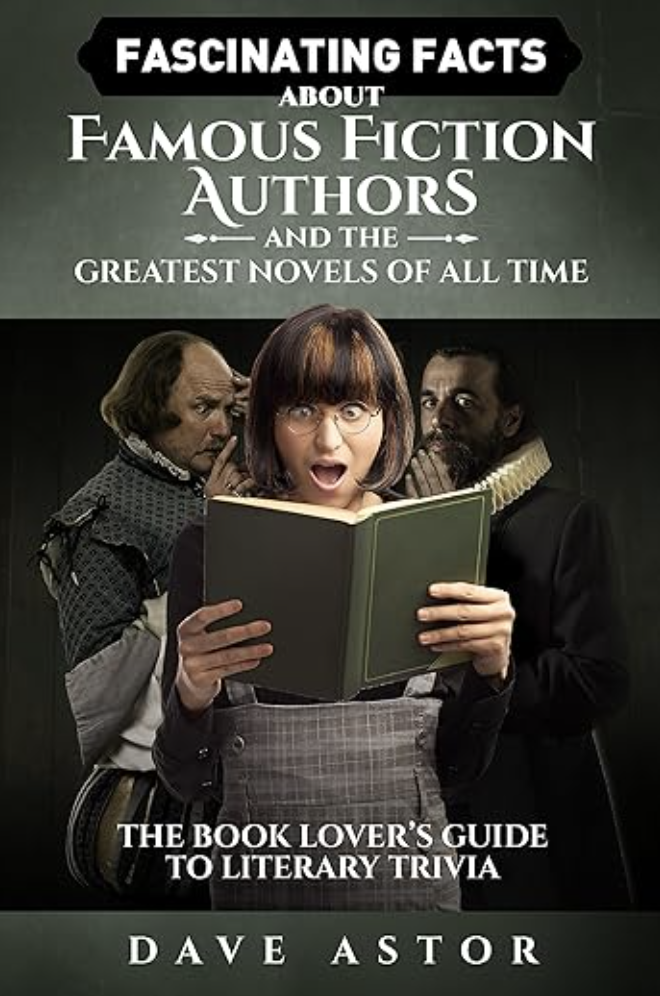
I’m also the author of a 2017 literary-trivia book…
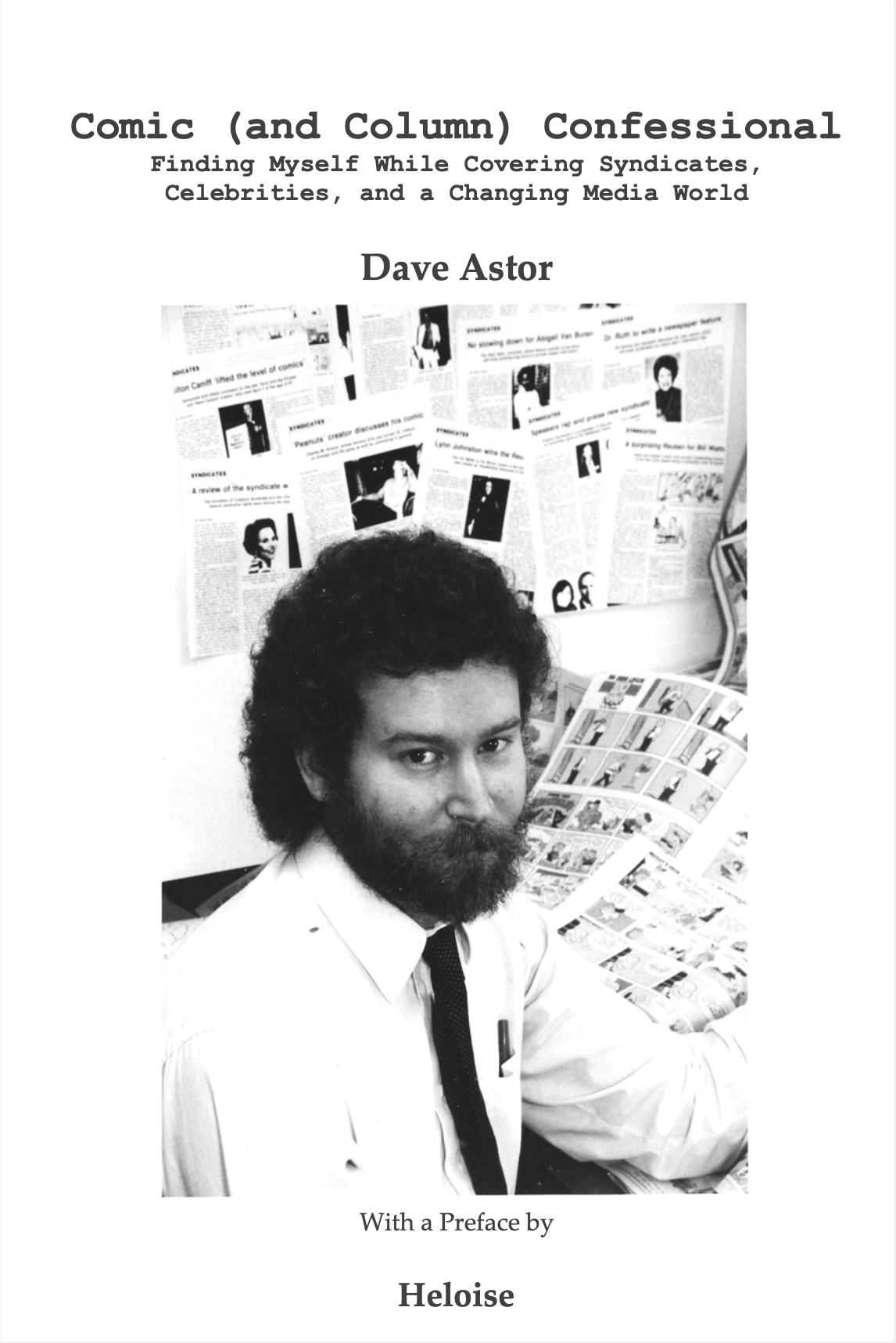
…and a 2012 memoir that focuses on cartooning and more, including many encounters with celebrities.
In addition to this weekly blog, I write the 2003-started/award-winning “Montclairvoyant” topical-humor column every Thursday for Montclair Local. The latest piece — about a VERY close budget referendum and a not-close but controversial development decision — is here.
 Dave Astor on Literature
When I was 13 or 14, my class was assigned OF MICE AND MEN. I had read books that made me cry because a beloved pet died (think of OLD YELLER), and I had cried through the scene in LITTLE WOMEN where Beth dies, but I was used to mainly happy endings. I could not believe how horribly sad OF MICE AND MEN was–I remember crying until my face was swollen. I still think it is one of the saddest books I have ever read, and I will never forget the shock it produced in me. It wasn’t just reading a sad book; it was realizing at quite a young age how completely unfair and tragic life was for many people.
LikeLike
Dave, among the books you’ve mentioned, I’ve read The Great Alone, Demon Copperhead, On the Beach, Beloved, and Nineteen Eighty-Four. I’ve also read My Sister’s Keeper, mentioned by Smitha. All memorable stories, long after closing the pages of the book. I’ve found that sad stories have an uncanny way of grabbing my attention and keeping me hooked to the end. Perhaps, it’s my yearning for a happy ending or redemption in the face of life’s trials.
LikeLike
“Midnight Cowboy” is one of my favorite books, Dave, and the ending was very sad! The disillusionment in that book was so relatable and eye-opening, too. As an aide, I’ll never think of a Florida orange juice sign in the same way again!
LikeLiked by 1 person
Thank you, Ada! You’re so right that the “Midnight Cowboy” ending is very sad (that bus ride to Florida 😦 ) — and most of the rest of the novel is not happy either. But, yes, a great book.
LikeLike
Thank you for yet again an excellent topic and post! I see that there are many sad books waiting for me to read. Though I have already read Stoner, and loved it.
LikeLiked by 1 person
Thank you, Thérèse! It’s a shame “Stoner” isn’t better known and more lauded. It’s a mesmerizing novel.
LikeLiked by 1 person
I’ll add some of these to my list, but I’ll add Margaret Laurence to yours. Her Stone Angel qualifies, but so do some of her other works. Maggie
LikeLiked by 1 person
Thank you, Maggie! I’ve never read Margaret Laurence, and just put her on my to-read list to give her work a try sometime this year. I appreciate the recommendation!
LikeLiked by 1 person
We just finished watching The Count of Monte Cristo on Masterpiece Theater. I read the book many years ago in high school. It’s sad because Edmond and Mercedes don’t end up together at the end. A lot of people dislike that ending. But at least he finds love with someone else.
LikeLiked by 1 person
Thank you, Marie! “The Count of Monte Cristo” — a fantastic novel — definitely has many sad elements: the thwarted romance you mentioned as well as the frame-up, the very long prison term, etc. Plus some more pleasing elements, including the Edmond Dantes/Abbe Faria prison friendship, the just retributions, etc.
LikeLiked by 1 person
Thanks for sharing this long list, which also touches on a crucial point: the best sad novels aren’t simple exercises in misery; they use pain to highlight our humanity, and the consequences of our choices.
Here are two of the tragic Italian novels I’ve read:
I Malavoglia by Giovanni Verga
The Garden of the Finzi-Contini by Giorgio Bassani
🌹🌹🌹I take this opportunity to wish you a Happy Birthday here too.🌹🌹🌹
LikeLiked by 1 person
Thank you, Luisa! I agree with your very wise words in your comment’s first paragraph. The better sad novels give us at least some inspiration and at least some thought-provoking content amid the misery.
I appreciate the two book examples, and the birthday wishes! 🙂
LikeLike
In addition to the list you mentioned are ‘Fault in our stars’ by John Greene, My Sister’s Keeper by Jodi Picoult, The Beekeeper of Aleppo, Lane and Able by Jeffrey Archer. These books made me cry… I didn’t realise I had read so many tragic books. I like to keep away from them because there’s enough tragedy around that’s thrown at you whether you like it or not.
LikeLiked by 1 person
Thank you, Smitha! I’ve read “The Fault in Our Stars” and “My Sister’s Keeper,” and I agree that they are both very sad. Severe medical problems in each novel, and one very much wonders about the morality of what the parents did to their younger daughter in Jodi Picoult’s book. Also, I totally understand your reluctance to read too many sad novels when there’s so many sad and infuriating things happening in real life. 😦
LikeLiked by 1 person
Yes, ‘My Sister’s Keeper’ was the saddest. I wept like a child when I read the book. I felt bad for both the sisters, their predicament, the parents. It was a catch – 22 situation.
LikeLiked by 1 person
So true, Smitha. No ideal choices. The older daughter was very ill and the parents were desperate and the poor younger daughter was sort of the “solution.” And then that added tragedy near the end of the novel. Certainly one of the most depressing 21st-century books out there. 😦
LikeLiked by 1 person
Hey Dave, great post. I found The Great Alone, Demon Copperhead, and House of Sand and Fog very memorable for this category. Jude the Obscure still awaits on my husband’s bookshelf. I will get to it eventually as I loved Hardy’s other novels.
LikeLiked by 1 person
Thank you, Jennifer! We are definitely in agreement about “The Great Alone,” “Demon Copperhead,” and “House of Sand and Fog” — all sad and all memorable.
Thomas Hardy IS a compelling novelist, and I think “Jude the Obscure” is one of his best.
LikeLiked by 1 person
So my husband says too!
LikeLiked by 1 person
Ah, two enthusiastic recommendations. 🙂
LikeLiked by 1 person
I’ll go with a classic: Madame Bovary. Of more recent vintage, I found The Vixen Amber Holloway by Carol LaHines very sad (although it’s billed as a black comedy).
LikeLiked by 1 person
Thank you, Liz! “Madame Bovary” is indeed a sad novel — written very well, of course. And I guess there can be a thin line between a book that’s a black comedy and a book that’s just plain downbeat, partly depending on how skillful the author is.
LikeLiked by 1 person
You’re welcome, Dave! In the case of The Vixen, very skillful!
LikeLiked by 1 person
Glad to hear that, Liz. I suppose that as skillful as an author might be, different readers might react to a black comedy novel as a black comedy novel — or not.
LikeLike
Many thanks, Dave, for your great sad books you presented here. As STONER by J. Williams was unputdownable for me and I even wrote a post about it, I went back to reread it and saw that the fact that Stoner didn’t fight for his beloved daughter made me most sad!
LikeLiked by 1 person
Thank you, Martina! “Stoner” is very melancholy yet very compelling. A novel written so well. The title character is definitely a flawed man — sympathetic in some ways, not in others.
LikeLiked by 1 person
:):)
LikeLiked by 1 person
🙂
LikeLike
One of the objectives of literary fiction is to show the human condition, so no wonder much of it is depressing.
Canadian literature (Canlit) is reputed to be especially grim, but I suspect this was common everywhere in the mid- to late 20th century.
One very well-written recent novel that shows resilience in a grim setting is The Weight of Snow and Regret by Elizabeth Gauffreau
LikeLiked by 1 person
Thank you, Audrey! Great point — literature is usually inspired by life, and life is often sad for many people.
I haven’t noticed Canadian fiction being grimmer than fiction from elsewhere, but who knows? Canada is definitely a country that does a lot less harm to other countries than the U.S. does.
And I appreciate you mentioning Liz and her great writing. Resilience in the face of sorrow is certainly to be admired.
LikeLike