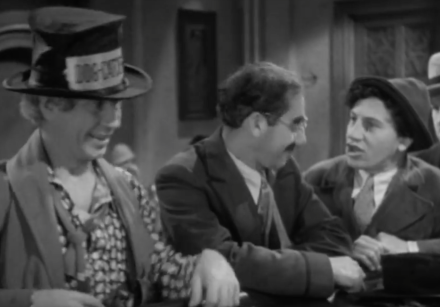
 In Marx Brothers movies, we have the talkative Groucho and Chico and the mute Harpo. “So it goes” with novels — there are some loquacious characters as well those who say little or nothing, though of course most are somewhere in between on the speaking scale.
When I think of chatty characters, the first one who comes to mind is the young Anne Shirley in L.M. Montgomery’s Anne of Green Gables. Her long, brainy, funny, descriptive, free-associative monologues are very endearing and memorable. Interestingly, Anne becomes less talkative as she grows older in that novel and in the various sequels; part of the reason is that she gains some confidence and is less insecure.
Also quite talkative is another young protagonist, Holden Caulfield of J.D. Salinger’s The Catcher in the Rye, though I would not call him endearing. Rather annoying, actually.
Some of literature’s loquacious adult characters?
In Charles Dickens’ Nicholas Nickleby, there’s the rarely-stops-talking Mrs. Nickleby — a well-meaning but silly person said to be partly based on the author’s mother. Also, Theo’s charismatic/kind-of-dangerous friend Boris in Donna Tartt’s The Goldfinch, the loyal/admirable Samwise Gamgee in J.R.R. Tolkien’s The Lord of the Rings, and the “religious” titular character in Sinclair Lewis’ Elmer Gantry (con men are usually big talkers). Many others, too.
Quieter characters? Among them are Matthew Cuthbert of the aforementioned Anne of Green Gables (making for quite a contrast between him and adopted daughter Anne) and the titular orphan character of Charlotte Bronte’s Jane Eyre (though the oft-beleaguered Jane can definitely say her piece at times, showing that shy characters are not always shy). Also, the gentle Beth March of Louisa May Alcott’s Little Women, the reclusive Boo Radley of Harper Lee’s To Kill a Mockingbird and the at first socially awkward Ireland-to-U.S. immigrant Eilis Lacey of Colm Toibin’s Brooklyn, to name just a few more.
Then there are characters who are nearly or completely mute, usually after experiencing or witnessing a traumatic event. For instance, the boy Ricky in John Grisham’s The Client becomes catatonic after seeing a suicide, and the boy Bernardo in Isabel Allende’s Zorro stops talking after witnessing his mother’s rape and murder. Also, in Maya Angelou’s novel-like autobiography I Know Why the Caged Bird Sings, she becomes mostly mute after being raped as a girl. Those kinds of characters clearly draw our sympathy for what they’ve been through.
Your favorite talkative or not-talkative people in fiction?
Here’s a clip with Groucho, Chico, and Harpo from the 1932 movie Horse Feathers. (A screen shot I took from the clip is above this blog post.)
I’ll be skipping a post next Sunday, November 24. Back on December 1!
My literary-trivia book is described and can be purchased here: Fascinating Facts About Famous Fiction Authors and the Greatest Novels of All Time.
In addition to this weekly blog, I write the award-winning “Montclairvoyant” topical-humor column for Baristanet.com. The latest weekly piece — which covers out-of-control development and rent control — is here.
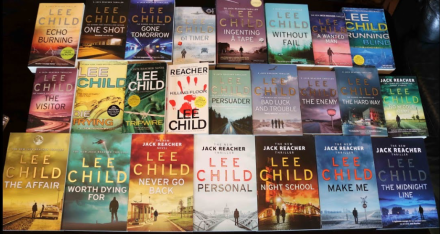 Some fiction authors are rather formulaic while others vary their approach with almost every novel — and I like both kinds of writers.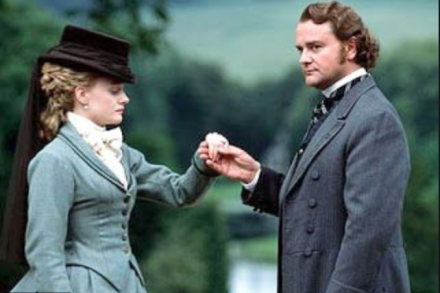
 One of the many jaw-dropping spectacles offered by the dumpster fire of the corrupt and incompetent Trump administration is seeing how low Rudy Giuliani (pictured above) can go.
 In the case of many novels, readers basically know the general parameters of what will happen. In the case of many other novels, the plot destination is a complete or near-complete unknown (unless a review or too-talkative friend gives things away 🙂 ). Either type of novel has the potential to be compelling.
 The first residents of what’s now the United States were Native Americans, but they haven’t often been first in the casts of novels. Still, there are a number of such characters, including more in recent years.
 Have you ever read just one novel by an author — her or his most famous work — but then waited years to read some of their other, lesser-known books?
 Last week, I listed my favorite novels published between 2010 and 2019. This week, I’ll go back a decade to rank my favorite novels with 2000-to-2009 releases. Don’t worry, there’ll be no list of 1990s fiction in next week’s post… 🙂
 As visitors to this blog know, I often write about novels that date back decades or centuries. But I also read some recent fiction, and thought I’d list my favorite novels published since 2010 — some literary, others mass-audience-oriented. Not necessarily the best novels of the past nine years (that’s so subjective anyway) but my personal favorites. Then I’ll ask for yours!
 While there are still a few months left in 2019, I thought I’d write a post about this year’s round-number anniversaries of some major novels I’ve read.
 Dave Astor on Literature