 Many well-known authors were almost exact contemporaries of other well-known authors. In some cases, that was just a meaningless coincidence. In other cases, they had some things in common.
I thought about this yesterday after FINALLY reading Johanna Spyri’s Heidi, which I greatly enjoyed. Then I tried to think of a blog topic that beloved 1881 book evoked, but I had seemingly written them all before. Novels starring children — check. Orphans in literature — check. (Mostly) upbeat fiction — check. Etc. So, out of desperation, I eventually came up with the similar-time-alive thing.
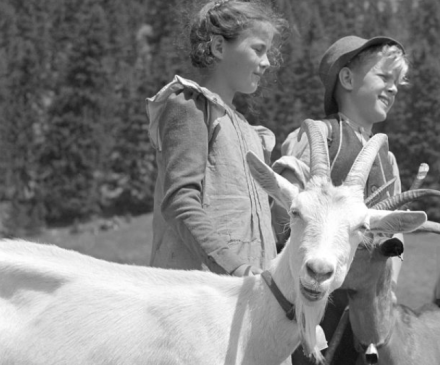
Spyri lived from 1827 to 1901, making her a somewhat-older contemporary of Mark Twain (1835-1910). Not much in common between a sort-of-famous writer (Spyri) and a VERY famous writer (the brilliant Twain). Heck, Heidi is a heartwarming novel — complete with its plucky protagonist and friendly goats (see above image) — while the often-funny/often-scathing Twain didn’t really “do” heartwarming. 🙂 But both authors created memorable young characters (of course Huck Finn and Tom Sawyer in Twain’s case), and Spyri’s home country of Switzerland was among the many places the U.S.-based Twain visited.
Having almost the same 19th-century birth and death years were George Eliot (1819-1880) and Fyodor Dostoyevsky (1821-1881). Both are among the very greatest novelists of all time, with their books’ many attributes including immense psychological insight. Dostoyevsky’s Crime and Punishment and Eliot’s Daniel Deronda are among my five favorite novels.
Mary Shelley (1797-1851) and Honore de Balzac (1799-1850) were near-contemporaries, too, but they didn’t have much in common I can think of other than both being extraordinary writers. One English, one French; one best-known for speculative fiction, the other best-known for naturalist fiction…
Also few similarities between French author Alexandre Dumas (1802-1870) and American author Nathaniel Hawthorne (1804-1864). The former is best known for his rousing adventure novels (that were also literary in their way), while the latter often focused on moral issues and the like in a more subtle fashion. (If they had somehow collaborated, I suppose “The House of the Seven Musketeers” might have resulted. 🙂 )
On the other hand, there were these exact contemporaries with a lot in common in their writing: Virginia Woolf (1882-1941) and James Joyce (also 1882-1941). Both are known for their modernist, nonlinear fiction — and they undoubtedly had some influence on each other’s work.
William Shakespeare (1564-1616) and Don Quixote author Miguel de Cervantes (1547-1616) died within days of each other, but Cervantes was obviously quite a bit older. Both are among literature’s most-iconic writers in different genres.
Gabriel Garcia Marquez (1927-2014) and Toni Morrison (1931-2019) both wrote multi-layered novels featuring memorable relationships and strong social-justice elements — relating to race, ethnicity, gender, class, etc. Also, both didn’t see their first novels published until they were around 40, with Marquez working as a journalist and Morrison as a book editor before that.
Ernest Hemingway (1899-1961) and John Steinbeck (1902-1968) were both 27 when their first novels appeared, and each mostly spotlighted male characters in their fiction — though Hemingway had a more macho/misogynist attitude. Together, they were married seven times (Hemingway four, Steinbeck three). Also, both did war reporting during their lives.
Science-fiction connections? Arthur C. Clarke (1917-2008) and Ray Bradbury (1920-2012) were approximate contemporaries. Frank Herbert (Dune) and Isaac Asimov were also born in 1920, but didn’t live nearly as long as Bradbury — Herbert until 1985 and Asimov until 1992.
Then there’s this trio born within a year of each other: Colette (1873-1954), Willa Cather (1873-1947), and L.M. Montgomery (1874-1942). The first two are known for adult fiction, the third mostly for young-adult fiction — though Montgomery also wrote excellent “grown-up” novels such as The Blue Castle. Montgomery and Colette could be very funny in their books; Cather much less so. Cather and Montgomery both wrote powerful World War I novels (One of Ours and Rilla of Ingleside) — illustrating that the time period when authors are alive can lead to similarly themed content. Cather was gay (something only obliquely referenced in her fiction) while Colette was bisexual (more directly referenced in some of her novels).
Any other authors you’d like to mention who were roughly contemporaries?
My literary-trivia book is described and can be purchased here: Fascinating Facts About Famous Fiction Authors and the Greatest Novels of All Time.
In addition to this weekly blog, I write the 2003-started, award-winning “Montclairvoyant” topical-humor column for Baristanet.com. The latest piece — about a controversial school principal incident and a supermarket that may or may not come to town — is here.
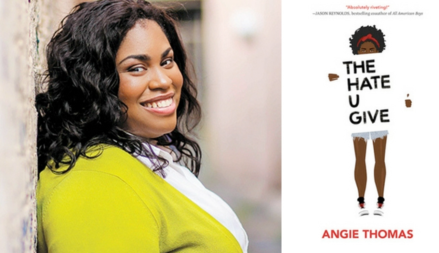 Have you ever read a novel you really like, but at the same time found it painful to read? Such is the case with The Hate U Give.
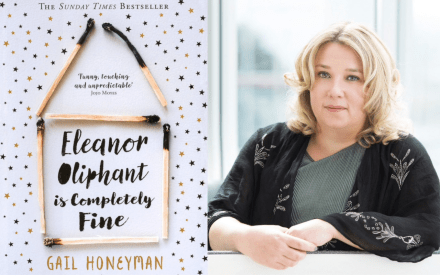 Some memorable couples in literature aren’t gorgeous, charismatic, socially adept, etc. That can be a good thing, because those couples seem more realistic, often evoke warm feelings, and perhaps have a better chance of staying together because there’s more than surface attraction.
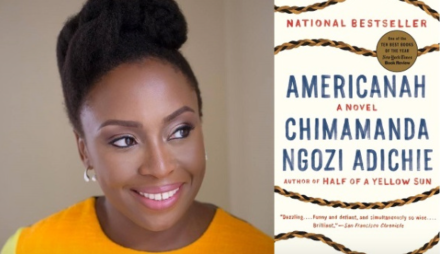 I was reminded once again of Africa’s rich literary tradition when I recently read…Americanah.
 When I read novels, themes for blog posts occur to me. So, after finishing Garth Stein’s The Art of Racing in the Rain last week, the logical theme would have been to write about memorable dogs in literature. But I already did that two weeks ago, which led to several commenters recommending I read…The Art of Racing in the Rain.
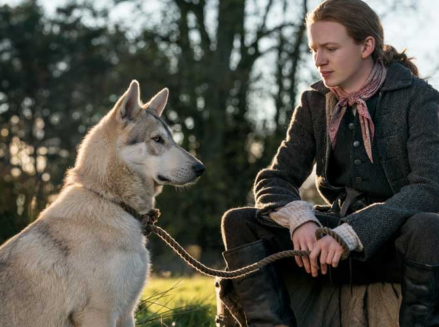 I’ve never lived with a dog, though I’ve gratefully shared my household with seven wonderful cats over the years. 🙂 I developed an appreciation of canines by meeting those who’ve lived with people I know and via…literature.
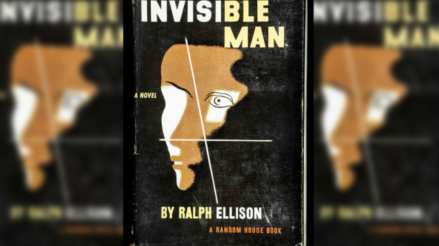 There have been countless protests around the world in recent weeks against the evils of racism and police brutality. Many of the admirable participants have been young people of all colors, providing hope for a future where…Black Lives Matter.
 Dave Astor on Literature