 It’s anniversary time again! With a month-plus of 2020 “in the books,” I’d like to mention some of my favorite (not necessarily the best) novels that were published in 1970, 1920, 1870, and various other years ending in that big ol’ round number of zero. And then you can tell me some of your favorites.
Let’s go chronologically backwards, shall we?
I already mentioned several novels published in 2010 and 2000 when I discussed my 2010-2019 faves last September in this post and my 2000-2009 faves a week later in this post, so I won’t repeat my brief summaries of those books here. Included were the 2010-released So Much for That by Lionel Shriver, 61 Hours by Lee Child, Freedom by Jonathan Franzen, and Three Stations by Martin Cruz Smith; and the 2000-released Harry Potter and the Goblet of Fire by J.K. Rowling, White Teeth by Zadie Smith, Prodigal Summer by Barbara Kingsolver, The Blind Assassin by Margaret Atwood, Winter Solstice by Rosamunde Pilcher, and The Amazing Adventures of Kavalier & Clay by Michael Chabon.
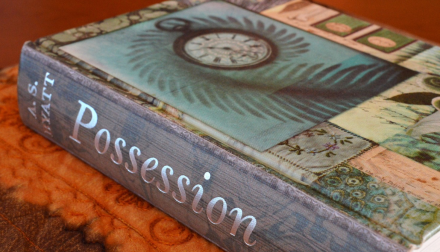
Anyway, on to (back to) 1990! My favorite novel of that year, and one of my top-ten novels of any time, is A.S. Byatt’s Possession. Her book is about two 20th-century academics researching the possible romance between two fictional 19th-century poets, and it’s much more compelling than that description sounds. There’s also Walter Mosley’s really good Devil in a Blue Dress, the first of his many novels starring detective Easy Rawlins; and Darryl Brock’s page-turner If I Never Get Back, one of my favorite time-travel works and one of my favorite baseball-themed works. Anne Rice’s The Witching Hour (its title is kind of self-explanatory) is also a pretty darn good 1990 read, albeit a bit overlong.
Published in 1980? Umberto Eco’s The Name of the Rose, a gripping 14th-century murder mystery set in an Italian monastery; John Kennedy Toole’s posthumously released A Confederacy of Dunces, which is about as funny and quirky as a novel can be; and Marilynne Robinson’s Housekeeping, a haunting work about three generations of women.
My favorite 1970 novel — 50 years ago — is Jack Finney’s time-travel tour de force Time and Again, which has the bonus of being illustrated with great 19th-century photos of New York City.
The best 1960 novel is a no-brainer: Harper Lee’s iconic To Kill a Mockingbird, which deserves all its renown and sales. I’m also a fan of Sheila Burnford’s The Incredible Journey, about two dogs and a cat trying to find their way home across 300 miles of Canadian wilderness.
A decade earlier, 1950 had high-profile titles such as Ray Bradbury’s The Martian Chronicles, Isaac Asimov’s I, Robot, Patricia Highsmith’s Strangers on a Train, and C.S. Lewis’ The Lion, the Witch and the Wardrobe.
Things were even more impressive in 1940 with Richard Wright’s Native Son (a searing look at race), Ernest Hemingway’s For Whom the Bell Tolls (the Spanish Civil War novel that’s my favorite Hemingway work), and Carson McCullers’ The Heart Is a Lonely Hunter (a stunning debut for an author in her early 20s).
Among the excellent novels published in 1930? William Faulkner’s As I Lay Dying, Dorothy L. Sayers’ Strong Poison, and Dashiell Hammett’s The Maltese Falcon.
My two 1920-released favorites from a century ago are Edith Wharton’s The Age of Innocence (the first novel by a woman to win the Pulitzer) and Sinclair Lewis’ Main Street (that author’s sixth novel but his first bestseller).
Of novels published in 1910, I particularly like Colette’s The Vagabond. And, for 1900, there’s Colette’s Claudine at School, Theodore Dreiser’s Sister Carrie, and L. Frank Baum’s The Wonderful Wizard of Oz.
The 19th century was graced with Emile Zola’s The Beast in Man, Oscar Wilde’s The Picture of Dorian Gray, and Arthur Conan Doyle’s The Sign of the Four (all released in 1890); Fyodor Dostoyevsky’s The Brothers Karamazov, Henry James’ Washington Square, and Zola’s Nana (1880); Jules Verne’s 20,000 Leagues Under the Sea (1870); George Eliot’s The Mill on the Floss (1860); Charles Dickens’ David Copperfield, Nathaniel Hawthorne’s The Scarlet Letter, Herman Melville’s White-Jacket, and Alexandre Dumas’ The Black Tulip (1850); and Dickens’ The Old Curiosity Shop and James Fenimore Cooper’s The Pathfinder (1840).
I think I’ll stop there.
Your favorite novels published in a year ending with zero? (Not zero sales for those authors. 🙂 )
My literary-trivia book is described and can be purchased here: Fascinating Facts About Famous Fiction Authors and the Greatest Novels of All Time.
In addition to this weekly blog, I write the award-winning “Montclairvoyant” topical-humor column for Baristanet.com. The latest piece — about an imaginary run for mayor of my town — is here.

 Back in 2013, when I was writing about literature for The Huffington Post, I did a piece about female-written novels that star male characters and male-written novels that star female characters. I’d like to expand on that today by discussing novels with other author/character dichotomies: those by writers who create protagonists of another race, ethnicity, sexual orientation, religion, etc.
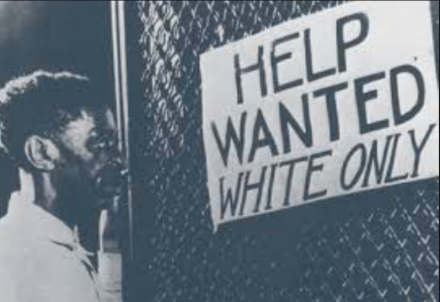 For a country that’s supposedly a great democracy, the United States has a breathtaking amount of virulent prejudice in its past and present — making the country a great democracy mostly for (rich) white males.
 Many novels of course contain character groupings — family members, or friends, or work partners, or other associations. Interesting interactions often result, and things can get even more interesting when the people are very different from each other.
 Some novels grab you from the first page or even first sentence, while others build more slowly. Sometimes so slowly — or so confusingly or so off-puttingly — that one flings the book away. (Hopefully not while reading it on an electronic device. 🙂 )
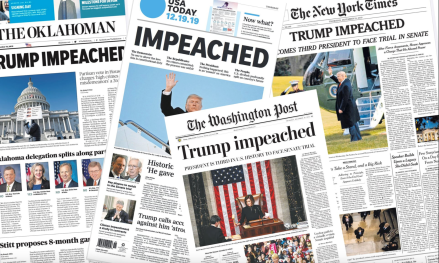 It’s always nice when wrongdoers suffer consequences, as was the case last week when the ultra-corrupt Trump was impeached by the U.S. House of Representatives. Sure, the repellent Republican majority in the U.S. Senate will acquit the Ogre-in-Chief after ignoring the huge trove of proof that he’s a criminal, but at least Trump got some comeuppance.
 Today’s theme? Novelists who keep readers off-balance by defying expectations with certain characters.
 Dave Astor on Literature