One great but also frustrating aspect of loving literature is anticipating the next novel in a series. Or anticipating an author’s next standalone novel. Or, back in the golden age of serialization, anticipating the next chapters of a novel.
After finishing the eighth Outlander book during a 2020 binge-reading of Diana Gabaldon’s riveting series, I wanted so badly to continue with the ninth novel. Unfortunately, Go Tell the Bees That I Am Gone wasn’t out yet (it might appear later this year). I don’t blame Ms. Gabaldon — authors work at their own pace, she’s very busy with various projects, and her Outlander romance/adventure novels are long and carefully researched and thus take years to write. Plus I was lucky in a way to discover the series late — meaning I could read the first eight books (published between 1991 and 2014) without waiting for the next one to be written.
(Pictured above are Caitriona Balfe as time-traveling 20th-century English physician Claire and Sam Heughan as 18th-century Scottish warrior Jamie in the popular Outlander TV series.)
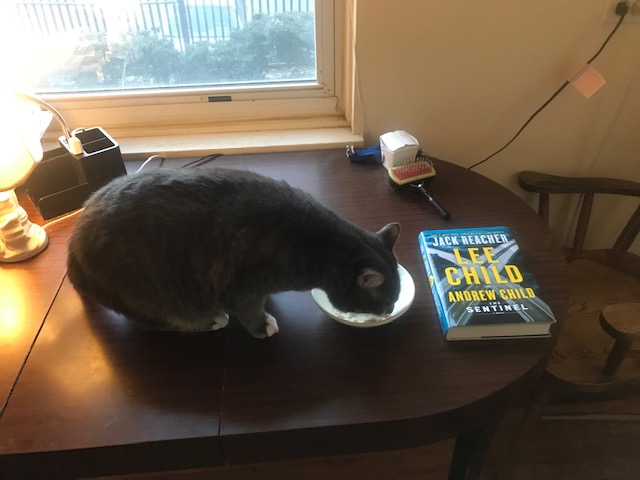
There’s also plenty of anticipation, but more publishing-date certainty, for the addictive Jack Reacher novels by Lee Child (now being co-written by his brother Andrew). A new Reacher thriller arrives every fall like Halloween — with both having treat appeal. Book number 26 expected this autumn.
Of course, probably the most famous modern book-anticipation phenomenon involved J.K. Rowling’s seven Harry Potter novels published from 1997 to 2007. I and my 1989-born older daughter — like millions of others — COULD NOT WAIT for each new installment to appear. As many people reading this will remember, quite a few bookstores even opened at midnight the day a new Potter novel was first available.
We also look forward to new stand-alone novels written by authors we love. Depending on how prolific the writer is, the wait might be long or short. We know that someone like Stephen King or Joyce Carol Oates will churn out one novel after another, so there’s not TOO much waiting. But in other cases…
Take Marilynne Robinson. I loved her first novel, Housekeeping, which came out in 1980. Then there wasn’t another, Gilead, until 2004 — nearly a quarter-century later. Unfortunately, I found Gilead rather boring, though it somehow won the Pulitzer Prize for fiction. Then Robinson wrote three more novels between 2008 and 2020. Didn’t see THAT coming.
There are also authors known for long, often-literary works that take many years to write. For example, Donna Tartt has authored only one stand-alone novel per decade — in 1992, 2002, and 2013; the third the excellent The Goldfinch. Could there be a fourth novel in two or three years? Maybe. Hope so.
Then there’s the serialization phenomenon most associated with the 19th century, as readers eagerly anticipated the next installment from novelists such as Charles Dickens. Even excitedly meeting ships as new chapters arrived. And if readers suddenly became less eager, authors could adjust. A famous instance of that was when Dickens, after about a half-dozen years of enormous popularity, found interest lagging in his being-serialized Martin Chuzzlewit novel. So the English author changed the plot on a dime to send Martin to the United States, and 1840s readers were hooked once again.
Which authors, series, and novels have you greatly anticipated?
My literary-trivia book is described and can be purchased here: Fascinating Facts About Famous Fiction Authors and the Greatest Novels of All Time.
In addition to this weekly blog, I write the 2003-started/award-winning “Montclairvoyant” topical-humor column for Baristanet.com. The latest piece — about teachers finally getting the okay for COVID vaccinations, and about new luxury apartments in my town even though it desperately needs more affordable housing — is here.