Thanks so much, everyone, for reading my literature blog and posting thousands of interesting comments in 2020! 🙂 As the devastating months of COVID hopefully start to fade in the rearview mirror, I thought I’d do a statistical look-back today before returning to my usual fare next Sunday.
Last year, this 2014-launched blog had 28,825 views, 14,124 visitors (the most ever), 4,530 comments, and 3,401 likes. The number of followers reached 4,930.
The top-15 places where views came from were 1) the United States (15,845), 2) the United Kingdom (4,008), 3) India (1,661), 4) Australia (1,436), 5) Canada (912), 6) Spain (361), 7) Germany (348), 8) Kuwait (297), 9) China (270), 10) the Philippines (268), 11) France (227), 12) Finland (199), 13) Nigeria (153), 14) Italy (151), and 15) Pakistan (127). Plus 125 other countries, thanks in large part to the worldwide reach of the WordPress blog platform.
Surprisingly, the most-read post in 2020 was from 2018 — “Strong Female Characters in 19th-Century Fiction.” Or maybe not so surprising, given the endless fascination with novels by Jane Austen, the Bronte sisters, George Eliot, Louisa May Alcott, Wilkie Collins, and others who created women protagonists who overtly or subtly defied the patriarchal norms of the 1800s.
The most-read 2020 piece that wasn’t sociopolitical? “The ’60s Live On. The 1860s, That Is” — which looked at the amazing group of novels published during that long-ago decade. War and Peace, Crime and Punishment, Great Expectations, and various other classics.
Lastly, even though this week’s piece is not my usual thematic post, I did want to mention that I just read and enjoyed Swedish author Jonas Jonasson’s The 100-Year-Old Man Who Climbed Out the Window and Disappeared — recommended by two regular commenters here (Susan and Martina Ramsauer) and three people I know from outside this blog (Allia Zobel Nolan, LJ Anderson, and Larry Esteves). It’s an offbeat novel with a lots of humor and suspense, and it was eye-opening to see which real-life famous leaders centenarian protagonist Allan Karlsson encountered while in various countries during his younger years.
In addition to this weekly blog, I write the 2003-started/award-winning “Montclairvoyant” topical-humor column for Baristanet.com. The latest piece — a 2020 year-in-review — is here.
One problematic literary trope over the centuries involves “first world” characters spending time in “third world” countries and having much bigger roles than the residents, who often serve as little more than “colorful” background.
It can be frustrating seeing white Americans or white Europeans star in those novels, get fleshed out more three-dimensionally than the people they’re amid, and too often act in patronizing or even racist ways toward the visited countries’ citizens — although novels of the past few decades, such as Barbara Kingsolver’s masterful The Poisonwood Bible, are thankfully likelier to take a critical view of, or satirize, this alleged “superiority.”
That said, some “first world in the third world” novels can of course still be damn good, and some of their European or American protagonists are decent people who at least treat the residents somewhat respectfully.
I thought about this subject the past few days while reading Malcolm Lowry’s Under the Volcano — an often-compelling, emotional, melancholy novel containing wonderfully rich prose. But dampening my pleasure a bit was the white-people-in-Mexico thing (with several “first world” bases covered by Lowry’s major characters: mopey alcoholic Geoffrey from England, his adventurous half-brother Hugh from England, former film actress/Geoffrey’s ex-wife Yvonne from the United States, and film director Jacques from France). Still, one can acknowledge that the 1947-published/1930s-set book was “of its time” and that Lowry (pictured above) gave some Mexican characters, such as physician Arturo Diaz Vigil, secondary roles a bit beyond the bare minimum.
There’s also the American-south-of-the-border trope in such novels as Cormac McCarthy’s All the Pretty Horses, featuring Texas teen John Grady Cole and his dramatic experiences in Mexico; James Michener’s Mexico, in which American journalist Norman Clay at least has some Hispanic blood; and Paul Theroux’s The Mosquito Coast, starring the rather nutso U.S. dad Allie Fox who yanks his family from Massachusetts to Honduras. All excellent books, but…
American or European characters in Africa? We have nasty Georgia evangelical Nathan Price, in the aforementioned The Poisonwood Bible, dragging his wife and four daughters to what was then the Belgian Congo to try to arrogantly convert the populace to Christianity; troubled New York couple Kit and Port enduring some disquieting experiences in North Africa in Paul Bowles’ The Sheltering Sky; three Englishmen traveling to East Africa to meet the imposing 2,000-plus-year-old (white) title character in H. Rider Haggard’s mesmerizing She; and that voyage along the Congo River in Joseph Conrad’s Heart of Darkness that would inspire the movie Apocalypse Now (in which the setting was transferred to Vietnam). On the part-fictional (?) memoir front, there’s Out of Africa by Danish author Karen Blixen.
Asian countries such as China and Japan are obviously now among the planet’s most developed nations, and China is a superpower, but those places used to be considered “third world” by the West. So, novels such as W. Somerset Maugham’s The Painted Veil (set in 1920s Hong Kong and China) and James Clavell’s Shogun (circa-1600 Japan) fit this blog post’s theme. Both of those compelling books have English protagonists.
Of course, many African and Latin American countries are also more industrialized today than at the time books such as She (1886) and Heart of Darkness (1902) were published.
Any “first world in the third world” novels you’d like to mention? And you’re of course welcome to discuss this blog post’s general theme. 🙂
In addition to this weekly blog, I write the 2003-started/award-winning “Montclairvoyant” topical-humor column for Baristanet.com. The latest piece — which eases up on the satire for a week to take a positive look at various things in my town — is here.
Some novels are full of puns, quips, humorous asides, made-up words, generally weird language, etc. All of that can be overdone, but it can also be fun. And those books can have serious moments, too.
One novel with a wordplay bonanza is Ali Smith’s There But For The, which I read last week. It’s a quirky book that opens with a dinner guest locking himself in a room for what will be weeks and weeks — angering the homeowner who hosted the meal — before the novel spins into depicting various people who knew the interloper. The turns of phrase come fast and furious, but there are also poignant sections — most notably one focusing on a very sick women in her 80s. Not sure I can strongly recommend the novel — it was a trial to read at times — but the author certainly deserves props for originality.
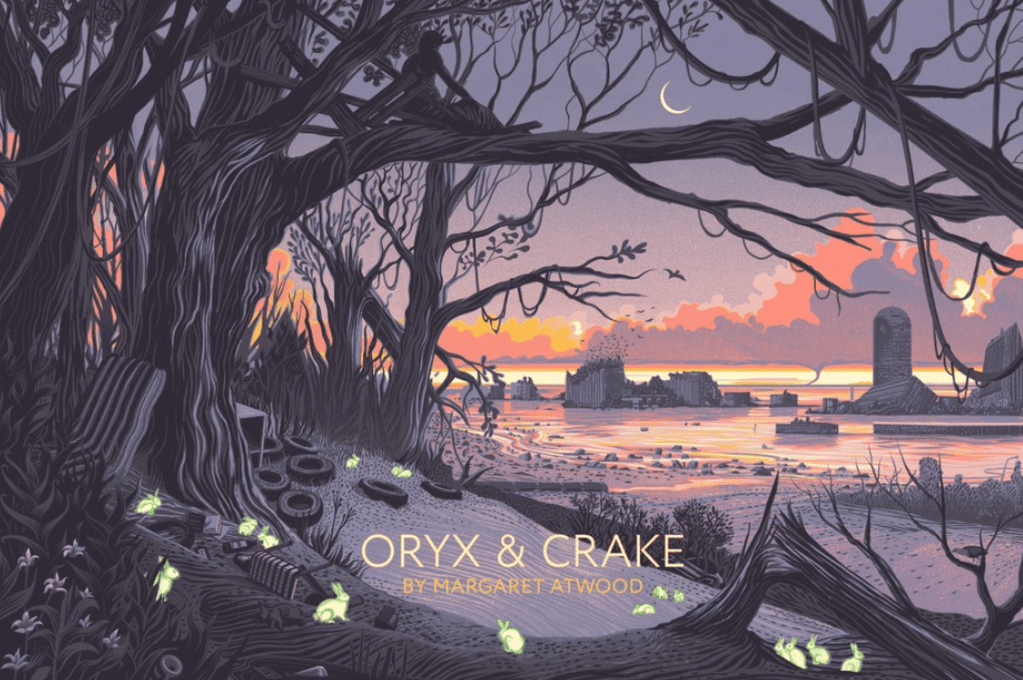
Another novel with plenty of wordplay is Margaret Atwood’s Oryx & Crake, a speculative-fiction work that combines laugh-out-loud humor, eco-consciousness, genetic engineering, and the post-apocalypse in an unusual but heady mix. The book includes an online game called Extinctathon, a company with the name AnooYoo, etc.
The Third Policeman by Flann O’Brien (pen name of Brian O’Nolan) not only has a wacky plot but also some offbeat language flourishes. Two examples: “I am completely half-afraid to think” and “It is nearly an insoluble pancake, a conundrum of inscrutable potentialities, a snorter.”
Quite a “snorter” (whatever the heck that means) is Jasper Fforde’s novel The Eyre Affair, in which a “literary detective” uses a “Prose Portal” to pursue a criminal inside the pages of Charlotte Bronte’s Jane Eyre. The detective’s name — Thursday Next — gives you an idea of Fforde’s enjoyable language shenanigans.
Among the many other novels with dazzling wordplay are Zadie Smith’s White Teeth, Henry Fielding’s Joseph Andrews, Vladimir Nabokov’s Pale Fire, Douglas Adams’ The Hitchhiker’s Guide to the Galaxy, Thomas Pynchon’s Inherent Vice, and Terry Pratchett’s Unseen Academicals (one of the books in that author’s Discworld series), to name just a few.
Last but not least, there are the Lewis Carroll classics Alice’s Adventures in Wonderland and Through the Looking-Glass. Language fun galore, and the latter book includes the iconic poem “Jabberwocky” — which starts and ends with this nonsensical verse:
“Twas brillig, and the slithy toves Did gyre and gimble in the wabe All mimsy were the borogroves And the mome raths outgrabe”
Your favorite novels with lots of wordplay?
A note: Last week, in my comedic literary version of “A Visit from St. Nicholas,” one of my poetic couplets read:
“The children are nestled all snug in their beds Too young for Dostoyevsky to mess with their heads”
I’m feeling a little guilty about that turn of phrase. I was trying to be funny, and the poem’s structure didn’t leave much room for nuance, so I wanted to reaffirm here that I LOVE Dostoyevsky’s brilliant, often disturbing work — even if it’s not exactly children’s fare. Heck, Crime and Punishment is one of my three or four favorite novels ever, and much of The Brothers Karamazov is also amazing — to name his two most famous titles.
In addition to this weekly blog, I write the 2003-started/award-winning “Montclairvoyant” topical-humor column for Baristanet.com. The latest piece — which contains FAIL and SAFE but has nothing to do with the “Fail Safe” novel and film 🙂 — is here.
My literary version of Clement Clarke Moore’s famous poem “A Visit from St. Nicholas”:
Twas 12 days before Christmas, and all through the nook Few things are more stirring than reading a book The novels are stacked by the chimney with care To read or reread, like the stellar Jane Eyre The children are nestled all snug in their beds Too young for Dostoyevsky to mess with their heads My wife at her desk and the cat in my lap To read George Eliot beats taking a nap
Then outside the window there arose such a clatter As if Jack Reacher had made all the bad guys scatter To that window I raced (I did not totter) As fast as Voldemort chased Harry Potter
The moon shone down on Outlander-ish snow Evoking ghostly visions of Edgar A. Poe
When what to my wondering eyes’ insistence Appeared Ruth the librarian and eight assistants Ruth read Tolstoy’s novels so lively and quick I knew in a moment she wasn’t St. Nick Her book faves came faster than Zadie Smith quips She laughed and she shouted and said with her lips:
“Now, Hobbit! Now, Huck Finn! Now, Rob Roy and Moby! On, Zora! On, Liane! On, Jhumpa and Toni! To the top of to-read lists! Best-seller lists, too! Whether dead or alive, they belong in your queue!”
The wind took book pages and made them fly Up into the air: The Sheltering Sky On top of the house the library team rose Their cart full of fiction: Remarque-able prose
And then, in a twinkling, I heard on the roof “Colette’s Claudine at School is such a fun goof” As I drew in my head, and spun all around, Down the chimney plunged Ruth, not Ezra Pound Sue Grafton mysteries that had come in the mail Stephen King novels streaked with ashes and hail Even more books that Ruth had flung on her back Including The Scarlet Letter in “A” big Nat-pack
Those books, how they twinkled! The titles so many! Atwood and Baldwin and Louise (last name Penny) Marquez magic realism and valet Jeeves And Lily Bart in Mirth — any reader grieves
Ruth knows William Faulkner put a pipe in his mouth And To Kill a Mockingbird is set in the South And Winnie the Pooh has a little round belly And Don Quixote “lived” before Mary Shelley And Thomas Hardy was hardly a jolly old elf And Of Human Bondage was based on Maugham himself
But don’t read Agatha Christie prior to bed To avoid waking up feeling nothing but dread
Ruth, as The Pathfinder, decides on a path Fills stockings with novels, like The Grapes of Wrath She then mutters Vonnegut’s phrase “So it goes” And back up the chimney the librarian rose She sprang again on the cart, and gave a whistle And away that crew flew like a sci-fi missile
But I heard Ruth exclaim, before she soared out of sight “The Great Gatsby is better than Tender Is the Night”
Apologies for omitting many authors (and novels by those authors) I’ve read. I ran out of Clement Clarke Moore poem lines to change. 🙂 Among those I wish I could have included: Chimamanda Ngozi Adichie, Louisa May Alcott, Isabel Allende, Isaac Asimov, Jane Austen, Fredrik Backman, Honore de Balzac, Ray Bradbury, Rita Mae Brown, Fanny Burney, Octavia Butler, Willa Cather, Kate Chopin, Wilkie Collins, Charles Dickens, Alexandre Dumas, Ralph Ellison, Buchi Emecheta, Louise Erdrich, Henry Fielding, Jack Finney,Fannie Flagg, Jonathan Franzen, Lisa Genova, Nikolai Gogol, John Grisham, Ernest Hemingway, Hermann Hesse, James Hilton, Khaled Hosseini, Victor Hugo, Aldous Huxley, John Irving,Shirley Jackson, Henry James, James Joyce, Barbara Kingsolver, Stieg Larsson,D.H. Lawrence, Sinclair Lewis, Jack London, Daphne du Maurier, Cormac McCarthy, Carson McCullers, James Michener, L.M. Montgomery, Elsa Morante, Walter Mosley, Haruki Murakami, George Orwell, Kate Quinn, Rosamunde Pilcher, Alexander Pushkin, Anne Rice, Philip Roth, Arundhati Roy, Richard Russo, Dorothy Sayers, Lionel Shriver, Isaac Bashevis Singer, Martin Cruz Smith, Harriet Beecher Stowe, Rabindranath Tagore, Amy Tan, Donna Tartt, Angie Thomas, Anne Tyler, Jules Verne, Alice Walker, H.G. Wells, Virginia Woolf, Herman Wouk, Richard Wright, Emile Zola, etc., etc.!
In addition to this weekly blog, I write the 2003-started/award-winning “Montclairvoyant” topical-humor column for Baristanet.com. The latest piece — about such topics as my town’s delay in reopening schools amid the COVID resurgence — is here.
Have you ever read a novel and felt it was sort of the child of two other books or two other authors? Not that the novel was plagiarized by any means, but that it was seemingly influenced by — or at least reminded you of — a previous pair of works or writers. And I realize that the authors of the more recent novels may not have even read the earlier novels.
All this occurred to me last week while reading the low-key but absorbing Never Let Me Go by Kazuo Ishiguro (pictured above). The Nobel Prize winner — best known for his also-subtle The Remains of the Day — is a very original author whose sci-fi-ish Never Let Me Go is a very original novel, so it’s not a criticism when I say I felt I was reading an interesting amalgam of Aldous Huxley’s Brave New World and the fiction of Henry James.
Naturally, I then thought of the “literary parentage” other novels evoke. For instance, John Irving’s The Cider House Rules — with its orphanage, its sweep, its social consciousness, its feminist aspects, etc. — feels a bit like the child of books by Charles Dickens and Margaret Atwood. How’s that for DNA? (With the D being Dickens and the A being Atwood.)
A.S. (Antonia Susan) Byatt’s fabulous novel Possession reminds a reader of the poetry/stalking elements of Vladimir Nabokov’s Pale Fire and the academic-gets-into-an-unexpected-romance theme of Alison Lurie’s Foreign Affairs. (Ms. Lurie died at age 94 this past Thursday, December 3 — a day after I finished writing this post.)
Walter Mosley’s Devil in a Blue Dress? With its depiction of living in a racist society and its California detective-noir vibe, it at times seems like an amalgam of novels by James Baldwin and Raymond Chandler.
Joseph Heller’s Catch-22, full of hilariously cutting anti-war/anti-military satire, brings to mind Jaroslav Hasek’s The Good Soldier Svejk and Mark Twain’s A Connecticut Yankee in King Arthur’s Court.
John Green’s The Fault in Our Stars, which features deeply humanized characters with grave illnesses/disabilities, evokes earlier novels such as Johanna Spyri’s Heidi and Nicholas Sparks’ A Walk to Remember.
And the child-of-a-traumatizing-mother, emerging-from-her-loner-shell Eleanor of Gail Honeyman’s Eleanor Oliphant Is Completely Fine feels like a cross between Ove of Fredrik Backman’s A Man Called Ove and Ms. Valancy Stirling of L.M. Montgomery’s The Blue Castle.
Any “literary parentage” examples you’d like to mention?
In addition to this weekly blog, I write the 2003-started/award-winning “Montclairvoyant” topical-humor column for Baristanet.com. The latest piece — my 200th since moving the column from the newspaper where it started — is here.
What did some novelists do before they became novelists? I assume they ate and breathed, but some also worked as full-time or contributing newspaper writers.
Makes sense. If somebody had a propensity and aptitude for writing, newspapers were one of the logical places to start — at least in the days before those print publications struggled and became thought of as “old media.” Newspaper writers learned to write fast, rewrite fast, write clearly, do research, and be accurate — well, much of the time. 🙂 They met people from all walks of life, and saw how those people thought and spoke. They visited different places. Heck, they even got used to low pay — also the lot of the many novelists who don’t hit it big. So, all in all, newspaper work could be good training for becoming a novelist.
Why did certain writers make the switch (even as some continued working for newspapers after penning novels)? Among the reasons: the chance to be more creative, use more of one’s imagination, experience longer-form writing, be more of one’s own boss, and perhaps find fame and fortune.
I’ll now proceed to offer a list (by no means complete) of newspaper writers who became novelists — mentioning them chronologically by their birth years.
Charles Dickens (1812-1870) worked as a journalist during part of the 1830s — covering Parliament, election campaigns, and more in England.
Mark Twain (1835-1910) wrote for a Nevada newspaper and later The Sacramento (Calif.) Union in the 1860s. A funny anecdote relating to Twain’s Union stint is at the end of this blog post.
Bram Stoker (1847-1912), author of the influential 1897 novel Dracula, was a theater critic for Ireland’s Dublin Evening Mail in the 1870s.
H.G. Wells (1866-1946) wrote articles for London’s The Pall Mall Gazette in the 1890s before authoring his first novel, The Time Machine.
L.M. Montgomery (1874-1942), best known for Anne of Green Gables (1908), wrote early-1890s nonfiction content for The Daily Patriot in Charlottetown on Canada’s Prince Edward Island.
P.G. Wodehouse (1881-1975), creator of the Jeeves novels and stories, wrote a column called “By the Way” for The Globe of London from 1901 to 1909.
Rebecca West (1892-1983) was a journalist for feminist and leftist newspapers and also wrote for dailies such as the New York Herald Tribune, the New York American, and The Daily Telegraph of London.
Ernest Hemingway (1899-1961) worked as a reporter for The Kansas City Star just after high school. (According to Wikipedia, he “relied on the Star‘s style guide as a foundation for his writing: ‘Use short sentences. Use short first paragraphs. Use vigorous English…'”)
Margaret Mitchell (1900-1949) wrote news stories, feature articles, and some book reviews for The Atlanta Journal starting in 1922. She left the Georgia newspaper in 1926, a decade before Gone With the Wind was published.
Gabriel Garcia Marquez (1927-2014) became a newspaper journalist starting in the late 1940s — first writing for El Universal, then El Heraldo, then El Espectador in Colombia. He wrote stories, columns, and film criticism — all well before his novel One Hundred Years of Solitude was published in 1967.
Maya Angelou (1928-2014) was associate editor of the English-language weekly newspaper The Arab Observer in Cairo, Egypt, in the early 1960s, and later did freelance writing for The Ghanaian Times. (Angelou didn’t become a novelist per se, but of course wrote memoirs with a literary bent, poetry, children’s books, etc.)
Charles Portis (1933-2020) — best known for his 1968 novel True Grit — was a reporter for newspapers in Tennessee, Arkansas (where he also wrote a column), and New York City (the Herald Tribune) before leaving journalism in 1964 and turning to fiction.
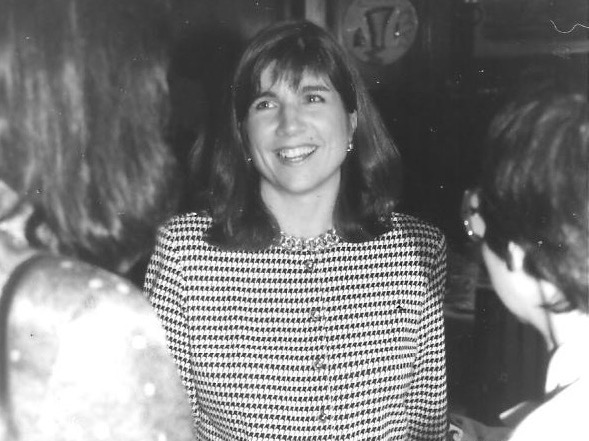
Anna Quindlen (1953-) was a reporter and then Pulitzer Prize-winning opinion columnist for The New York Times before concentrating on novel writing. (I took the photo of Ms. Quindlen that’s atop this blog post after she spoke at a Newspaper Features Council meeting in Charleston, South Carolina, in 1991 — the year her first novel came out.)
Carl Hiaasen (1953-) is a syndicated Miami Herald columnist who still writes those columns as he churns out his many part-comedic thrillers set in Florida. He was a reporter before becoming a columnist.
Stieg Larsson (1954-2004) was a journalist in Sweden before and while penning his best-selling, posthumously published Millennium Trilogy (The Girl With the Dragon Tattoo, etc.).
Geraldine Brooks (1955-) was a reporter for The Sydney Morning Herald and then a foreign correspondent for The Wall Street Journal. The native of Australia is best known for her Pulitzer-winning 2005 novel March, about the harrowing Civil War experiences of the father from Louisa May Alcott’s Little Women.
Connie Schultz (1957-) is a Pulitzer-winning syndicated columnist whose first novel, The Daughters of Erietown, was published earlier this year. She was a reporter before becoming a columnist.
Leonard Pitts Jr. (1957-) is also a Pulitzer-winning syndicated columnist who has authored four novels while continuing his Miami Herald-based column. He was previously a music critic.
Here’s the promised Twain-related anecdote, also mentioned in my 2012 memoir Comic (and Column) Confessional, that I heard at the 1993 National Society of Newspaper Columnists conference in Portland, Oregon. Herb Caen, the famed San Francisco Chronicle gossip columnist who had previously worked for The Sacramento Union, said the Union kept the desk ostensibly used by Twain. When someone expressed interest in buying it, the newspaper parted with it for $200. “We sold dozens,” Caen chuckled.
Any journalists-turned-novelists you’d like to discuss?
I spoke about my past career covering cartoonists (and columnists) in the latest podcast hosted by masterful Vancouver, Canada-based interviewer/conversationalist Rebecca Budd, who also writes several blogs and often comments here as Clanmother. Link below. You’ll hear my memories of, and thoughts about, these comic creators I knew: Charles M. Schulz (“Peanuts”), Gary Larson (“The Far Side”), Mort Walker (“Beetle Bailey”), Milt Caniff (“Terry and the Pirates”), Garry Trudeau (“Doonesbury”), Lynn Johnston (“For Better or For Worse”), and Bill Watterson (“Calvin and Hobbes”). Some of those memories and thoughts are also in my aforementioned Comic (and Column) Confessional book.
In addition to this weekly blog, I write the 2003-started/award-winning “Montclairvoyant” topical-humor column for Baristanet.com. The latest piece — about two local champion soccer teams, my town’s ambitious mayor, and Thanksgiving — is here.
Guilt. It’s a five-letter word that feels like a four-letter word.
Many fictional protagonists suffer from guilt, which can make their lives difficult and give a novel plenty of drama. Those characters often evoke our sympathy, mainly because someone who feels guilt has a conscience. Of course, the action or actions that cause people to feel guilt range from deliberate to accidental, which can affect what we think of those erring folk.
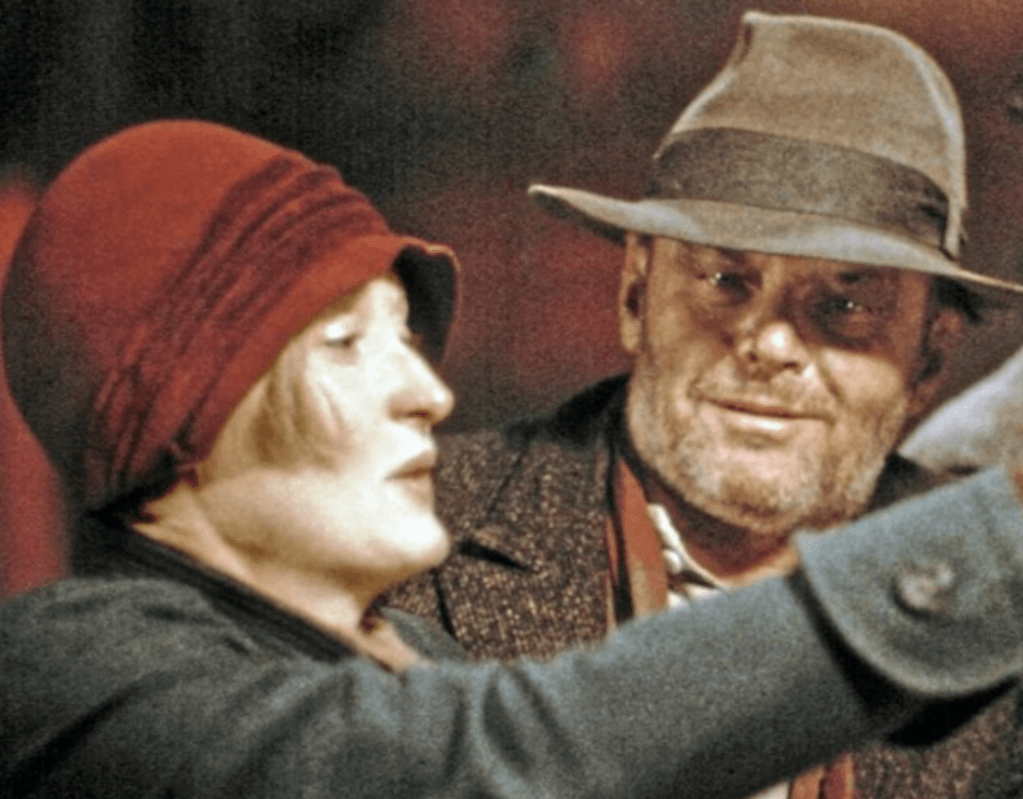
I just read William Kennedy’s mesmerizing/melancholy Ironweed, whose main character’s entire life changes because of guilt. Once a very good turn-of-the-20th-century Major League baseball player, Francis Phelan has become a homeless alcoholic wandering the streets of Albany, New York, in 1938. Things went downhill after a perhaps-drunk-that-day Francis accidentally dropped and killed his infant son. The young father, who also killed a strikebreaker around that time, never forgave himself and proceeded to leave his wife Annie and two other kids and allow his life to go to hell. One feels a mix of pity and “why didn’t you try to deal with things better?” for Francis — who was forgiven by Annie, their son, and (to an extent) their daughter.
Phelan’s companion in homelessness, former singer Helen Archer, began her downward spiral after an awful betrayal by her mother. But that mom feels no guilt, even on her deathbed.
(Above are Meryl Streep as Helen and Jack Nicholson as Francis in the 1987 Ironweed movie.)
Moving to other novels and characters, Raskolnikov experiences a huge amount of guilt after committing murder in Crime and Punishment — even as he had delusional hopes he wouldn’t feel that way. Few authors have ever depicted guilt as feverishly as Fyodor Dostoyevsky did via his classic novel’s nerve-wracked protagonist.
Like Francis, a haunted Eve Gardiner becomes a guilt-ridden alcoholic in Kate Quinn’s The Alice Network. Eve was an adept English spy during World War I who thought — upon regaining consciousness after being tortured — that she had betrayed a fellow spy. She believes this for decades, until…
In Fredrik Backman’s A Man Called Ove, the title character felt guilt about the bus accident that left his late wife Sonja paralyzed from the waist down. Ove didn’t cause the accident (revealed in the novel’s back story); he had noticed that the bus driver had alcohol on his breath when he and Sonja first boarded but didn’t say anything. Unlike Francis (whose guilt was of course more direct), Ove stuck loyally and lovingly with his wife until Sonja died years after making the best of her radically changed life by becoming a beloved teacher.
Sophie of Sophie’s Choice lives for years with almost unbearable guilt over a choice she made while in Nazi captivity. There is also plenty of survivor’s guilt in William Styron’s novel, or virtually any Holocaust/post-Holocaust novel.
Obviously, there can be guilt over adultery or other kinds of problematic romantic affairs — as felt, for instance, by Christabel LaMotte in A.S. Byatt’s Possession and Rev. Arthur Dimmesdale in Nathaniel Hawthorne’s The Scarlet Letter.
And what about parental guilt when a mom or dad (more often the mom) feels they are not spending enough time with their kids because of career-related responsibilities? One example is Claire in Diana Gabaldon’s Outlander series going through long days of intensive medical training while her daughter Brianna is young.
There can also be guilt over shabbily treating a friend. That’s the case for the young Amir, in Khaled Hosseini’s The Kite Runner, who does not do right by faithful childhood pal Hassan. There is some measure of atonement, though hardly enough, for Amir later in the novel.
Finally, there’s of course guilt over acting cowardly — as in Stephen Crane’s The Red Badge of Courage and Joseph Conrad’s Lord Jim. In some cases, the protagonists might at least partly make up for that by behaving bravely later on.
In addition to this weekly blog, I write the 2003-started/award-winning “Montclairvoyant” topical-humor column for Baristanet.com. The latest piece — about the effect of Covid on my town — is here.
Last week, I discussed the 1940s as a stellar decade for novels. This week, I’ll jump back a century to perhaps an even more stellar literary period: the 1840s. The Bronte sisters, Charles Dickens, William Thackeray, Alexandre Dumas, Honore de Balzac, Herman Melville, James Fenimore Cooper, Nikolai Gogol, early Fyodor Dostoevsky…
The novel as a medium truly came into its own in the 1840s — no previous decade had such a large and varied array of what would become fiction classics.
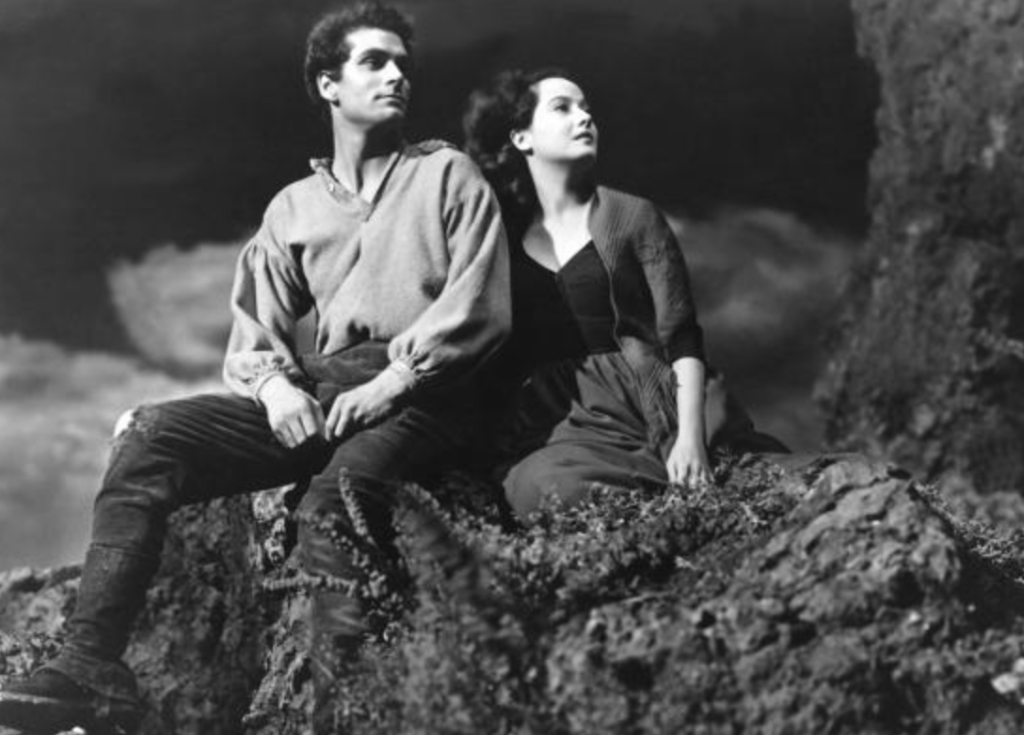
Let’s start with the astonishing two-year run by Charlotte, Emily, and Anne Bronte. Charlotte’s 1847 Jane Eyre — my favorite novel — is of course the gripping story of an independent-minded orphan who becomes a governess and falls mutually in love with her employer Edward Rochester. Published later that same year was Emily’s Wuthering Heights — a highly original and tempestuous tale of romance, obsession, and cruelty. Following in 1848 was Anne’s The Tenant of Wildfell Hall, the compelling early feminist novel chronicling a woman’s escape from a bad marriage. Anne (Agnes Grey/1847) and Charlotte (Shirley/1849) also wrote other, not-as-memorable novels in that decade.
(Pictured above are Laurence Olivier and Merle Oberon in the 1939 Wuthering Heights movie.)
For Charles Dickens, the 1840s was his most productive decade — churning out one absorbing novel after another — even as several of his most-admired books (including A Tale of Two Cities and Great Expectations) would come later. My Dickens favorites from the ’40s include The Old Curiosity Shop (1841), A Christmas Carol (1843), Martin Chuzzlewit (1844), and Dombey and Son (1848).
Another English author, Willam Thackeray, wrote 1848’s Vanity Fair — starring the smart, witty, manipulative, unforgettable Becky Sharp.
Over in France, Alexandre Dumas blazed through the 1840s with novels such as his highly entertaining The Three Musketeers and the riveting revenge saga The Count of Monte Cristo. Both books were finished in 1844 — how’s that for an authorial year? There was also his less-known-but-great Georges (1843), the one Dumas novel that reflected the author’s part-African heritage; and Twenty Years After (1845), the satisfying first sequel to The Three Musketeers.
Another French author, Balzac, penned most of his best novels in the 1830s, but the excellent Cousin Bette and The Black Sheep came out in 1846 and 1842, respectively.
Over in the U.S., Herman Melville wrote several very good semi-autobiographical sea novels in the 1840s before authoring 1851’s extremely good Moby-Dick. They included Typee (1846), Omoo (1847), and Redburn (1849).
Two of James Fenimore Cooper’s “Leatherstocking” quintet came out early in that decade: The Pathfinder (1840) and The Deerslayer (1841). Cooper did not write the five novels chronologically; for instance, The Deerslayer — which I think is the best of the series — is set from 1740 to 1755 while the previously written The Last of the Mohicans (1826) takes place later (in 1757).
In Russia, Nikolai Gogol’s eye-opening Dead Souls came out in 1842. Fyodor Dostoevsky started his novel-writing career with 1846’s Poor Folk; the masterpieces Crime and Punishment (1866) and The Brothers Karamazov (1880) would arrive quite a few years later. I haven’t yet read Mikhail Lermontov’s A Hero of Our Time (1840).
Don’t worry, next week’s post won’t focus on the 1740s — though Henry Fielding’s Tom Jones (1749) and Joseph Andrews (1742) were pretty darn good. 🙂
In addition to this weekly blog, I write the 2003-started/award-winning “Montclairvoyant” topical-humor column for Baristanet.com. The latest piece — about the election and more — is here.
When one looks at U.S. politics these days, one can’t help but think of the 1940s. Joe Biden, the centrist President-elect, was born in 1942. His far-right Republican opponent Donald Trump (who makes Lord Voldemort seem like a choir boy) arrived in 1946. Another far-right Republican, Senate Majority Leader Mitch McConnell, was born in 1942. Another centrist Democrat, House Speaker Nancy Pelosi, was born in 1940. And 1941 was the birth year of progressive Bernie Sanders, the runner-up to Biden in the Democratic primaries. Yes, the U.S. has some older leaders.
Anyway, you probably know where this is heading: I’m going to discuss the 1940s as another memorable decade for novels — mentioning only ones I’ve read until the next-to-last paragraph. The content in many of those books was of course affected by World War II and its aftermath, with anti-Nazi themes unsurprisingly part of the mix.
The decade began with a bang as three 20th-century classics were published in 1940. The trio: Native Son by Richard Wright (pictured above), who took a searing look at how racism shaped the lives and perspectives of his African-American and white characters; The Heart Is a Lonely Hunter, the amazing debut novel written when Carson McCullers was in her early 20s; and For Whom the Bell Tolls, the gripping novel set against the backdrop of the Spanish Civil War. (It’s my favorite book by Ernest Hemingway, who I have mixed feelings about.) Graham Greene’s 1940 The Power and the Glory, which focuses on a not-very-priestly priest, gets an honorable mention.
In 1941, F. Scott Fitzgerald’s unfinished The Last Tycoon was posthumously published. This compelling Hollywood novel would have been quite something if completed.
The year 1942 saw Albert Camus’ memorable/existential The Stranger and John Steinbeck’s The Moon Is Down, the latter about a Northern European town occupied by the Nazis (though the Nazis aren’t named per se). A rare Steinbeck novel set outside California and the U.S.
Nineteen forty-three? I got nothing. 🙂
Two of the most interesting novels of 1944 were written by authors who were older, but not quite as old as the politicians mentioned in this blog post’s first paragraph. One book was The Razor’s Edge — among W. Somerset Maugham’s top works despite the author being 70 — about a World War I veteran trying to find some meaning in life. The other was Gigi, published when Colette was 71. A rather frothy, lightweight novella that doesn’t measure up to Colette’s many deeper works, but her most famous book.
In 1945, Erich Maria Remarque came out with one of his very best novels: Arch of Triumph, about a German surgeon in Paris who had fled the Nazis, and his tempestuous romance while in the French city. There was also Animal Farm, George Orwell’s renowned allegorical look at authoritarianism; and Cannery Row, John Steinbeck’s expert blend of social commentary and humor.
Robert Penn Warren’s All the King’s Men was probably the most important 1946 novel with its take on American politics, corruption, and more.
Albert Camus appeared again in 1947 with The Plague, his riveting novel about a disease-devastated Algerian city. That year also saw the publication of James Michener’s debut novel Tales of the South Pacific, which consists of interrelated stories set during World War II. It of course inspired the musical South Pacific, but the book is more substantial.
A highlight of 1948 was Alan Paton’s Cry, the Beloved Country — set in apartheid South Africa.
The most famous 1949 book was indisputably George Orwell’s iconic dystopian novel Nineteen Eighty-Four. That year also saw the release of Paul Bowles’ The Sheltering Sky, about an American couple who don’t fare well in North Africa.
Among the well-known ’40s novels I haven’t read are James M. Cain’s Mildred Pierce (1941), Betty Smith’s A Tree Grows in Brooklyn (1943), Ayn Rand’s The Fountainhead (1943), John Hersey’s A Bell for Adano (1944), Astrid Lindgren’s Pippi Longstocking (1945), Malcolm Lowry’s Under the Volcano (1947), and Norman Mailer’s The Naked and the Dead (1948).
In addition to this weekly blog, I write the 2003-started/award-winning “Montclairvoyant” topical-humor column for Baristanet.com. The latest piece — about the election and more — is here.
Soon after Trump took office in 2017, I wrote a post changing the plots of famous novels to make them about the despicable new U.S. president (aka Liar-in-Chief, Racist-in-Chief, Misogynist-in-Chief…). Today, as Election Day nears on November 3, I’ll do something similar — using titles of some of the novels I’ve read since 2017. I’ll go backwards chronologically, starting with books I’ve finished most recently.
Fredrik Backman’s My Grandmother Asked Me to Tell You She’s Sorry: for voting for Trump in 2016.
Jess Walter’s The Financial Lives of the Poets: in which the Trump family recites “Roses are red/money is green/our corruption and greed/are worse than obscene.”
Wilkie Collins’ No Name: about the impossibility of deciphering Trump’s scrawl of a signature.
Gail Honeyman’s Eleanor Oliphant Is Completely Fine: because she moved to Canada after Trump was elected.
Angie Thomas’ The Hate U Give: Trump never stops giving it. Who says he isn’t philanthropic?
Chimamanda Ngozi Adichie’s Americanah: America hopefully says “nah” to a second Trump term.
Carolyn Keene’s The Secret of the Old Clock: Nancy Drew investigates why the clock in Trump’s White House is turned back 60 years rather than 60 minutes every November.
Diana Gabaldon’s The Fiery Cross: Non-reader Trump was eager to start this Outlander novel before realizing it didn’t glorify the white-supremacist, cross-burning Ku Klux Klan.
Martin Cruz Smith’s The Siberian Dilemma: which asks whether Trump adores Russian autocrat Vladimir Putin or ADORES Russian autocrat Vladimir Putin.
Liane Moriarty’s Nine Perfect Strangers: if Trump steals a second term and makes all nine Supreme Court justices far-right-wingers, this novel would be renamed Nine Perfect Strangers to Decency.
H. Rider Haggard’s She: the story of a woman almost unimaginably evil. About time there was a novelization of Ivanka Trump’s life.
Lee Child’s Blue Moon: Jack Reacher hopes enough Americans are “good to go” vote “blue” to defeat Trump.
Kate Quinn’s The Alice Network: would’ve been about Fox News if the book were titled The Malice Network.
Isabel Allende’s Daughter of Fortune: what — a second novelization of Ivanka’s life?
Lisa Genova’s Left Neglected: shows Trump and other non-liberal U.S. politicians doing their anti-progressive thing.
John Grisham’s The Racketeer: an alternate history of Trump being a criminal-minded tennis player rather than a criminal-minded golfer.
Sherman Alexie’s Reservation Blues: about Trump and his fellow Republicans suppressing the vote on Native-American land, among other places.
Rosamunde Pilcher’s The Shell Seekers: Trump and his fellow Republicans do everything they can to seek the continued support of Shell and other oil companies.
James Houston’s The White Dawn: Trump likes it that color any time of the day.
Richard Russo’s Nobody’s Fool: anyone who sees through swamp increaser Trump’s fake promise to “drain the swamp.”
Janet Evanovich’s Two for the Dough: a Trump-Mitch McConnell buddy book.
Ivan Turgenev’s A House of Gentlefolk: not about any home in which Trump ever lived.
Michael Ondaatje’s The English Patient: ironically titled novel about Brits (among other populations) being impatient with Trump’s pathologies.
Ray Bradbury’s Something Wicked This Way Comes: people watching Trump approach a podium.
Flannery O’Connor’s Wise Blood: what Trump would desperately need if he got a transfusion.
Fannie Flagg’s The Whole Town’s Talking: it sounds like that when Trump never shuts up.
John Green’s The Fault in Our Stars: when those stars are the Trump family.
Octavia E. Butler’s Parable of the Sower: much better than the Trump saga Parable of the Sewer.
Donna Tartt’s The Secret History: about Trump cheating on his taxes for decades. Actually, not a secret.
Sue Grafton’s D Is for Deadbeat: about Donald (Trump) stiffing creditors, contractors, towns where he’s made political appearances, etc.
Walter Mosley’s A Red Death: what will hopefully happen to the red-state-oriented Republican Party that has cynically and spinelessly enabled Trump.
Any novels you’d like to “Trump-ify”?
(Thanks to jhNY for recommending The Financial Lives of the Poets — a novel funny and topical enough to partly make up for its unlikable male protagonist. Also, thanks to Mary Kay Fleming for recommending A Man Called Ove author Fredrik Backman, whose My Grandmother Asked Me to Tell You She’s Sorry is a quirky novel about a loner girl, her unusual grandmother, and their sharing of a fantasy world.)
In addition to this weekly blog, I write the 2003-started, award-winning “Montclairvoyant” topical-humor column for Baristanet.com. The latest piece — about a planned return to in-person schooling in my town and a reprieve for a group trying to kill needed local rent control — is here.