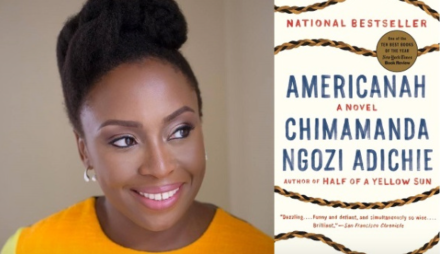
 I was reminded once again of Africa’s rich literary tradition when I recently read…Americanah.
Though much of the novel is set in the United States, Chimamanda Ngozi Adichie’s 2013 book tells a story that starts and ends in Nigeria. And the author splits her time between Nigeria (where she was born in 1977) and the U.S.
Americanah stars Ifemelu — who comes to the U.S. to study, becomes a widely read blogger on race after working in a variety of more-menial jobs, and gets into diverse romantic relationships even as she remains drawn to Nigeria and her former lover there (Obinze). So we get a fascinating look at Nigerian society (its culture, class divisions, etc.) through the eyes of someone from that nation as well as a fascinating look at American society (its culture, racism, etc.) from that same character — who’s initially a total outsider in the U.S. and rarely feels truly comfortable even after more than a decade in Pennsylvania, Maryland, Connecticut, and New Jersey.
Among Adichie’s other novels are Half of a Yellow Sun (2006), a compelling chronicle of how various characters are affected by Nigeria’s 1967-70 civil war.
Obinze’s daughter in Americanah is named Buchi — possibly a nod to renowned Nigerian writer Buchi Emecheta (1944-2017), who moved to the United Kingdom in her late teens. Emecheta’s excellent second novel is the semi-autobiographical Second Class Citizen, about a young woman who relocates to the UK and deals with a difficult marriage, exhausting parenthood, racism, and sexism as she tries to become a writer.
Adichie’s inspirations included Chinua Achebe (1930-2013) and his classic 1958 novel Things Fall Apart, which chronicles pre-colonial life and the arrival of Europeans in Nigeria.
Another renowned Nigerian writer is 1934-born Wole Soyinka, recipient of the 1986 Nobel Prize in Literature. Soyinka has written many more plays and poems than novels, but his The Interpreters (1964) is a memorable book starring five middle-class characters who live and work in early-1960s Lagos.
Yes, all four writers mentioned so far are/were from Nigeria.
There are of course also native African novelists who are white — among them the 1991 Nobel-winning Nadine Gordimer (1923-2014) and Cry, the Beloved Country author Alan Paton (1903-1988). Both were South Africa residents with anti-apartheid views. I have not yet tried the work of 1940-born J.M. Coetzee of that same country; I’ve read every other author mentioned in this post.
Also, 2007 Nobel winner Doris Lessing (1919-2013) spent much of her early life in what’s now Zimbabwe before moving to England.
Non-African authors who wrote novels with African settings include — among others — 2008 Nobel winner J.M.G. Le Clezio, whose Desert is partly set in Morocco; Paul Bowles, whose The Sheltering Sky also has a North African milieu; Joseph Conrad, whose Heart of Darkness unfolds in what’s now the Democratic Republic of the Congo; and H. Rider Haggard, whose fantastical She takes place in “a lost African kingdom.”
Of course, a number of Africa-set novels by non-Africans suffer from some stereotyping and patronizing attitudes on the part of their writers.
Any authors and novels you’d like to mention that fit the theme of this post?
My literary-trivia book is described and can be purchased here: Fascinating Facts About Famous Fiction Authors and the Greatest Novels of All Time.
In addition to this weekly blog, I write the 2003-started, award-winning “Montclairvoyant” topical-humor column for Baristanet.com. The latest piece — which discusses topics such as the damage done by Tropical Storm Isaias — is here.
 When I read novels, themes for blog posts occur to me. So, after finishing Garth Stein’s The Art of Racing in the Rain last week, the logical theme would have been to write about memorable dogs in literature. But I already did that two weeks ago, which led to several commenters recommending I read…The Art of Racing in the Rain.
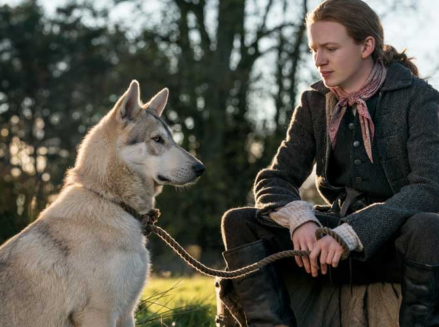 I’ve never lived with a dog, though I’ve gratefully shared my household with seven wonderful cats over the years. 🙂 I developed an appreciation of canines by meeting those who’ve lived with people I know and via…literature.
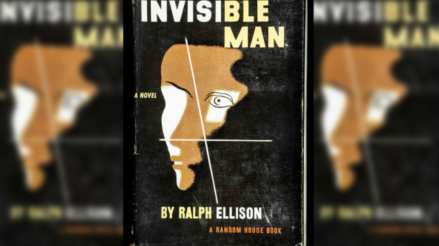 There have been countless protests around the world in recent weeks against the evils of racism and police brutality. Many of the admirable participants have been young people of all colors, providing hope for a future where…Black Lives Matter.
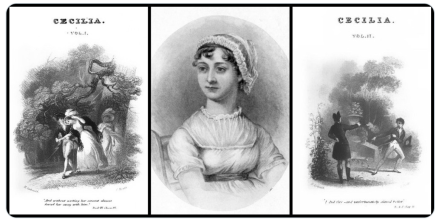 All authors are influenced by other authors, whether that influence is conscious or unconscious. Most writers are not plagiarists, of course, but their reading of other writers has an impact — often manifested in their early work before developing a more original voice.
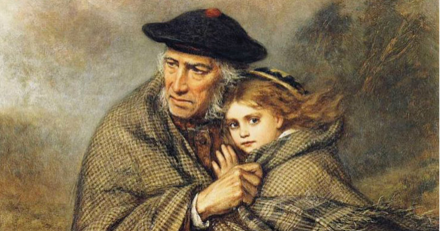 Today is Father’s Day, so, in an effort to write a blog post with the most unoriginal theme ever, I’m going to discuss some of my favorite dads in literature — seven to be exact. I’ll go backward in time, starting with the most recent releases.