They’re Serious about Series and Standalone Novels

Some authors are good at two or more things: novels and short stories, fiction and nonfiction, literary fiction and mass-audience fiction, etc. For this post, I’ll add to that by focusing on authors who are good at series as well as standalone novels. It certainly requires some different writing muscles to wrap up things in one book vs. extending things across multiple books.

This topic occurred to me last week as I read Val McDermid’s A Place of Execution, a superb standalone novel with a concluding twist that will knock your socks off. My previous experience with McDermid was with her series fiction, including the books starring “cold case” detective Karen Pirie.

I followed A Place of Execution with Martin Cruz Smith’s Independence Square — his 10th in the series starring Russian investigator Arkady Renko that began with Gorky Park. (Independence Square was okay; not as good as the earlier Renko books.) Smith has also written standalone novels such as Rose.

Sometimes, authors toggle throughout their careers between standalone books and series — as has been the case with Smith and McDermid as well as authors such as Walter Mosley with his Easy Rawlins books and much more. Other times, authors start with standalone novels before hitting on a hit series and focusing on that — as did Sue Grafton, who wrote two standalones before launching her popular Alphabet Mysteries (25 in all; she reached the letter “Y” before she died).

J.K. Rowling has also written many more series novels than standalone ones: seven Harry Potter books, then The Casual Vacancy one-off, then seven Cormoran Strike/Robin Ellacott crime novels (so far).

L.M. Montgomery followed her classic Anne of Green Gables with seven sequels over the years, during which time she also penned the Emily trilogy and standalones such as The Blue Castle.

Stephen King is known mostly for standalone novels, with a sprinkling of sequels and trilogies, but has also written many books in The Dark Tower series.

Some long-ago authors also toggled. For instance, James Fenimore Cooper wrote the five “Leatherstocking” novels (including The Last of the Mohicans) as well as various standalone books. Alexandre Dumas did both as well — many standalones (most famously The Count of Monte Cristo) as well as The Three Musketeers and its five sequels (sometimes published as fewer sequels when certain books were combined into one edition).

Your thoughts about and examples of this topic?

Misty the cat says: “My fitness tracker better record backward steps.”

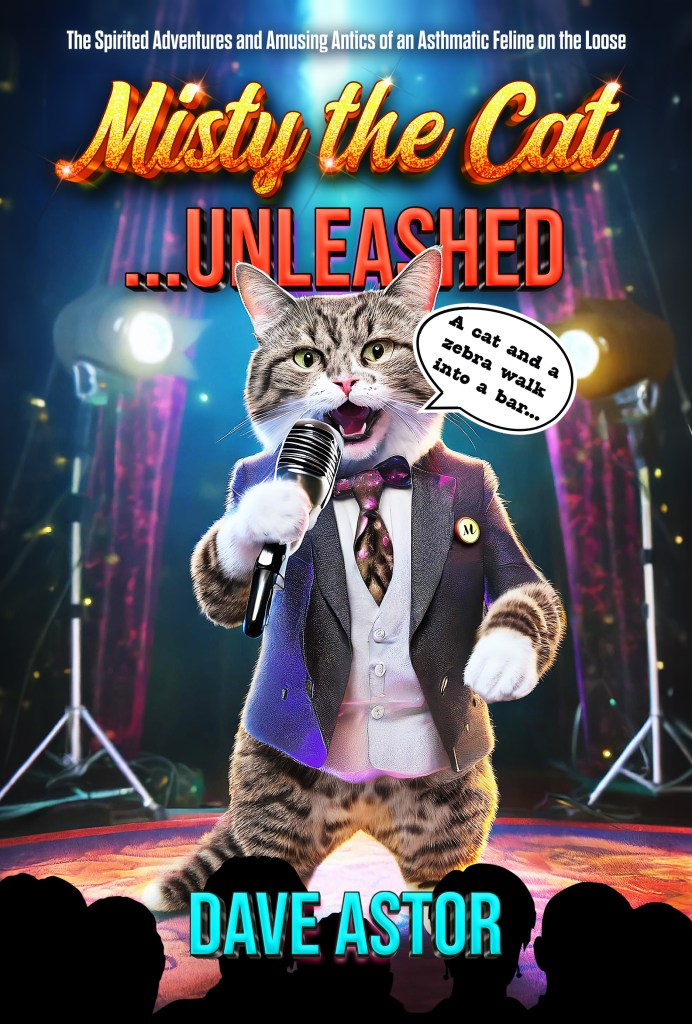
My comedic 2024 book — the part-factual/part-fictional/not-a-children’s-work Misty the Cat…Unleashed — is described and can be purchased on Amazon in paperback or on Kindle. It’s feline-narrated! (And Misty says Amazon reviews are welcome. 🙂 )

This 90-second promo video for my book features a talking cat: 🙂

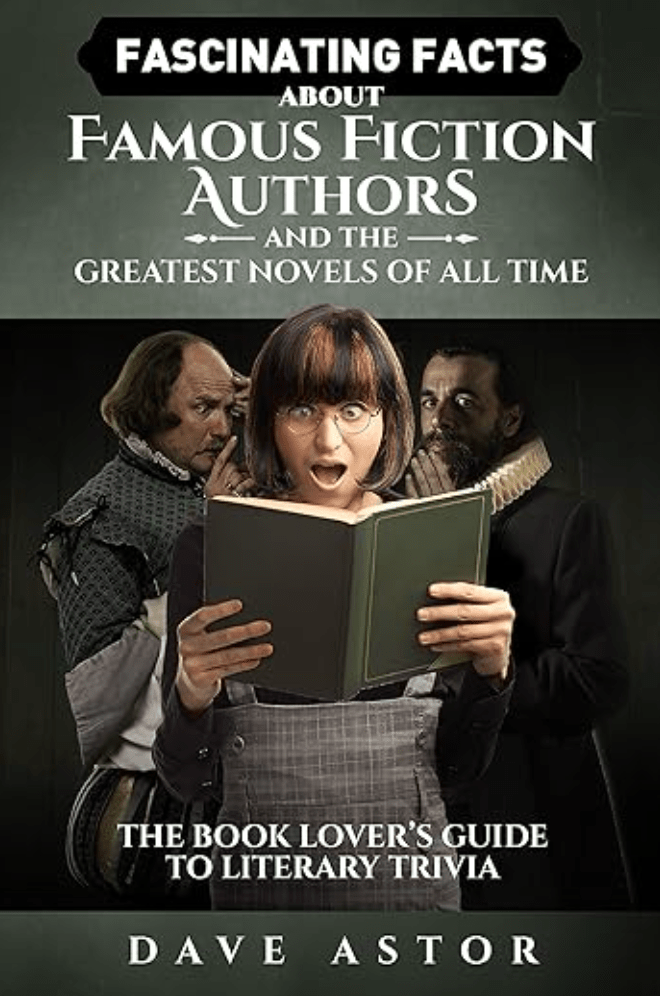
I’m also the author of a 2017 literary-trivia book

…and a 2012 memoir that focuses on cartooning and more.

In addition to this weekly blog, I write the 2003-started/award-winning “Montclairvoyant” topical-humor column every Thursday for Montclair Local. The latest piece — about a lot of school news during a non-school time — is here.

When It’s Two or More, Jaws Can Hit the Floor

J.K. Rowling with the screen versions of her Harry Potter, Hermione Granger, Cormoran Strike, and Robin Ellacott characters (Everett/Getty/BBC).

It’s impressive enough when a novelist creates one successful series — as, say, Lee Child did with his Jack Reacher books and Sue Grafton did with her alphabet mysteries. But an author who creates two or more successful series? Wow!

Some writers produce multiple series consecutively — finishing one series before starting another. Other writers tack back and forth between different series. Either way, it takes some impressive and wide-ranging creative talent, and helps “serial” novelists stay fresh. Those authors can also feel good about readers staying with them as they offer something new.

Among the queens and kings of multiple series is J.K. Rowling. She of course penned the seven mega-popular Harry Potter books. Then, after writing The Casual Vacancy standalone novel, Rowling as “Robert Galbraith” launched her crime series starring private investigators Cormoran Strike and Robin Ellacott. I’m currently close to finishing the seventh installment — The Running Grave, in which Robin goes undercover to infiltrate a very problematic cult — and its 945 pages are full of the thrills, humor, suspense, poignancy, complications, excellent prose, and believable dialog Rowling always provides.

Walter Mosley is best-known for his detective series starring Easy Rawlins, who has now starred in 16 novels. But the author has interspersed those books with smaller series such as the King Oliver books and the Socrates Fortlow books. Mosley is always a great read, no matter who the protagonist is.

Val McDermid has gone the several-series route, too, including a compelling saga starring inspector Karen Pirie and another featuring journalist Allie Burns. Also not a clunker in the installments I’ve read.

Leaving contemporary fiction for a minute, L.M. Montgomery wrote Anne of Green Gables and its many sequels while also penning the semi-autobiographical Emily trilogy. (I consider a trilogy to be a series of sorts.)

Returning to a living author, Diana Gabaldon has gone the “sub-series” route by writing nine main Outlander novels (so far) and a number of offshoot books starring the Lord John character who’s a supporting player in the main novels.

Your thoughts about, and examples of, this theme?

Misty the cat says: “Snow means ‘Middlemarch’ author George Eliot wrote ‘Middledecember,’ too.”

My comedic 2024 book — the part-factual/part-fictional/not-a-children’s-work Misty the Cat…Unleashed — is described and can be purchased on Amazon in paperback or on Kindle. It’s feline-narrated! (And Misty says Amazon reviews are welcome. 🙂 )

This 90-second promo video for my book features a talking cat: 🙂

In addition to this weekly blog, I write the 2003-started/award-winning “Montclairvoyant” topical-humor column every Thursday for Montclair Local. The latest piece — which discusses what’s happening with my town’s animal shelter and much more — is here.

The Many-Decade Spans of Some Sequels and Series

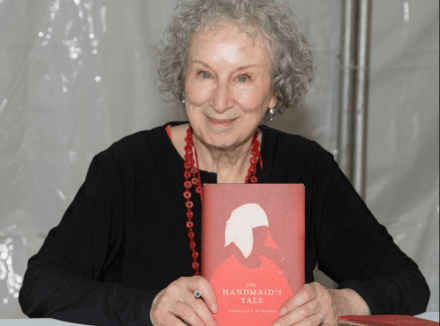
After reading last week that Margaret Atwood is writing a follow-up to The Handmaid’s Tale, I thought about which sequels — and series — spanned the most time.

Atwood’s famous, feminist, dystopian novel came out in 1985, and The Testaments will be published in 2019 — making for a gap of 34 years. Not quite the 36-year-period between Stephen King’s The Shining (1977) and its sequel Doctor Sleep (2013), but plenty long.

Why gaps like that? Authors such as King and Atwood (pictured above) are of course busy writing many other books, and may not want to revisit the same characters — at least until several decades go by. In Atwood’s case, one spur for the coming sequel is the high popularity of the current The Handmaid’s Tale television series. Also, the Republican Party’s current far-right/misogynist politics make her 1985 novel prescient and very relevant to today.

The Testaments will reportedly begin 15 years after The Handmaid’s Tale ends. Other sequels can of course be set closer or farther away in time from the original novel.

Can many-years-later sequels be better? Sometimes. Heck, the authors have often become more mature writers. But they might also be past their prime, a bit tired, and not have as many new ideas. Still, numerous fans don’t mind if a sequel isn’t as good; they’re just happy it exists. Plus there’s money to be made for the authors — not that superstar writers like Atwood and King need it. 🙂

Other one-sequel, multiple-sequel, or series scenarios spanning many a decade?

P.G. Wodehouse wrote his Jeeves novels and stories over a stunning period of nearly 60 years — 1915 to 1974!

Agatha Christie featured Hercule Poirot in 40-plus novels and short-story collections for more than a half-century — from 1920’s The Mysterious Affair at Styles into the 1970s. And Christie’s Miss Marple character starred in more than 10 books from 1930 (The Murder at the Vicarage) into the ’70s.

John Updike’s four Rabbit novels were published over a period of 30 years (1960, 1971, 1981, 1990) — with a novella added to the mix in 2001. So, 41 years total.

Other large spans include 35 years between Sue Grafton’s first and 25th “alphabet mysteries” starring Kinsey Millhone (“A” Is for Alibi, 1982/“Y” Is for Yesterday, 2017); 32 years between Martin Cruz Smith’s first and eighth Arkady Renko novels (Gorky Park, 1981/Tatiana, 2013); 26 years between Walter Mosley’s first and 14th Easy Rawlins novels (Devil in a Blue Dress, 1990/Charcoal Joe, 2016); 25 years between Jack Finney’s Time and Again (1970) and From Time to Time (1995); 24 years between Janet Evanovich’s first and 25th Stephanie Plum novels (One for the Money, 1994/Look Alive Twenty-Five, 2018); and 23 years between Richard Russo’s Nobody’s Fool (1993) and Everybody’s Fool (2016).

Then there are Honore de Balzac’s and Emile Zola’s many-book sagas containing stand-alone but interlinked novels featuring characters who pop in and out, sometimes as lead protagonists and sometimes as supporting players. Balzac wrote his La Comedie Humaine works from 1830 to the late 1840s — not that long a period because of his relatively early death, but an extraordinarily prolific period that produced a whopping 90-plus novels (such as Old Goriot and Cousin Bette) and stories! Zola penned his 20 Rougon-Macquart novels (The Drinking Den, Germinal, etc.) from 1871 to 1893.

Other sequels and series you can name with many-year publishing spans? And/or any comments about the ones I mentioned?

I will not be posting columns on December 9 and 16 (because of another trip to Florida to deal with my late mother’s estate and some other reasons). Back on December 23! I’ll still reply to comments under already-published columns. 🙂

My 2017 literary-trivia book is described and can be purchased here: Fascinating Facts About Famous Fiction Authors and the Greatest Novels of All Time.

In addition to this weekly blog, I write the award-winning “Montclairvoyant” topical-humor column for Baristanet.com. The latest weekly piece — written by my cat! — is here.

‘A Game of Thrones’ vs. ‘The Lord of the Rings’

It took me a long time to get to it, but I finally read A Game of Thrones after commenters here recommended it.

The first volume of George R.R. Martin’s “A Song of Ice and Fire” epic fantasy series clocks in at nearly 700 large-size, small-print pages. I almost abandoned the novel after a few chapters, because the author kept jumping to so many different characters that it was hard to get absorbed. But I finally did, and found the book really compelling from then on.

Rather than write a straightforward review of A Game of Thrones — which, along with its sequels, inspired the hit TV series — I thought I’d compare it to the other epic fantasy tour de force read by many people (like me) who usually don’t read fantasy. I’m of course referring to J.R.R. Tolkien’s trilogy The Lord of the Rings, and its prequel The Hobbit.

Overall, Tolkien’s wonderful classic is more of a page-turner — the storytelling is mostly linear, and the quest to destroy that titular ring is riveting. Martin’s most noticeable plot line — various families striving for power — is also exciting but a bit more diffuse. Yet A Game of Thrones (I haven’t read the sequels) surpasses The Lord of the Rings in certain ways.

Both epics have great writing, memorable characters, and excellent humor (though Tolkien is somewhat funnier — at least in The Hobbit). Each also features all kinds of death and war, but Martin’s depiction of violence is much more graphic and realistic. Perhaps partly a product of our current time.

Martin expertly juggles a somewhat larger cast of principal players, and, to his credit, has far more female protagonists in major roles. That might also be partly a product of a later era, but, heck, plenty of novels in Tolkien’s heyday had prominent female characters.

Perhaps most importantly, Martin’s characters are more three-dimensional than the vast majority of those in Tolkien’s cast. Few of the Game of Thrones denizens are all good or all bad — and that kind of moral ambiguity makes things very interesting.

Another interesting difference between the Martin and Tolkien works is that A Game of Thrones is mostly populated by humans, while The Lord of the Rings features a variety of bipeds: humans, hobbits, wizards, elves, orcs, etc.

Also, both series are set in long-ago, pre-modern-technology times. Martin does a better job of depicting the squalor and difficulties of living in such an era; things are more sanitized in The Lord of the Rings.

Will I read more of “A Song of Ice and Fire”? Not sure. A Game of Thrones was a large investment of time (about two weeks), and I’m not a fantasy buff. But I might. The novel ended on a very intriguing note, and I’m curious about what will happen to such characters as Daenerys Targaryen, the timid teen girl who turns into a ruthless dynamo; Arya Stark, the resourceful “tomboy”; Jon Snow, the outcast “bastard” son who makes something of his life; Joffrey Baratheon, the appalling young prince-turned-king; and Tyrion Lannister, the witty/crafty dwarf with perhaps the biggest personality in the book. (Tyrion, as played by Peter Dinklage in the HBO series, is pictured above.)

If you’ve read them, any thoughts on George R.R. Martin’s and J.R.R. Tolkien’s famous creations? (For those counting, that’s four “R” initials you just saw. 🙂 ) What other fantasy works have you enjoyed?

My 2017 literary-trivia book is described and can be purchased here: Fascinating Facts About Famous Fiction Authors and the Greatest Novels of All Time.

In addition to this weekly blog, I write the award-winning “Montclairvoyant” topical-humor column for Baristanet.com. The latest weekly piece — about climate change, a Board of Education resignation, and a school stairway collapse — is here.

Different Approaches to Reading Sequels

When we finish a great novel that’s part of a series or has sequels, it’s a wonderful feeling to know there’s more to come. But how to go about it? Do we focus on those books for weeks or months on end, ignoring the work of other authors? Or do we read the next installments sporadically over a longer period of time while mixing in different writers?

There’s no right answer, of course — it’s whatever the individual reader prefers. And if the next installment hasn’t been written/published yet, obviously fiction fans will read other authors as they eagerly await a serial saga’s continuation.

The pros and cons of each approach? If one reads a series or sequels while ignoring novels by different writers, one can achieve wonderful immersion and momentum, really get to know the characters, more easily remember foreshadowing from previous books, and pick up other kinds of nuances. On the negative side, a bit of sameness can set in. And think of all the literary variety temporarily being missed!

My most memorable experience with both approaches involved J.K. Rowling’s stellar Harry Potter series. Starting in the late 1990s, I waited each year or so for the next installment. A painful wait, but there were plenty of months to read other authors. Then, several years after the seventh and last of the Potter novels was published, I went back and reread them one after another — with no non-Potter book in between. It was a terrific experience, partly for the reasons mentioned in the previous paragraph.

I also consecutively read James Fenimore Cooper’s five “Leatherstocking” novels (The Last of the Mohicans, etc.). I don’t care that Mark Twain hated those books; I liked them a lot.

And of course when you have a compelling trilogy, you might as well read all three books in a row — as I did with Suzanne Collins’ The Hunger Games and its two sequels, Stieg Larsson’s The Girl With the Dragon Tattoo and its two sequels, Cormac McCarthy’s All the Pretty Horses and its two sequels, and J.R.R. Tolkien’s The Lord of the Rings. (For me, there was a gap between reading Tolkien’s trilogy and an earlier reading of The Hobbit prequel.)

Recently, it was Martin Cruz Smith’s work that had me wrestling with how to go about reading sequels. I liked his Gorky Park so much last month that I quickly borrowed the first two sequels from the library. Polar Star (claustrophobically set on a fishing ship) was almost as good, as was Red Square. But I did manage to squeeze another author’s book — Philippa Gregory’s very good historical novel Earthly Joys — between Gorky Park and Polar Star. Which made me want to read the Earthly Joys sequel Virgin Earth. 🙂 But when I visited my local library this past Friday, Virgin Earth wasn’t there, so I borrowed the five other Gorky Park sequels! (Havana Bay, Wolves Eat Dogs, Stalin’s Ghost, Three Stations, and Tatiana.)

Other times, months or even years go by before I get to the next installment. That was the case with John Steinbeck’s Cannery Row and its sequel Sweet Thursday.

Or it can be a little of both approaches. For instance, I read L.M. Montgomery’s Anne of Green Gables and its first three sequels consecutively, and then later got back to the other sequels.

There’s also the case of reading some sequels but not all of them. I enjoyed Walter Mosley’s first two Easy Rawlins mysteries and Sue Grafton’s first four Kinsey Millhone alphabet mysteries, but not quite enough to immediately continue with more. But I might get back to them!

And how about reading a series mostly out of order? I’ve done that with Lee Child’s Jack Reacher novels, partly because some of the books were at my local library only some of the time.

How do you read series and sequels?

Because of some travel, I will not be posting columns March 25 and April 1. I look forward to returning with a new piece on April 8! I’ll still respond when I can to any comments under already-published columns.

My 2017 literary-trivia book is described and can be purchased here: Fascinating Facts About Famous Fiction Authors and the Greatest Novels of All Time.

In addition to this weekly blog, I write the award-winning “Montclairvoyant” topical-humor column for Baristanet.com. The latest weekly piece — about topics such as a mayor’s interference in the search for a schools superintendent — is here.