Today is “The Ides of March,” the March 15 date on which Roman dictator Julius Caesar was assassinated in the year 44 BC. So, I’m going do a word salad rather than a Caesar salad discussing some memorable murders in literature — while trying to avoid too many spoilers in the specific details.
Murders are of course awful, even as they’re sometimes almost merited for righteous revenge reasons. Whatever the motives behind them, they can be a key plot device and make for painfully dramatic reading.
One novel’s title that literally telegraphs a killing is Chronicle of a Death Foretold by Gabriel Garcia Marquez. Written in a journalistic reconstruction fashion, the book is far from the author’s best work but still interesting.
Also quite interesting is Albert Camus’ The Stranger and its puzzling murder by the novel’s detached protagonist.
The brutal double-killing early in the iconic Crime and Punishment is…iconic. Then we spend the rest of Fyodor Dostoevsky’s psychological novel observing Rodion Raskolnikov’s angst, his attempts to justify his action, his worry about capture, and more.
Other novels with multiple murders? We’ve read a few — including Agatha Christie’s classic And Then They Were None and its many dispatched characters. They deserve some punishment, but do they deserve dying? Murders, of course, are a staple of mysteries, detective fiction, and thrillers.
Totally innocent is Black teen Donte Drumm, who’s wrongly accused of killing a white high school girl in John Grisham’s The Confession. Will that murder by someone else lead to another murder — the execution of Drumm — by racist authorities?
Which reminds me of the unjust killings by law enforcement of characters in novels such as Angie Thomas’ The Hate U Give (another Black teen is the victim) and John Steinbeck’s The Grapes of Wrath (a white man is the victim).
Retaliatory killings? We see righteous ones in Alexandre Dumas’ The Count of Monte Cristo, Erich Maria Remarque’s Arch of Triumph, and Percival Everett’s James — the last book a reimagining of Mark Twain’s Adventures of Huckleberry Finn. Speaking of Twain, he wrote about the execution of a real-life heroine in Personal Recollections of Joan of Arc — a novel in the historical-fiction genre also inhabited by Margaret Atwood’s Alias Grace and its double-murder.
If we include genocide in this discussion, various grim novels come to mind — including Holocaust ones such as William Styron’s Sophie’s Choice and Herman Wouk’s War and Remembrance.
In the short-story realm, there many murder-in-the-mix tales to choose from: “The Lottery” by Shirley Jackson, “A Good Man Is Hard to Find” by Flannery O’Connor, “A Jury of Her Peers” by Susan Glaspell, “The Tell-Tale Heart” and “The Cask of Amontillado” by Edgar Allan Poe, etc., etc.
Your thoughts about, and examples of, this topic?
I will probably be offline much of tomorrow (Monday, March 16) while in New York City but will reply to comments after I return. 🙂
Misty the cat asks: “Is it necessary for my building to have a steering wheel?”
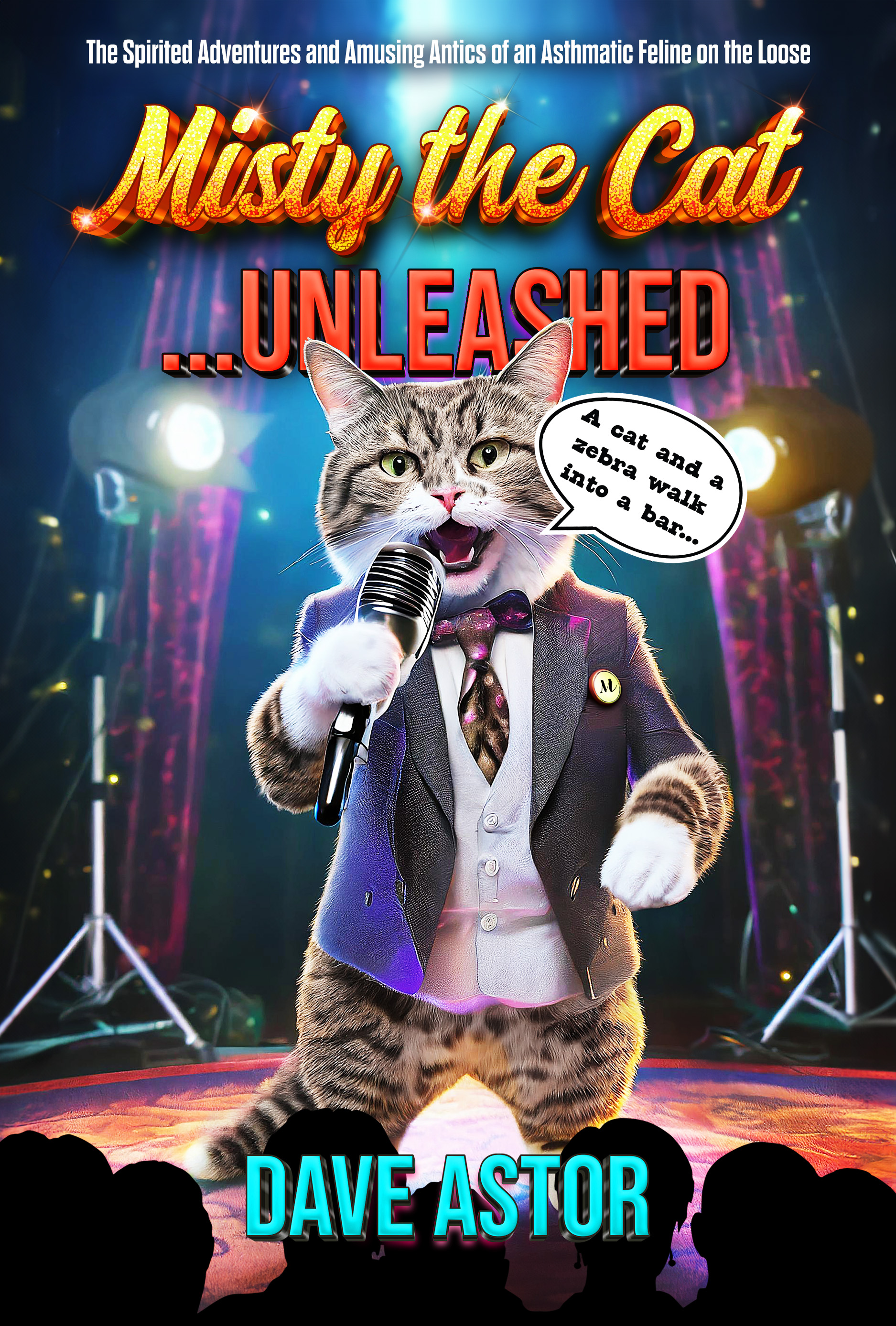
My comedic 2024 book — the part-factual/part-fictional/not-a-children’s-work Misty the Cat…Unleashed — is described and can be purchased on Amazon in paperback or on Kindle. It’s feline-narrated! (And Amazon reviews are welcome. 🙂 )
This 90-second promo video for the book features a talking cat: 🙂
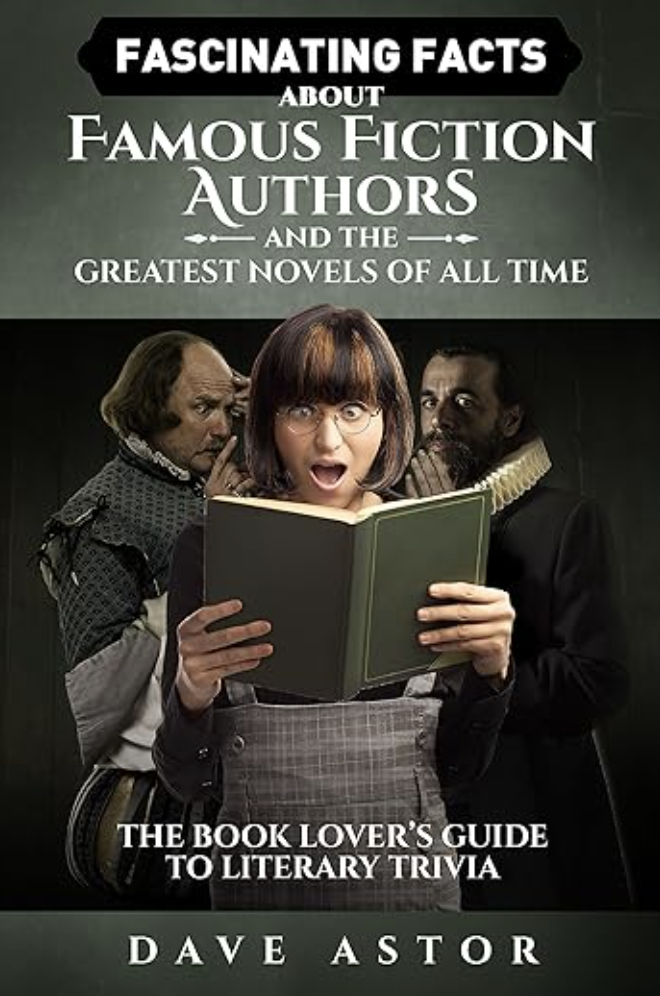
I’m also the author of a 2017 literary-trivia book…
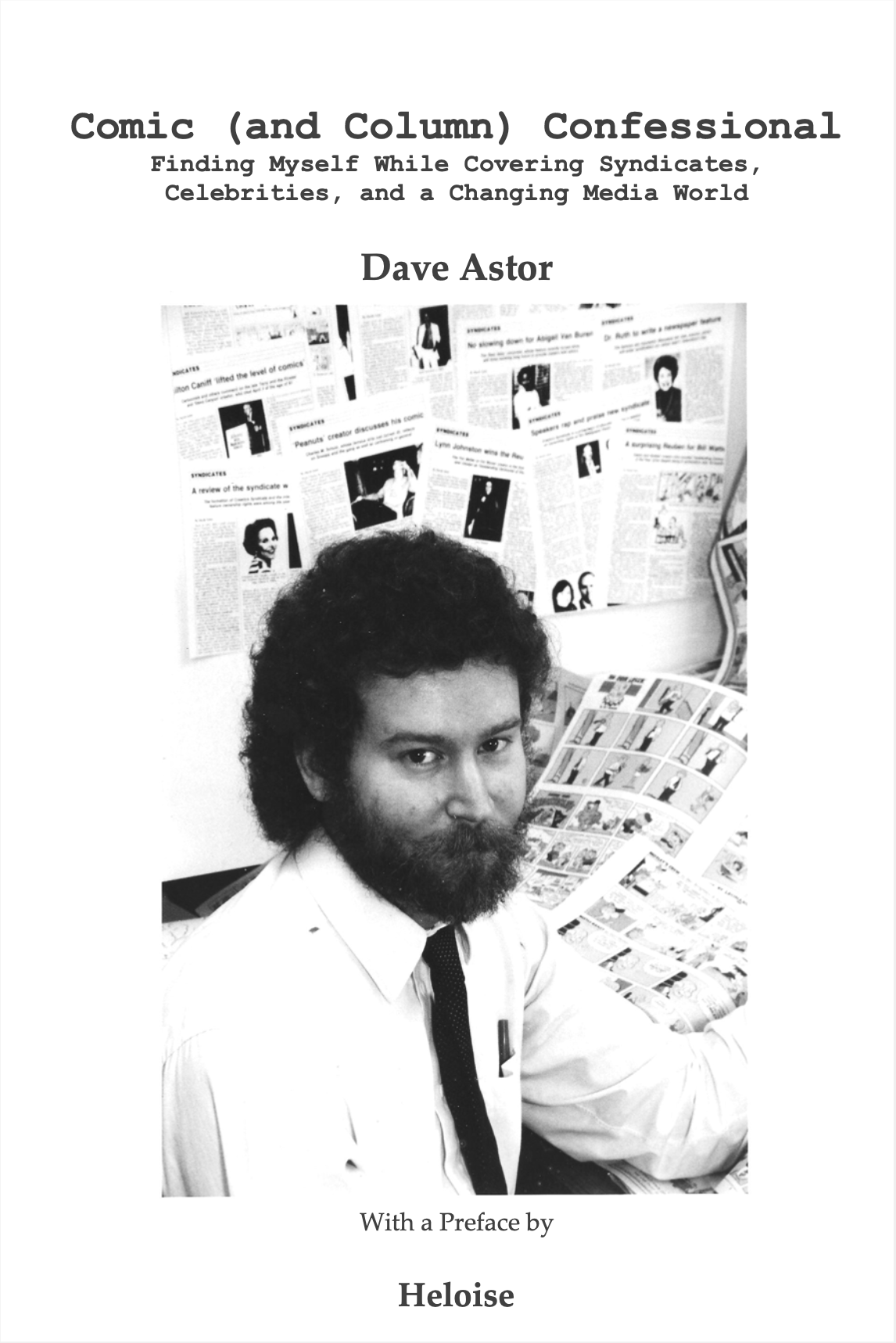
…and a 2012 memoir that focuses on cartooning and more, including many encounters with celebrities.
In addition to this weekly blog, I write the 2003-started/award-winning “Montclairvoyant” topical-humor column every Thursday for Montclair Local. The latest piece — with my thoughts about unofficial voting results on a school deficit matter roiling my town — is here.
 Dave Astor on Literature
Josephine Tey again, as her unlikely detective Lucy Pym, escaped French teacher, now accidently a best selling writer on psychology, works out, near the end of Miss Pym Disposes, which P.E. student really killed the unpopular Barbara Rouse. A goddess, of course, the blue eyed, golden haired Pamela Beau Nash. Miss Pym’s spotted, at last, how cold those blue eyes are. Never charged, police satisfied it was an accident. Miss Pym knows better.
Shuddering as eight o’clock strikes, and another murderer hangs, I suspect Lord Peter Wimsey prefers deaths that aren’t murder, Denis Cathcart’s suicide, Geoffrey Deacon’s technically impossible death by bellringing, and Harriet Vane’s escape from death by strangulation, foiled by a dog collar ( a dog harness wouldn’t have saved her) ,
.
LikeLiked by 1 person
Thank you, Esther, for those vivid mentions regarding the works of Josephine Tey and Dorothy L. Sayers! I enjoyed seeing your thoughts.
LikeLiked by 1 person
Hi Dave!
I was immediately drawn to the title of your latest post ‘Murder They Wrote’. Murder/crime/mysteries is my favourite genre in fiction.
You have mentioned some great books. I haven’t read ‘Crime and Punishment’ in many years. I am keen to read it again now!
Thank you Dave for your enlightening thoughts on this genre.
Hope the week is going well.
Best wishes,
Sharon 📚
LikeLiked by 1 person
Thank you, Sharon! I’ve also become a big fan of mysteries, etc., in the past couple of years. Better late than never. 🙂
I’ve read “Crime and Punishment” twice and found it just as compelling the second time even though I knew what would happen.
Hope your week is going well, too!
LikeLiked by 1 person
Hi Dave!
Thank you for your kind wishes for the week.
I really enjoy mysteries, I’m glad you do now also!!
Yes, ‘Crime and Punishment’ I’m sure I will enjoy it again too. Great short story!
Thanks again, Dave ☺
LikeLiked by 1 person
Mysteries definitely distract readers (for a little while) from all the awful real-life stuff happening in the world. Thanks, Sharon, for your follow-up comment! 🙂
LikeLiked by 1 person
I hear that Dave! That’s the beauty of reading fiction in general. It’s a good way to switch off the real world for a while.
All the very best!
😊 📚
LikeLiked by 1 person
“That’s the beauty of reading fiction in general. It’s a good way to switch off the real world for a while” — I totally agree, Sharon. Couldn’t have said it better. 🙂
The very best to you, too!
LikeLiked by 1 person
☺
LikeLiked by 1 person
🙂
LikeLiked by 1 person
I meant to add that Edgar Allan Poe invented the murder mystery genre with his stories The Murders in the Rue Morgue,” “The Mystery of Marie Rogêt,” and “The Tell-Tale Heart.’
LikeLiked by 1 person
Loved Poe’s pioneering fictional investigator C. Auguste Dupin! Also in “The Purloined Letter.”
LikeLike
I haven’t read Tge Purloined Letter. I will look for it. Thank you 🙏
LikeLiked by 1 person
Not quite as good as “The Murders in the Rue Morgue,” but still pretty compelling!
LikeLike
This is good to know. I like Poe 💛🍔
LikeLiked by 1 person
Me, too, Robbie!
LikeLike
😊
LikeLiked by 1 person
🙂
LikeLike
Hi Dave, murder can be very defining in a book and you have cited some terrific examples. I am going to add Rebecca by Daphne du Maurier, all the Agatha Christie books, Tess of the d’Urbervilles (Tess murders Alex), Macbeth by Shakespeare, and Oliver Twist by Charles Dickens
LikeLiked by 1 person
Thank you, Robbie, for all those excellent examples! I wonder if Agatha Christie ever wrote a mystery without a murder or murders? (I’m not sure; I’ve only read about a half-dozen of her novels.) The killing in “Oliver Twist” was very shocking for many readers at the time.
LikeLike
Dear Dave Astor, I always find a great joy reading you. Sometimes, I respond late. Please, forgive me for that. I read Campus’ The Stranger and Christy’s Ten There Were and None in high school. Thank you for bringing them back to my mind. Now, I am more mature, I think I’ll have to read them again for a better and deeper understanding. And I appreciated your previous Women in fiction. Sincerely, Ahmadou
LikeLiked by 2 people
Thank you very much, Ahmadou! Glad you liked this murder post and the previous piece about women characters. Hope you enjoy “The Stranger” and “And Then There Were None” when you reread them. 🙂
LikeLike
Dave, your Ides of March “word salad” is an intriguing way to wander through literature’s darker moments. Shakespeare’s Macbeth comes to mind for me. The murder of King Duncan is shocking, yet the play quickly turns away from the act itself and toward the unraveling of Macbeth’s conscience and ambition.
That is something I find fascinating in many great works of literature. Murder may begin the story, but it is rarely the real subject. The deeper question becomes why it happens and what it reveals about human nature, guilt, power, and the consequences of our choices.
In that sense, the act itself is almost secondary. What endures is the way the author uses it to illuminate the human heart. I love this powerful line from Macbeth (Act 1, Scene 7)
“I have no spur
To prick the sides of my intent, but only
Vaulting ambition, which o’erleaps itself
And falls on th’ other.”
Safe travels and enjoy New York.
LikeLiked by 2 people
Thank you, Rebecca! When one thinks of murder and Shakespeare’s plays, “Macbeth” is definitely a prime example! And I hear you about how murder can be sort of the scaffolding for a plot while not necessarily being the absolutely main plot. “The deeper question becomes why it happens and what it reveals about human nature, guilt, power, and the consequences of our choices” — an excellent observation by you!
LikeLiked by 1 person
I LOVE our conversations, Dave!
LikeLiked by 1 person
The feeling is mutual, Rebecca! 🙂
LikeLiked by 1 person
I always love when the Hate U Give is brought up, because it reminds me how much that book impacted me. Such a great read. I’m reading Dan Brown’s Secret of Secrets, and like many of his other reads, there is some murder along with the mayhem! 🙂
LikeLiked by 1 person
Thank you, M.B.! I agree that “The Hate U Give” has a big impact on a reader; it’s a really memorable modern novel.
I didn’t like Dan Brown’s “The Da Vinci Code” enough to read more from that author, but maybe someday…
LikeLiked by 1 person
That’s fair! 🙂
LikeLiked by 1 person
I liked the intricate plot but thought the writing was clunky. 🙂
LikeLiked by 1 person
So many great books in this genre that I’ve not yet read, Dave! I don’t know if I’ve actively steered clear out of dislike or lack of time. Either way, I’ve just got some catching up to do! Just this weekend a friend mentioned “Listen for the Lie” by Amy Tintera. New to me…a book with murderous overtones from what I gleaned. And a great title! Sending Monday smiles to you my friend – thanks for another fab post. 💝😊💝
LikeLiked by 1 person
Thank you, Vicki! I hear you about the possible reasons for not reading that many books featuring murders. 🙂 And “Listen for the Lie” IS a great title!
A good Monday to you, too! 🙂
LikeLiked by 1 person
Thank you! 😉❤️😉
LikeLiked by 1 person
🙂
LikeLike
Awful or not… as can be seen from you post and the comments, murders sure make good and popular reading
LikeLiked by 1 person
Thank you, Shehanne! Yes, hard to write fiction about a topic much more compelling and consequential than murder.
LikeLiked by 1 person
Oh oih loikes a good murder oih does!
LikeLiked by 1 person
For plot purposes, yes indeed!
LikeLiked by 1 person
.Abso
LikeLiked by 1 person
How could anyone think otherwise……….
LikeLiked by 1 person
Yes! 🙂
LikeLiked by 1 person
Many thanks, Dave, for having made me remember of some of the the very touching crime stories! I still remember quite well The Count of Monte Cristo, which you also mentioned and I also remember Charles Manson and his cult “The family” which used to kill famous people such as Sharon Tate! Many thanks for your topic and all the best:)
LikeLiked by 1 person
Thank you, Martina! “The Count of Monte Cristo” is an amazing novel, isn’t it? Long but never boring. Charles Manson — ugh. What a monster. 😦
LikeLiked by 1 person
Yes, Dave, I read this unputdownable book as a young girl and remember, above all, the time when “The Count” was in prison on an island and finally managed to escape thanks to a very cunning way!! The world seems to be full up of monsters! Many thanks for your answer/question:)
LikeLiked by 1 person
Yes, such an amazing, dramatic, innovative escape, Martina! I thought about that escape when I visited the Chateau d’If prison while in Marseille in 2007.
LikeLike
👏🌷
LikeLiked by 1 person
🙂
LikeLike
Well, I am rather stumped, I am afraid! Reading novels about murder (and mayhem) are not my cuppa of tea. Watch series and films are fine, but generally I wouldn’t know the authors, apart from Agatha Christie and Arthur Conan Doyle, for example. Sorry about that, Dave.
LikeLiked by 1 person
Thank you, Chris! That’s quite all right. 🙂 Reading about murder is not exactly pleasurable, but at least the fictional killings ones are…fictional. 🙂
LikeLiked by 1 person
A thought-provoking post, Dave! I remember reading Crime and Punishment in my late teens and it blowing my mind! It left quite an impression on me. I’d quite like to reread it now that I’m in my forties, and also Camus’s The Stranger, too. 😊
LikeLiked by 1 person
Thank you, Ada! I totally agree that “Crime and Punishment” is mind-blowing — an absolutely riveting novel. I reread it once, and it was worth every minute.
LikeLiked by 1 person
As usual, Dave, your blog perfectly fits my current reading experience. Not the book (no murders in “The Rosie Project” but the fact that I just ate a Caeser salad while on my lunch break reading the somewhat problematic Simsion novel.
‘Murders are of course awful…’ Gotta disagree with this one, Dave. At least in the world of fiction. George RR Martin certainly wrote a murder or two that I greatly enjoyed! Stephen King has also pulled it off once or twice. Oh, and Anne Rice killed off the first ever vampire in a very satisfying way.
LikeLiked by 2 people
Thank you, Sue! Et tu, Caesar salad?! 🙂
I guess I was speaking of real-life killings with my murder is awful line, but, yes, some fictional ones can be satisfying. And some real-life murders evoke more regret than others.
LikeLiked by 1 person
I’m going to suggest another classic by Agatha Christie. Murder on the Orient Express is a different kind of multiple murder.
I’ll also plug the books in my Dreamer’s Alliance series. Murders, attempted murders — revenge, suicide and self-defense — all kind of murders.
LikeLiked by 1 person
Thank you, Dan! “Murder on the Orient Express” is definitely a classic, and, yes, it feature a very clever plot premise that redefines the multiple in multiple murder.
Also, great that you mentioned your series! Quite a variety of methods of death…
LikeLiked by 1 person
I have to say I can’t think of anything but murder mysteries off the top of my head. “The Stranger” definitely had an effect on me in high school. And didn’t someone recently write a reimagining of it? There’s lots to work with. (K)
LikeLiked by 1 person
“The Meursault Investigation” .
LikeLiked by 1 person
Thank you, Kerfe! “The Stranger” definitely has an impact on readers’ psyches. And I didn’t realize there was a reimagining of that book!
My favorite Camus novel is “The Plague” — depressing but terrific.
LikeLiked by 1 person
Another good one.
LikeLiked by 1 person
Yes!
LikeLiked by 1 person
Dan Brown’s The Da Vinci Code begins with a murder at the Louvre Museum and unfolds through historical and religious enigmas
LikeLiked by 2 people
Thank you, Luisa! Excellent mention! That murder near the start of “The Da Vinci Code” is quite something. 😦
LikeLiked by 1 person
I appreciate your kind reply, dear Dave !
LikeLiked by 1 person
🙂
LikeLiked by 1 person
An apt topic for The Ides of March, Dave. Sad to say, I’ve read only a few of the novels you mention. Though I can’t recall any memorable murders in literature, I’ve found the murder of a child or a beloved character the most impactful.
LikeLiked by 2 people
Thank you, Rosaliene! Yes, the murder of a child or a beloved character in literature is devastating, as is their death from disease or something else. One can almost be scared to start such a novel if one has an inkling that that might happen after reading a review or hearing something word-of-mouth.
LikeLiked by 1 person
Dave, I experienced a similar scare/tension recently while reading Paula Hawkins’ mystery/thriller novel “Into the Water” (2017). In order to continue reading, I read the final chapters. Crazy!
LikeLiked by 1 person
A reader must cope in any way possible! 🙂
LikeLiked by 1 person
I see you mention the old Alfred Hitchcock Presents in the comments. That show is exactly what your topic reminded me of…such unusual murders or twisty outcomes of those deaths. I loved that show, even as a kid. No surprise that my favorite genre ended up being mystery:)
LikeLiked by 2 people
Thank you, Becky! I saw several reruns of that Hitchcock TV series years ago, and “unusual” and “twisty” are two very accurate words to describe the plots! Maybe not as transcendent a series as “The Twilight Zone,” but still darn good. I can see why you were a fan.
LikeLiked by 2 people
I also love Twilight Zone. I still like to catch an ep now and then. For some, I’ve forgotten the endings:)
LikeLiked by 1 person
Forgetting an ending can be a good thing if it makes the rerun episode feel almost like a first-watch. 🙂
LikeLiked by 1 person
I agree!
LikeLiked by 1 person
An excellent topic, Dave, and no less than I’d expect of you. To my shame I haven’t read many of the books you list, although ‘The Stranger’ was a favourite and I have ‘Crime and Punishment’ waiting in my TBR. ‘Julius Caesar’ was of course a teen school read, and the subject of ‘justified killing’ was something that occupied the minds of Shakespeare and his contemporaries. Jacobean Revenge Tragedy was very much about the subject, especially where the murder victim was a ruler or other person of great power. Thomas Middleton’s ‘The Revenger’s Tragedy’ concerns a protagonist whose love was murdered some years before by the Duke, who’s also the ruler of their land. The revenge plot succeeds, but the revenger too meets his death – the feeling of the times being that it wasn’t a good thing to show somebody killing a ruler and getting away with it. That conflict continues today – note the recent killing in the USA of the CEO of a healthcare conglomerate, concerning which I’ve seen demonstrations on TV by those who feel the killer ought to be freed as the company failed in its duty to many who suffered and even died due to their seemingly heartless putting of profit over people. The problem is, of course, that a murder was committed, and letting the killer off would set a bad precedent. And of course I’ve gone off topic; but art of course mirrors real life, and vice-versa, which is why murder in literature is such an engrossing topic. Rant over. Catch you again later, Dave. Have a good week. 🙂
LikeLiked by 2 people
Thank you, Laura! Art indeed mirrors real life, which is definitely one reason why there’s so much murder and other deaths in literature.
That killing of the UnitedHealthcare exec you mentioned does bring up all kinds of issues. It was wrong for him to be murdered, yet the decisions he and his company made to deny medical benefits to countless people in the interest of maximizing profits led to thousands of deaths. Reminds me a bit of the debate between terrorism vs. state terrorism.
Which also reminds me of the horrific recent U.S. bombing of that girls’ school in Iran as part of the wasn’t-necessary U.S./Israeli war on that country — but that bombing was allegedly accidental/allegedly based on out-of-date mapping, though who knows? 😦
Certainly some ultra-memorable deaths in Shakespeare’s works, including “Macbeth” of course. I appreciate the other mentions, too!
LikeLiked by 1 person
Thank you, Dave. I know who I believe in the ‘who bombed that school’ debate, and it’s not who I’d want to believe; but this is where we are in this surreal situation where threats of breaking international humanitarian law are being made, as in ‘giving no quarter’, which would be a war crime. 😦
LikeLiked by 1 person
Yes, Laura, war crimes galore — both committed and threatened. 😦
LikeLiked by 1 person
Pingback: Murder They Wrote | dean ramser
Most good books have a violent death, murder or otherwise.
A double murder that didn’t happen, if the intended deaths did, in The Human Stain by Philip Roth.
In Flannery O’Connor’s brilliant and haunting novel Wise Blood the principal character dies at the hand of a young policeman who preferred him unconscious as that would reduce the burden of bringing him in. He hits the man over the head with his billy club (new, for detail). “We don’t want to have no trouble with him”, he said [to his equally inexperienced partner]. You take his feet”. He died in the squad car, but they didn’t take notice, as the narrator casually observes.
LikeLiked by 1 person
Thank you, Dingenom! True that many memorable novels have death in them, sometimes violent. It just occurred to me that one of the most violent “literary” novels I’ve ever read is Cormac McCarthy’s “Blood Meridian,” in which there’s all kinds of disgusting slaughter by white guys in the 19th-century American West.
I’ve read “Wise Blood,” and it IS excellent and haunting. Flannery O’Connor was of course better known for her short stories, but did well with her rare longer-form writing.
LikeLiked by 1 person
This day commemorates what some thought was a justified murder. Motives for murder are endlessly interesting, both in real life and in fiction.
All this is to give my brain time to serve up some titles that haven’t been mentioned yet. Sadly, the only one that comes to mind is one of my own books, so I’ll bow out right here. 😃
LikeLiked by 1 person
Thank you, Audrey! Yes, when leaders rule in a brutal matter (which Caesar did at least partly), their murders can feel justified by some.
You and others are always welcome to mention their own books, or books by fellow bloggers, in comments here. 🙂
LikeLiked by 1 person
You’re welcome, Dave.
Now that I’m awake, I have remembered one rather strange book that involves murder: Drive Your Plough Over the Bones of the Dead by Olga Tokarczuk. It’s one of those unreliable narrator books that muddles the brain (in a good way).
And I’ll just mention my book The Friendship of Mortals, as an extra. Thanks for your indulgence!
LikeLiked by 1 person
Thanks, Audrey, for mentioning your book and Olga Tokarczuk’s book! Both with very intriguing titles. (Novels with unreliable narrators can be quite challenging/compelling.)
LikeLiked by 1 person
As a writer of mystery novels and a devoted mystery reader, I can list title after title of excellent books with murders in them. However, with the exception of Agatha Christie’s novel, I get the impression you are talking about “literature,” Dave. There are a number of outstanding mysteries that I think should count as literature, though. Here are three examples of genre books with murders that I think are classics:
Daphne du Maurier’s REBECCA
Dorothy L. Sayers’s STRONG POISON
Josephine Tey’s BRAT FARRAR
LikeLiked by 2 people
Thank you, Kim! I avoided talking a lot about mysteries/detective fiction today because I’ve recently touched on that genre in several posts. I should have made that clear. 🙂 When one thinks of murders in novels, mysteries are a REALLY important part of the discussion, and, yes, that genre often is excellent literature.
I appreciate the three examples you offered! I’ve read at least something by all those authors, and they’re great at creating suspense, psychological nuance, and more. (Among what I’ve read are du Maurier’s “My Cousin Rachel,” Sayers’ “Gaudy Night,” and Tey’s “The Daughter of Time.”)
LikeLiked by 2 people
I’ve read those three books, too. More favorites. I thought of putting down Gaudy Night, but it actually only has attempted murder in it. 🙂
LikeLiked by 2 people
You’re right — no murder in “Gaudy Night”! But lots of intrigue. 🙂
LikeLiked by 2 people
I’ve only read “Rebecca” once. I’m greatly looking forward to re-reading it one day to see how differently that unexpected murder hits when I know that it’s coming.
LikeLiked by 4 people
Some novels are definitely worth rereading, Sue. I’ve only read “Rebecca” once, too.
LikeLiked by 1 person
I read your posts for the wonderful wealth of knowledge and to reacquaint myself with literature I once studied decades ago. So I had to Google famous murders in fiction for a list of works you didn’t have room to cover, and Roald Dahl’s “Lamb to the Slaughter” sounds like an interesting listen while I am working, if I can find an audio file. But I have been wanting to listen to Crime and Punishment for a while. So I might listen to that one first.
LikeLiked by 2 people
Thank you for the kind words and comment, R. Jay! Googling can definitely help; I did that a few times while writing the post. 🙂 I remember seeing “Lamb to the Slaughter” adapted for a 1950s “Alfred Hitchcock Presents” TV episode (I watched a rerun of it at some point). “Crime and Punishment” would be very interesting to listen to!
LikeLiked by 2 people
Native Son by Richard Wright comes to mind. (That book made a big impression on me.) The Lovely Bones is another book featuring a murder, although I found the book flawed. The central conceit started unravelling about half way through.
I just finished writing a short story based on a former student of mine who brutally murdered a store clerk.
LikeLiked by 3 people
Thank you, Liz! Great mentions! That’s quite a fraught/painful/memorable murder in “Native Son” — and very relevant to race dynamics in the U.S. then and now. As for “The Lovely Bones,” I read it at least 20 years ago and can’t remember what I thought of how the central conceit was handled.
We might eventually see your just-finished short story on your blog? That had to be a personally intense story to write.
LikeLiked by 4 people
You’re welcome, Dave. Speaking of fraught, I forgot to mention The Confessions of Nat Turner by William Styron.
I’m hoping to get my new story published in a literary magazine, after which I’ll share it on my blog. We’ll see!
LikeLiked by 2 people
“The Confessions of Nat Turner”! Yes, many killings in that novel; slaves in revolt have much reason to take revenge.
The best of luck, Liz, getting your story accepted by a literary magazine!
LikeLiked by 2 people
Thanks, Dave!
LikeLiked by 2 people
You’re welcome, Liz!
LikeLiked by 2 people
It’s going to need more than a lifetime…but I’m glad there’s a treasure chest that will never get depleted. Thank you for these posts.
LikeLiked by 3 people
So true, Smitha. And I love your line “…a treasure chest that will never get depleted”!
LikeLiked by 2 people
I love reading your posts. It makes me realise how many books there are that I need to read.😊
LikeLiked by 3 people
Thank you, Smitha! Much appreciated! We all have many books to get to. 🙂
LikeLiked by 2 people