Some well-known novels are reaching round-number anniversaries in 2021 — as in 25 years (published in 1996), 50 years (1971), 75 years (1946), 100 years (1921), 150 years (1871), and 200 years (1821).
I’ll mostly mention novels I’ve read, and a few I haven’t. Let’s begin…
Alias Grace, Margaret Atwood’s rare foray into historical fiction, came out in 1996. It takes a gripping look at a 19th-century double murder in Canada — and how guilty or not the sentenced-to-life-in-prison Grace Marks was as an accomplice.
Hard to believe it was that long ago, but also published in 1996 was A Game of Thrones — the first installment of George R.R. Martin’s best-selling A Song of Ice and Fire series that later became a TV phenomenon. It’s the only novel I’ve read in the series, and I found it compelling after struggling a bit to get into it.
Among the notable ’96 novels I haven’t read are David Foster Wallace’s Infinite Jest and Helen Fielding’s Bridget Jones’s Diary.
A half-century ago, we had William Peter Blatty’s 1971 horror novel The Exorcist — a widely read book turned into a smash-hit movie. Also Ernest J. Gaines’ The Autobiography of Miss Jane Pittman, which covers nearly a century of history through the eyes of an African-American woman — and also inspired a highly popular film, in that case for TV. Plus, E.L. Doctorow’s The Book of Daniel, a thinly veiled retelling of the Rosenberg case from the vantage point of the couple’s children; Hunter S. Thompson’s riotous, semi-autobiographical Fear and Loathing in Las Vegas; and Erich Maria Remarque’s posthumously published Shadows in Paradise.
Also in ’71 were John Updike’s Rabbit Redux, the first sequel to the Rabbit, Run novel I had mixed feelings about (a bit too much toxic masculinity); and Herman Wouk’s epic The Winds of War, which I haven’t read but I sure did like that author’s earlier The Caine Mutiny and Marjorie Morningstar.
Memorable releases in 1946 — the birth year of despicable white-riot inciter Trump — included Robert Penn Warren’s All the King’s Men, a novel about a Huey Long-like politician, rampant corruption, and more; Carson McCullers’ The Member of the Wedding, starring a 12-year-old tomboy; and Nikos Kazantzakis’ Zorba the Greek. I’ve read the first two, not the third.
In 1921, parts of Marcel Proust’s opus In Search of Lost Time were released — as were L.M. Montgomery’s World War I-themed Rilla of Ingleside, one of the best Anne of Green Gables sequels; Crome Yellow, Aldous Huxley’s somewhat-interesting debut novel; and Booth Tarkington’s Pulitzer Prize-winning Alice Adams.
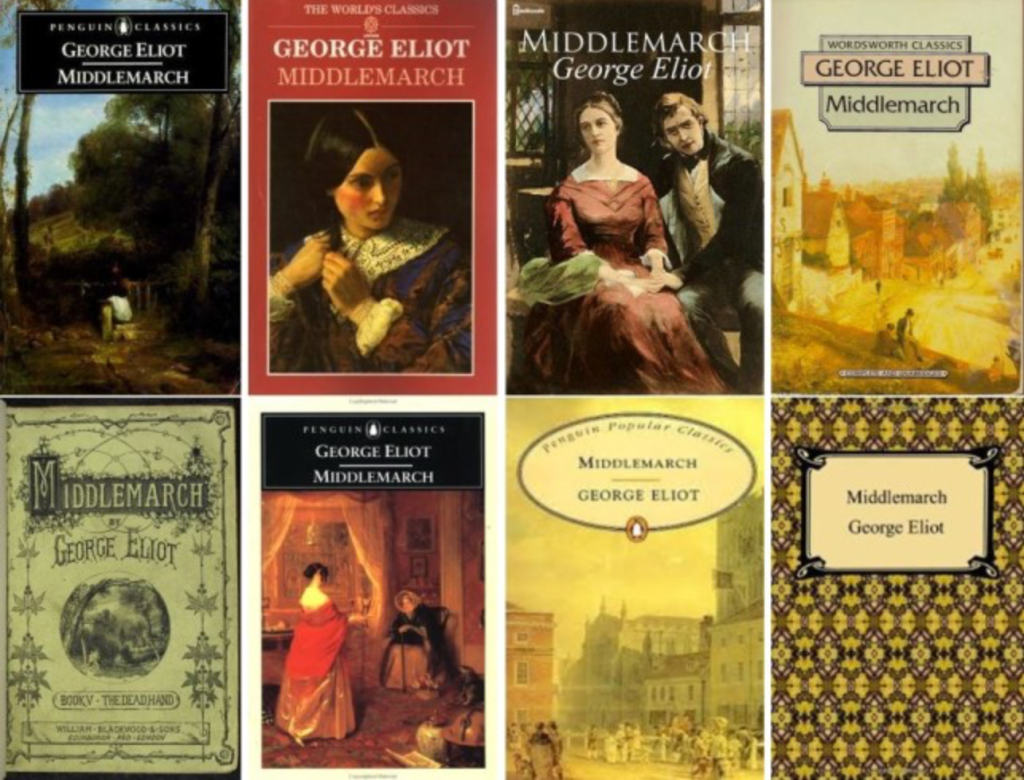
It was in 1871, 150 years ago, that George Eliot’s masterpiece Middlemarch was published. Clearly her best book in terms of scope, characterizations, and social analysis — and you’ll rarely read a better dissection of troubled marriages. But I do think several of Eliot’s slightly less masterpiece-y novels — including The Mill on the Floss and Daniel Deronda — pack an equal or greater emotional wallop.
Also released in 1871 were Lewis Carroll’s Through the Looking-Glass, the memorable sequel to Alice’s Adventures in Wonderland; Henry James’ debut novel Watch and Ward (published by a magazine in 1871 but not in book form until 1878); and Louisa May Alcott’s Little Men.
I haven’t read any 1821 novels, which included Kenilworth by Sir Walter Scott and The Spy by James Fenimore Cooper — two authors whose other books I’ve liked a lot. But, hey, Fyodor Dostoevsky was born that year — and Madame Bovary writer Gustave Flaubert, too.
Any novels with round-number 2021 anniversaries you’d like to discuss? (Including those I mentioned and those I didn’t.)
My literary-trivia book is described and can be purchased here: Fascinating Facts About Famous Fiction Authors and the Greatest Novels of All Time.
In addition to this weekly blog, I write the 2003-started/award-winning “Montclairvoyant” topical-humor column for Baristanet.com. The latest piece — about parking, leaf blowers, the Georgia runoffs, Trump, and more — is here.