We’ve Got Their Number: Our Most-Read Novelists

When I recently finished Past Tense, the latest page-turner starring Jack Reacher, I realized that I had now read 20 of Lee Child’s 23 great Reacher books. Which made me wonder, have I ever read that many novels by any other author?

So I scoured my list of books read, and my memory, to try to figure out which authors I had spent the most time with during my life. Of course, some writers pen longer novels than others, but I was looking strictly for number of books.

My first thought turned to Charles Dickens, because I took a college literature course in which the students read nothing but him. It turned out that I’ve read 14 Dickens novels, with a few of them perused pre- and post-college. Among my favorites? David Copperfield and The Pickwick Papers.

But I’ve actually read more books by Stephen King, not surprising given how prolific a writer he is. Fifteen of his novels, with my favorites Misery and From a Buick 8, among others. Actually, Misery might go under the category of “most intense” rather than a number-one favorite.

John Steinbeck? Thirteen of his novels read, with The Grapes of Wrath and East of Eden the ones I liked best. Also 13 for Colette, with my favorites The Vagabond and Claudine at School.

I’ve read all 12 of Willa Cather’s novels, enjoying My Antonia and The Song of the Lark the most. Twelve for Margaret Atwood, too, with my preferences including The Robber Bride and Alias Grace. And 12 for L.M. Montgomery, including my favorite-ever YA novel — Anne of Green Gables — as well as various Anne sequels and the sublime stand-alone novel The Blue Castle.

With 12 a popular number here, I’ll add J.K. Rowling. I’ve read her seven Harry Potter books as well as The Casual Vacancy, and am now in the middle of the fourth title (Lethal White) in her excellent crime series written under the Robert Galbraith alias. I’ve also read Harry Potter and the Cursed Child, but that’s a theater piece. I’m just doing novels here, not plays, short-story collections, nonfiction, etc.

Some of my other most-read authors (and some of my favorite novels of theirs) include Alexandre Dumas, 10 books (The Count of Monte Cristo and Georges); Sir Walter Scott, 10 (Old Mortality and The Heart of Midlothian); Martin Cruz Smith, 10 (Gorky Park and Rose); Jack London, 9 (Martin Eden and The Sea-Wolf); Cormac McCarthy, 9 (Suttree and Blood Meridian); Fannie Flagg, 8 (Fried Green Tomatoes at the Whistle Stop Café and The All-Girl Filling Station’s Last Reunion); and six authors with seven apiece: Henry James (The Portrait of a Lady and The American), Barbara Kingsolver (The Poisonwood Bible and Prodigal Summer), Herman Melville (Moby-Dick and Pierre), Erich Maria Remarque (Arch of Triumph and The Night in Lisbon), Mark Twain (Adventures of Huckleberry Finn and A Connecticut Yankee in King Arthur’s Court), and Emile Zola (Germinal and The Beast in Man).

Then there’s Jane Austen, 6 (Persuasion and Pride and Prejudice); and these novelists with five apiece: Honoré de Balzac (Old Goriot and Eugenie Grandet), James Fenimore Cooper (The Deerslayer and The Last of the Mohicans), Fyodor Dostoyevsky (Crime and Punishment and The Brothers Karamazov), George Eliot (Daniel Deronda and The Mill on the Floss), Aldous Huxley (Brave New World and Point Counter Point), W. Somerset Maugham (Of Human Bondage and The Razor’s Edge), Leo Tolstoy (War and Peace and Anna Karenina), Jules Verne (Around the World in Eighty Days and Journey to the Center of the Earth), H.G. Wells (The Time Machine and The First Men in the Moon), and Edith Wharton (The House of Mirth and The Age of Innocence).

Looking over my list so far, I’m embarrassed that there are no authors of color listed, though Dumas and Colette had some black ancestry. But I’ve read anywhere from one to four novels apiece by writers (my favorite books of theirs in parentheses) such as Isabel Allende (The House of the Spirits), James Baldwin (Go Tell It On the Mountain), David Bradley (The Chaneysville Incident), Octavia Butler (Kindred), Junot Diaz (The Brief Wondrous Life of Oscar Wao), Ralph Ellison (Invisible Man), Buchi Emecheta (Second Class Citizen), Alex Haley (Roots), Zora Neale Hurston (Their Eyes Were Watching God), Jhumpa Lahiri (The Lowland), Gabriel García Márquez (One Hundred Years of Solitude), Terry McMillan (Waiting to Exhale), Toni Morrison (Beloved), Walter Mosley (Devil in a Blue Dress), Arundhati Roy (The God of Small Things), Zadie Smith (White Teeth), Wole Soyinka (The Interpreters), Alice Walker (The Color Purple), and Richard Wright (Native Son), among various others.

Well, I guess I’ve never read more books by a writer other than Lee Child. He and his Jack Reacher character are highly addicting.

Which novelists have you read the most, in number of books?

My literary-trivia book is described and can be purchased here: Fascinating Facts About Famous Fiction Authors and the Greatest Novels of All Time.

In addition to this weekly blog, I write the award-winning “Montclairvoyant” topical-humor column for Baristanet.com. The latest weekly piece — about the 2020 Democratic presidential field and a hometown astronaut’s unfortunate association with Trump at the State of the Union address — is here.

Novelists With Short Fiction in Their Jurisdiction

Many famous authors known mostly for their novels also penned a number of short stories.

They may have started their writing careers with brief fiction, and may have continued to compose stories after turning to novels. They wrote stories for the money, to try different genres, to explore themes they felt wouldn’t work as well in the longer novel format, to take a “breather” from novels, etc.

All this came to mind last week while reading a collection of F. Scott Fitzgerald’s stories. Fitzgerald is of course best known for his small canon of novels — The Great Gatsby obviously being the most famous — but he also sold about 160 pieces of short fiction to magazines during his 44-year life. Fitzgerald even used some of his stories — such as the compelling “The Curious Case of Benjamin Button,” about a “baby” born old who grows younger — to delve into fantasy or supernatural themes almost entirely absent from his novels.

Fitzgerald’s stories include those, such as the poignant “Babylon Revisited” and the barbed “Bernice Bobs Her Hair,” with themes (spoiled/rich characters, troubled relationships, social competition, lots of drinking, etc.) reminiscent of his long fiction. Then there’s the eye-opening “The Diamond as Big as the Ritz,” about the world’s wealthiest family trying to keep their existence secret in a remote area of Montana. It’s a creepy/fascinating/memorable tale, unfortunately lessened by blatant racism that can’t be excused by Fitzgerald’s somewhat-satiric approach.

Leo Tolstoy, author of the classic novels War and Peace and Anna Karenina, also wrote some amazing short fiction — some of it just long enough to edge into novella territory. The snowy “Master and Man,” the melancholy “The Death of Ivan Ilyich,” the dramatic “The Kreutzer Sonata,” the history-tinged “Hadji Murat,” etc.

Herman Melville’s main claim to fame is the iconic Moby-Dick and other novels, but he also penned memorable/wide-ranging short fiction — including the slavery saga “Benito Cereno,” the sublimely disturbing office tale “Bartleby, the Scrivener,” and the droll “I and My Chimney.”

In addition to writing terrific novels such as The House of Mirth and The Age of Innocence, Edith Wharton penned some very absorbing short stories that included a number of excellent ghost tales.

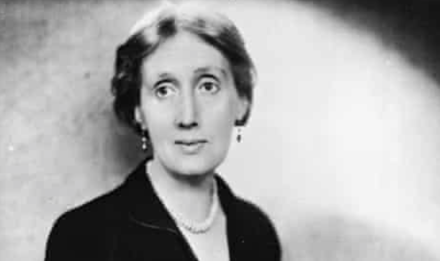
Other deceased novelists who wrote excellent short fiction include James Baldwin, Honoré de Balzac, Willa Cather, Kate Chopin, George Eliot, Graham Greene, Nathaniel Hawthorne, Ernest Hemingway, Zora Neale Hurston, James Joyce, D.H. Lawrence, Jack London, Gabriel García Márquez, W. Somerset Maugham, Carson McCullers, Rabindranath Tagore, Mark Twain, Virginia Woolf, and Richard Wright, among many others.

Prominent living novelists who have successfully gone down the short-story road include Isabel Allende, Margaret Atwood, Lee Child, Stephen King, Barbara Kingsolver, Jhumpa Lahiri, and Alice Walker, to name just a few. Lahiri hit the Pulitzer Prize jackpot with her Interpreter of Maladies story collection, which preceded her novels The Namesake and The Lowland. I love Kingsolver’s Homeland and Other Stories and Atwood’s Wilderness Tips collection. And the title tale of Atwood’s Stone Mattress collection is a gripping piece of fiction.

Of course, there are also authors who have produced novels that are basically an assemblage of related stories: Sherwood Anderson (Winesburg, Ohio), Isaac Asimov (I, Robot), Ray Bradbury (The Martian Chronicles), Elizabeth Gaskell (Cranford), Amanda Moores (Grail Nights), Elizabeth Strout (Olive Kitteridge)…

Some of your favorite writers known mainly for novels but who’ve also done plenty of short stories?

My literary-trivia book is described and can be purchased here: Fascinating Facts About Famous Fiction Authors and the Greatest Novels of All Time.

In addition to this weekly blog, I write the award-winning “Montclairvoyant” topical-humor column for Baristanet.com. The latest weekly piece — about my town’s mixed environmental record — is here.

Literary Works With Ambiguous Endings

There are novels with happy endings, which most readers love if the happiness doesn’t feel forced. Then there are novels with sad endings, which readers tolerate if those conclusions seem appropriate. And there are novels with endings somewhere in between — the subject of this blog post.

I kind of like ambiguous endings. Life is often like that, and those conclusions make you think — wondering about the fate of characters beyond a book’s last pages.

Of course, novels in a series often have non-closure endings — cliffhangers perhaps — to increase your desire to read the next book installment. But there are also stand-alone novels with far-from-definitive conclusions.

Take Herman Wouk’s The Caine Mutiny, which I also discussed last week in a different context. While that novel has a mostly shipboard setting, there’s a relationship subplot between U.S. Navy guy Willie Keith and modestly successful nightclub singer May Wynn (born Marie Minotti). May grows to love Willie, and he’s enamored with her, but the Ivy League-educated/from-an-affluent-family Willie is snobbishly uncomfortable with May’s working-class origins, Italian-American ethnicity, and Catholicism. He eventually breaks up with May and then, after a near-death military experience on his boat, realizes how compatible they are. But May is in another relationship back home in New York City, and perhaps still not totally trusting of Willie’s feelings, so the book ends unresolved about whether they’ll have a future together. I was satisfied with that finish.

Another novel that interestingly dashes closure expectations is Donna Tartt’s The Little Friend, in which a boy’s murder radically affects the lives of his surviving family — most notably his sister Harriet. Readers assume that Robin’s mystery death will be solved at the end, but it never is. I found that intriguing, and realistic in its way.

Then there’s John Steinbeck’s The Grapes of Wrath, which has a poignantly beautiful conclusion — yet it’s uncertain what will happen to the remnants of the Joad family as they try to survive broke, homeless, and weather-beaten in the 1930s California they had traveled to with high hopes.

Set just a few years after Steinbeck’s American masterpiece, Erich Maria Remarque’s Arch of Triumph features surgeon Ravic — who has fled the Nazis for Paris, where he ekes out a living, falls in love, and seeks revenge against a Gestapo man. As the heartbreaking novel concludes, it looks like Ravic might end up a German prisoner. Will he survive World War II? A reader has no idea.

The ending of Zadie Smith’s scintillating novel White Teeth is deliberately confusing and uncertain, with various scenarios posited for the future lives of its majority-immigrant cast. (Ms. Smith is pictured atop this blog post.)

Then there are novels with endings that are kind of ambiguous, but one figures things out on a closer reading or rereading. That’s the case with Charles Frazier’s Cold Mountain, in which one is initially uncertain if Civil War soldier Inman dies or doesn’t die after his long, arduous journey to return to Ada.

Short stories can of course also have non-definitive endings. A prime example is Frank Stockton’s much-anthologized 1882 tale “The Lady or the Tiger?” — in which the on-trial lover of a king’s daughter has to choose between two doors: one with a ferocious tiger behind it and the other with a woman (not the king’s daughter) he would have to marry. He reaches for the door the (jealous?) daughter imperceptibly tells him to open, and the story ends there.

I’ll finish with a mention of the famous final scene from The Sopranos TV series in which the screen cuts to black as we wonder what happened or didn’t happen at the restaurant that Tony S. and other characters were in. (That restaurant — Holsten’s in Bloomfield, New Jersey — happens to be about a mile from my apartment in nearby Montclair.)

Your favorite fictional works with ambiguous endings?

My 2017 literary-trivia book is described and can be purchased here: Fascinating Facts About Famous Fiction Authors and the Greatest Novels of All Time.

In addition to this weekly blog, I write the award-winning “Montclairvoyant” topical-humor column for Baristanet.com. The latest weekly piece — about my town’s African-American population unfortunately decreasing — is here.

Bad Bosses in Books

With Donald Trump in the White House, Americans have the bad boss from hell. Not only have his actions been a disaster for the U.S. and the world, but his “leadership” style has driven out a record number of almost-as-abysmal people from his administration.

Trump embodies the worst qualities of a bad boss. Mean, lazy, corrupt, cowardly, erratic, untruthful, incompetent, racist, sexist, homophobic, a sexual harasser, etc. So let’s take a look at some fictional bosses who, while mostly not as awful as Trump, are pretty darn substandard.

How about Captain Queeg of Herman Wouk’s enthralling Pulitzer Prize-winning 1951 novel The Caine Mutiny, which I just read? Queeg is a second-rate captain — not that skilled, cowardly, sadistic, a harsh disciplinarian on trivial matters, has the hypocritical philosophy of “do as I say not as I do,” just friendly enough at times to keep his crew off-balance, and, like Trump, blames underlings for his own mistakes. (Pictured at the top of this column is Humphrey Bogart as Queeg.)

Staying at sea for another paragraph, we of course have Captain Ahab of Moby-Dick, who deliberately puts the Pequod crew in danger as he seeks his irrational revenge on Herman Melville’s titular white whale.

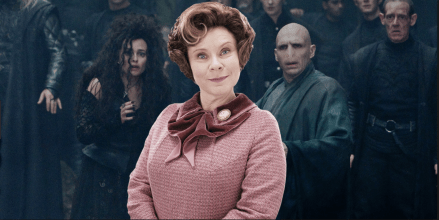
Then there’s the faux-sweet Dolores Umbridge, of J.K. Rowling’s Harry Potter series, who temporarily becomes high inquisitor and then headmistress at Hogwarts. She rules the wizardry school in an unfair and ruthless manner (which includes vicious harassment of Harry), and is basically on the side of arch-villain Lord Voldemort.

Umbridge eventually gets her comeuppance — exemplifying a satisfying potential plot rationale for having bad-boss characters in literature. Plus readers empathize with and root for the beleaguered underlings. But good doesn’t always triumph over evil in nasty fictional workplaces.

Of course, novels with workplaces that are depicted at least somewhat realistically will feature plenty of bad bosses. If not, they’re fantasy novels of a sort. 🙂

A boss doesn’t have to be on-the-scene to be crummy. In Richard Russo’s Empire Falls, wealthy widow Francine Whiting almost never visits the Empire Grill she owns, but makes life hell for the eatery’s mild-mannered manager Miles Roby. Why does Francine treat Miles that way? She’s a nasty control-freak, and the rich Whiting family and not-rich Roby family have a complicated intertwined history.

Another bad boss is Vinnie Plum, cousin of bounty-hunter protagonist Stephanie Plum in Janet Evanovich’s mysteries. Vinnie is lazy, a gambler, a sexual pervert, and contemptuous of his employees — despite those employees being much better workers and much better people than he is.

Then there’s the bank boss in Jules Verne’s Paris in the Twentieth Century who fires protagonist Michel Dufrénoy and his co-worker after they make just one mistake.

Also in the bad-boss club are — among others — Nurse Ratched of Ken Kesey’s One Flew Over the Cuckoo’s Nest, Miranda Priestly of Lauren Weisberger’s The Devil Wears Prada, and Ebenezer Scrooge (until he’s transformed) of Charles Dickens’ A Christmas Carol.

Which bad bosses in fiction are most memorable to you?

My 2017 literary-trivia book is described and can be purchased here: Fascinating Facts About Famous Fiction Authors and the Greatest Novels of All Time.

In addition to this weekly blog, I write the award-winning “Montclairvoyant” topical-humor column for Baristanet.com. The latest weekly piece — about dance vs. gym, an unauthorized hotel addition, and more — is here.

Novels Set Long Ago

There are many dichotomies in novel reading — including books by women or men, books by authors of color or white writers, books that are literary or more mass-market, books that are long or short, books with third-person or first-person narratives, and books set in recent times or long ago.

I was thinking about that last dichotomy when I recently read, back-to-back, Richard Russo’s Everybody’s Fool and Anita Diamant’s The Red Tent. Russo’s 2016 novel, an excellent sequel to Nobody’s Fool, takes place in near-contemporary times. Diamant’s absorbing 1997 novel — told from the viewpoint of Dinah (daughter of Jacob/Leah, granddaughter of Isaac/Rebecca, great-granddaughter of Abraham/Sarah) — is set in biblical times thousands of years ago.

This blog post will focus on novels set many centuries in the past, whether written recently or…many centuries in the past. It’s fascinating to get a taste of what life was like long ago — seeing the differences and similarities from the way we live today. And — what do you know! — human emotions were pretty much the same, even as smartphone use was 50% less in ancient times.

Set VERY long ago is Jack London’s Before Adam, in which a man dreams he’s living in the era when apes were evolving into humans. (This was well before U.S. Republican leaders began devolving.) Part of Arthur C. Clarke’s mind-blowing 2001: A Space Odyssey takes place during roughly the same period.

Another far-back novel with a not-quite-so-old milieu is Anthony Burgess’ The Kingdom of the Wicked — which unfolds during the time of Christianity’s birth 2,000 years ago. There are of course numerous fictional works featuring or referencing Jesus Christ during the time he lived (if you believe he lived).

Taking place roughly during that same time period is Robert Graves’ I, Claudius — set during the Roman Empire.

Moving ahead several hundred years, we have Mark Twain’s pointed/hilarious A Connecticut Yankee in King Arthur’s Court, in which the 19th-century protagonist travels back to the late-5th/early-6th-century days of Camelot.

Then there’s Ivanhoe, Sir Walter Scott’s famous historical novel set in 12th-century England.

Plus The Name of the Rose, Umberto Eco’s intellectual murder mystery that takes place in 14th-century Italy; and The House on the Strand, Daphne du Maurier’s gripping novel that features time travel back to that 1300s period in England.

The iconic Don Quixote is set in the 1500s, or perhaps the early 1600s — when Miguel de Cervantes wrote it.

And James Clavell’s compelling Shogun takes place in the feudal Japan of 1600.

Speaking of Japan, there’s Murasaki Shikibu’s The Tale of Genji, which takes place about a thousand years ago — and was written by Ms. Shikibu about a thousand years ago! (A scene from that early novel is shown atop this blog post.)

What are some of your favorite novels set many centuries in the past? I realize there are countless titles I didn’t name.

My 2017 literary-trivia book is described and can be purchased here: Fascinating Facts About Famous Fiction Authors and the Greatest Novels of All Time.

In addition to this weekly blog, I write the award-winning “Montclairvoyant” topical-humor column for Baristanet.com. The latest weekly piece — about structural problems in three old schools, the possible reopening of a historic movie theater, and my town’s new congresswoman — is here.

Long-Lived Literary Lions and Lionesses

Last week, I wrote about famous writers who died young. This week — you guessed it! — I’ll discuss famous writers who lived into old age, 85 or more.

The only way to start this is by mentioning Herman Wouk, who’s still alive at…103! He’s the author of modern classics such as The Caine Mutiny, Marjorie Morningstar, The Winds of War, and War and Remembrance; I need to read at least one of them! And To Sir, With Love novelist E.R. Braithwaite was 104 when he died two years ago.

Many writers who lived many decades did their best work in their 20s and 30s, many others peaked in mid-career, and some finally put it all together only when approaching senior-citizen status. For those in the latter two groups, we’d never have gotten to enjoy their A+ efforts if they had died young.

For instance, the now-94-year-old Rosamunde Pilcher wrote 22 novels before The Shell Seekers — her masterpiece — came out when she was 63. Maybe the author had to be that age to depict 60-something protagonist Penelope Keeling so convincingly and wonderfully? Pilcher went on to pen five more novels before retiring in 2000.

The Unexpected Mrs. Pollifax, a novel I read this month, was written by Dorothy Gilman in her 40s — so she’s an example of an author who peaked mid-career, decades before dying at age 88. The book, which stars a widowed New Jersey homemaker in her 60s who becomes a CIA operative, is both hilarious and action-packed — a tough combination to pull off. (A scene from a screen version is pictured above.)

A prime example of a long-lived author who peaked early is of course Harper Lee, who was in her mid-30s when To Kill a Mockingbird rocketed to fame; she died at 89. Upton Sinclair was still in his 20s when The Jungle was published — though, unlike Lee, he wrote dozens of subsequent (albeit lesser-known) novels into his 80s. He passed away at 90.

Other authors who were with us for many decades? Renowned mystery writers P.D. James and Agatha Christie lived to 94 and 85, respectively, while sci-fi greats Ray Bradbury and Ursula K. Le Guin died at 91 and 88. (Yes, I know those authors sometimes worked outside the genres I mentioned; Le Guin, for instance, was also known for her fantasy fiction.) Comedic writer P.G. Wodehouse, creator of the iconic Jeeves, lasted until 93.

Long-lived authors known more for “general fiction” included Eudora Welty, Robert Serling, Harriet Doerr, and the still-living Alison Lurie, all 92; W. Somerset Maugham and J.D. Salinger, both 91; Nadine Gordimer and James Michener, both 90; Saul Bellow and Janet Frame, both 89; Isaac Bashevis Singer, Jean Rhys, and Muriel Spark, all 88; Gabriel García Márquez, Thomas Hardy, Fanny Burney, the still-living Toni Morrison, and the still-living Alice Munro, all 87; Jorge Luis Borges, Graham Greene, and Gore Vidal, all 86; and Harriet Beecher Stowe, Hermann Hesse, Philip Roth, the still-living Cormac McCarthy, and the still-living Charles Portis, all 85.

Then there’s poet Robert Frost (88) and poet/memoirist Maya Angelou (86). And while known mostly for his nonfiction, W.E.B. Du Bois wrote several novels during his 95 years.

Among my favorite novels and short stories by some of the writers in the above three paragraphs? And Then There Were None (Christie), Fahrenheit 451 (Bradbury), Stones for Ibarra (Doerr), Foreign Affairs (Lurie), Of Human Bondage (Maugham), Caravans (Michener), Yellow Flowers in the Antipodean Room (Frame), “Gimpel the Fool” (Singer), Wide Sargasso Sea (Rhys), One Hundred Years of Solitude (Márquez), Jude the Obscure (Hardy), Evelina (Burney), Beloved (Morrison), “The Aleph” (Borges), “Proof Positive” (Greene), Uncle Tom’s Cabin (Stowe), Steppenwolf (Hesse), Suttree (McCarthy), True Grit (Portis), “Stopping by Woods on a Snowy Evening” (Frost), and I Know Why the Caged Bird Sings (Angelou).

Your favorite writers (ones I mentioned or didn’t mention) who lived to 85 or older? You’re also welcome to name some slightly younger ones. 🙂

My 2017 literary-trivia book is described and can be purchased here: Fascinating Facts About Famous Fiction Authors and the Greatest Novels of All Time.

In addition to this weekly blog, I write the award-winning “Montclairvoyant” topical-humor column for Baristanet.com. The latest weekly piece — a comedic year in review — is here.

Writers of Worth Who Spent a Short Time on Earth

Among literature’s “writers for the ages” are many who died at a young or relatively young age. They packed memorable works into their short time on Earth — in some cases, just one or several works; in other cases, quite a few. Pretty impressive.

It’s poignant to think of what else they might have produced if they hadn’t died well before their senior-citizen days because of suicide, disease, alcoholism, hard living, an accident, etc. Some might have never surpassed the “A” quality of their early output, but even “B” work would have been welcome.

In this post, I’m going to focus on writers who never reached the age of 45.

The first I’ll mention is died-at-44 Joseph Roth (1894-1939), an Austrian writer who’s not that well known today but should be. This month I read his novel Right and Left, and was impressed. Not his best or most-remembered work — that’s probably The Radetzky March, which I haven’t read — but Right and Left is a fascinating look at several not particularly appealing characters living in 1920s Germany, just a few years before the Nazis rose to power. Roth conveys what it’s like for Jewish or part-Jewish people to live at that time and place, and we see plenty of politics, wealth, poverty, unhappy relationships, self-hatred, shallowness, melancholy, and more.

Also 44 when they died were four much more famous writers: Anton Chekhov, F. Scott Fitzgerald, Robert Louis Stevenson, and D.H. Lawrence.

Chekhov is of course known for his terrific, subtle short stories as well as his plays. Fitzgerald is obviously most associated with his great The Great Gatsby, but one can also find a lot to like in his novels Tender Is the Night and (the unfinished) The Last Tycoon. This Side of Paradise? Meh. I plan to eventually read Fitzgerald’s short stories.

The novels Stevenson is most remembered for include Treasure Island and Strange Case of Dr. Jekyll and Mr. Hyde — but, as I’ve written before, I think his last book was his best: the exquisite Weir of Hermiston, unfortunately also not completed. Lawrence made his mark with novels such as Sons and Lovers and Women in Love.

I’ll take a brief break here from writers known mostly for novels or short stories to mention some known mainly for poetry during their short lives: Countee Cullen (who lived to 42), Arthur Rimbaud (37), Lord Byron (36), Phillis Wheatley (31), Percy Bysshe Shelley (29), and John Keats (25). In the theatrical realm, we have A Raisin in the Sun playwright Lorraine Hansberry (34).

Nikolai Gogol, who lived to 42, was a playwright, novelist (Dead Souls), and more. Guy de Maupassant, also 42, made his name with short stories and some novels. Jane Austen of course wrote six now-classic novels (including Pride and Prejudice and Persuasion) before dying at 41. Jack London churned out a large number of works in his 40 short years on Earth, with my four favorite novels of his The Call of the Wild, White Fang, The Sea-Wolf, and Martin Eden. Edgar Allan Poe produced many works of horror and some non-horror before dying at age 40. And Franz Kafka (40), is perhaps best known for his surreal novella The Metamorphosis.

There are also Flannery O’Connor (39), most famous for her story “A Good Man Is Hard to Find” and her novel Wise Blood; Alexander Pushkin (37), the Russian poet, playwright, and novelist; Nathanael West (37) of The Day of the Locust and Miss Lonelyhearts renown; John Kennedy Toole (31), whose Pulitzer Prize-winning A Confederacy of Dunces was published posthumously through the efforts of his mother and author Walker Percy; Sylvia Plath (30), who wrote The Bell Jar and more; and Stephen Crane (28), who penned The Red Badge of Courage and more.

Before concluding, I obviously also have to mention the Brontë sisters: Charlotte, 38; Emily, 30; and Anne, 29 (all pictured in the painting atop this blog post). Charlotte lived long enough to pen several novels, including the iconic Jane Eyre. Emily’s one novel was of course the tempestuous Wuthering Heights, and the best of Anne’s two novels was The Tenant of Wildfell Hall. There was more than a little Brontë poetry, too.

Who are some of your favorite writers (ones I mentioned or didn’t) who died young or relatively young? You can go a few years over 45 if you’d like (as did George Orwell, O. Henry, Henry Fielding, H.P. Lovecraft, Shirley Jackson, Margaret Mitchell, Edward Bellamy, Carson McCullers, Stieg Larsson, Honoré de Balzac, William Shakespeare, Richard Wright, Mary Shelley, Kate Chopin, Emily Dickinson, James Hilton, etc.)!

My 2017 literary-trivia book is described and can be purchased here: Fascinating Facts About Famous Fiction Authors and the Greatest Novels of All Time.

In addition to this weekly blog, I write the award-winning “Montclairvoyant” topical-humor column for Baristanet.com. The latest weekly piece — about a heartwarming fundraiser and not-heartwarming overdevelopment — is here.

The Many-Decade Spans of Some Sequels and Series

After reading last week that Margaret Atwood is writing a follow-up to The Handmaid’s Tale, I thought about which sequels — and series — spanned the most time.

Atwood’s famous, feminist, dystopian novel came out in 1985, and The Testaments will be published in 2019 — making for a gap of 34 years. Not quite the 36-year-period between Stephen King’s The Shining (1977) and its sequel Doctor Sleep (2013), but plenty long.

Why gaps like that? Authors such as King and Atwood (pictured above) are of course busy writing many other books, and may not want to revisit the same characters — at least until several decades go by. In Atwood’s case, one spur for the coming sequel is the high popularity of the current The Handmaid’s Tale television series. Also, the Republican Party’s current far-right/misogynist politics make her 1985 novel prescient and very relevant to today.

The Testaments will reportedly begin 15 years after The Handmaid’s Tale ends. Other sequels can of course be set closer or farther away in time from the original novel.

Can many-years-later sequels be better? Sometimes. Heck, the authors have often become more mature writers. But they might also be past their prime, a bit tired, and not have as many new ideas. Still, numerous fans don’t mind if a sequel isn’t as good; they’re just happy it exists. Plus there’s money to be made for the authors — not that superstar writers like Atwood and King need it. 🙂

Other one-sequel, multiple-sequel, or series scenarios spanning many a decade?

P.G. Wodehouse wrote his Jeeves novels and stories over a stunning period of nearly 60 years — 1915 to 1974!

Agatha Christie featured Hercule Poirot in 40-plus novels and short-story collections for more than a half-century — from 1920’s The Mysterious Affair at Styles into the 1970s. And Christie’s Miss Marple character starred in more than 10 books from 1930 (The Murder at the Vicarage) into the ’70s.

John Updike’s four Rabbit novels were published over a period of 30 years (1960, 1971, 1981, 1990) — with a novella added to the mix in 2001. So, 41 years total.

Other large spans include 35 years between Sue Grafton’s first and 25th “alphabet mysteries” starring Kinsey Millhone (“A” Is for Alibi, 1982/“Y” Is for Yesterday, 2017); 32 years between Martin Cruz Smith’s first and eighth Arkady Renko novels (Gorky Park, 1981/Tatiana, 2013); 26 years between Walter Mosley’s first and 14th Easy Rawlins novels (Devil in a Blue Dress, 1990/Charcoal Joe, 2016); 25 years between Jack Finney’s Time and Again (1970) and From Time to Time (1995); 24 years between Janet Evanovich’s first and 25th Stephanie Plum novels (One for the Money, 1994/Look Alive Twenty-Five, 2018); and 23 years between Richard Russo’s Nobody’s Fool (1993) and Everybody’s Fool (2016).

Then there are Honore de Balzac’s and Emile Zola’s many-book sagas containing stand-alone but interlinked novels featuring characters who pop in and out, sometimes as lead protagonists and sometimes as supporting players. Balzac wrote his La Comedie Humaine works from 1830 to the late 1840s — not that long a period because of his relatively early death, but an extraordinarily prolific period that produced a whopping 90-plus novels (such as Old Goriot and Cousin Bette) and stories! Zola penned his 20 Rougon-Macquart novels (The Drinking Den, Germinal, etc.) from 1871 to 1893.

Other sequels and series you can name with many-year publishing spans? And/or any comments about the ones I mentioned?

I will not be posting columns on December 9 and 16 (because of another trip to Florida to deal with my late mother’s estate and some other reasons). Back on December 23! I’ll still reply to comments under already-published columns. 🙂

My 2017 literary-trivia book is described and can be purchased here: Fascinating Facts About Famous Fiction Authors and the Greatest Novels of All Time.

In addition to this weekly blog, I write the award-winning “Montclairvoyant” topical-humor column for Baristanet.com. The latest weekly piece — written by my cat! — is here.

Non-Living Things Can Offer Literary Zings

Sometimes the main or almost-main character in a novel or short story is an inanimate object. And sometimes that object can seem almost as alive as characters who are actually alive (albeit fictionally).

My latest object of (literary) desire is the painted drum in Louise Erdrich’s absorbing novel The Painted Drum, which I’m in the middle of reading. As is often the case with fiction’s noteworthy objects, the non-living thing is named in the title. And this Native-American artifact has a personality of sorts, crafted beauty, and a major impact on the plot. (Ms. Erdrich is pictured above.)

Other prominent objects in literature of course include houses, cars, art, jewelry, statues, and more.

When a house is the title “character,” there’s frequently something about it that makes the human protagonists uneasy. For instance, Jane Austen’s part-spoof-of-Gothic-fiction Northanger Abbey features a character (Catherine Morland) whose overactive imagination gets a bit out of hand when she visits the titular dwelling. The house in Shirley Jackson’s The Haunting of Hill House is legitimately scary, the one in Nathaniel Hawthorne’s The House of the Seven Gables is not exactly a happy place, and the abode in Daphne du Maurier’s The House on the Strand is the jumping-off point for some weird time travel.

More positive is the house in L.M. Montgomery’s The Blue Castle. It’s not literally a blue castle, but it’s the dream home Valancy Stirling has always wished for but never thought she’d have — and Valancy ends up living there with a man she loves through a very improbable set of circumstances.

Speaking of time travel a la du Maurier, there’s also H.G. Wells’ The Time Machine — with that titular device a vehicle of sorts.

Cars? The automobile “character” I first thought of is the one in Stephen King’s From a Buick 8 that’s a portal to a spooky place.

Art? Donna Tartt’s set-in-recent-times novel The Goldfinch is built around Carel Fabritius’ 1654 painting “The Goldfinch,” which is taken from a museum by protagonist Theo Decker amid the chaos of a terrorist attack that kills his mother and others. The priceless painting subsequently has a giant effect on Theo’s life.

Jewelry, gems, and such? Wilkie Collins’ The Moonstone — an early novel in the detective genre — “stars” a huge diamond. The also-huge, very valuable pearl in John Steinbeck’s novella The Pearl is not the positive find Kino and his family hope it will be; it turns out to be a disaster — as does the article of jewelry in Guy de Maupassant’s devastating short story “The Necklace.”

Then there’s of course J.R.R. Tolkien’s The Lord of the Rings, in which the trilogy’s most-powerful ring is as consequential (to the plot and the future of Middle-earth) as it gets.

Statues? There’s the stone pillar in Erich Maria Remarque’s The Black Obelisk that can be seen as a symbol of the nascent Nazi movement in 1920s Germany. And there’s the famous statuette that’s the title of Dashiell Hammett’s novel The Maltese Falcon, starring detective Sam Spade.

Another sleuthing work focusing on an object is Edgar Allan Poe’s short story “The Purloined Letter,” featuring detective C. Auguste Dupin. Poe also put inanimate things in the titles of several other tales — including “The Cask of Amontillado,” “The Oblong Box,” and “The Oval Portrait,” among others.

Oh, and there are the fateful overpasses in The Bridge of San Luis Rey by Thornton Wilder and Alexander’s Bridge by Willa Cather.

Novels and stories you remember that prominently feature objects?

My 2017 literary-trivia book is described and can be purchased here: Fascinating Facts About Famous Fiction Authors and the Greatest Novels of All Time.

In addition to this weekly blog, I write the award-winning “Montclairvoyant” topical-humor column for Baristanet.com. The latest weekly piece — about a disruptive snowstorm and more — is here.

Characters Who Are First in Prominence, But Not the First to Appear

Usually, a novel’s main protagonist appears quickly at/near the start of the book. But there are times she or he doesn’t enter the story until somewhat later, with readers perhaps first meeting a secondary character or two.

While the latter approach can seem odd and counterintuitive — especially if the novel is named after the main protagonist — there are advantages to waiting a bit. We might initially see the protagonist through another character’s eyes, which can offer readers some early insight into the not-yet-met person. Also, waiting for the book’s star to take the stage can be a nice “tease” — building some tension and imbuing the star with some mystery as our gratification is delayed. Last but not least, we sort of get eased into the novel.

I most recently noticed this approach in Richard Russo’s very absorbing Nobody’s Fool. Readers first encounter Beryl, an interesting 80-year-old woman in a small New York State town. After a few pages, I thought the novel would be mostly about her, but then — through Beryl — we meet her upstairs tenant Donald Sullivan, who turns out to be the book’s main character. By that time, thanks to Beryl, we already know a good deal about “Sully” (who, in the above photo, was played by Paul Newman in the 1994 Nobody’s Fool movie; he’s next to Jessica Tandy as Beryl).

Another novel I read this fall that initially traveled the indirect route was The Cuckoo’s Calling by J.K. Rowling (writing as Robert Galbraith). We first meet Robin Ellacott as she travels to the office of private investigator Cormoran Strike to work as a temp for him. Then, we start to learn about Strike when he crashes into Robin as she approaches his office — with the large Cormoran almost knocking Robin down the stairs as he dashes out the door to try to catch the longtime girlfriend who just broke up with him. As it turns out, Robin displays private-investigator abilities and becomes the co-star of The Cuckoo’s Calling and subsequent books in that Rowling series.

A number of much older novels also take this kind of story-telling route.

For instance, Lockwood visits his landlord Heathcliff in the opening chapters of Wuthering Heights. We of course also meet Heathcliff, the co-star of Emily Bronte’s book, and a scared Lockwood, while sleeping, intensely feels the spirit of the deceased Catherine — the other Wuthering Heights co-star. Soon, through the narration of housekeeper Nelly Dean, we learn the tempestuous tale of Catherine and Heathcliff’s relationship.

Mr. Smith, the grandfather of a differently spelled Nellie, is the first character we meet in Fyodor Dostoevsky’s The Insulted and the Injured. But he turns out to be a minor figure. The semi-autobiographical young author Vanya is the novel’s star, and Natasha (loved by Vanya), Alyosha (loved by Natasha), the orphaned Nellie, and other characters are much more significant players. But by trying to help the gravely ill Mr. Smith early in the novel, readers learn of Vanya’s decency and concern for others. And his moving into Mr. Smith’s place after that old man dies helps set some of the plot machinations in motion.

L.M. Montgomery starts Anne of Green Gables by showing nosy neighbor Rachel Lynde watching in shock as shy, scruffy old Matthew Cuthbert, who rarely leaves home, rides away in his horse-and-buggy dressed in his best suit. Turns out he’s going to pick up an orphan boy to help with farm work, but an orphan girl appears at the train station instead. We first learn of Anne Shirley’s braininess, originality, and other traits as she talks nonstop to the bewildered Matthew on the ride home. Anne then of course becomes the novel’s star — with the kind/gentle Matthew, his harder-edged sister Marilla Cuthbert, Anne’s best friend Diana Barry, Anne’s future love interest Gilbert Blythe, and others playing crucial supporting roles.

In Sir Walter Scott’s Rob Roy, we first meet Francis Osbaldistone. It’s quite a while until Francis and the novel’s readers encounter Robert “Rob Roy” MacGregor, the leader of a band of Highlanders. (In the 1995 movie starring Liam Neeson, the Rob Roy character is much more front and center.)

Which novels can you think of that don’t open with the main protagonist?

My 2017 literary-trivia book is described and can be purchased here: Fascinating Facts About Famous Fiction Authors and the Greatest Novels of All Time.

In addition to this weekly blog, I write the award-winning “Montclairvoyant” topical-humor column for Baristanet.com. The latest weekly piece — a nightmare fantasy about Donald Trump possibly becoming mayor of my town — is here.