Titles of novels can be interesting for various reasons, including occasionally having more than one meaning.
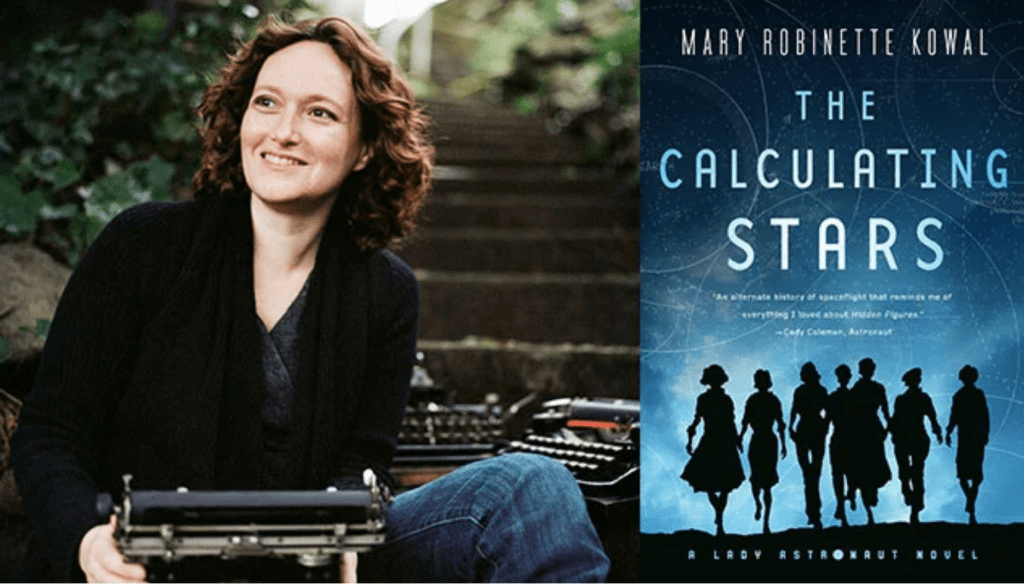
Take the book I’m currently reading — Mary Robinette Kowal’s The Calculating Stars. Its main character, Elma York, is a brilliant mathematician who’s among the novel’s “calculating stars.” The apocalyptic work’s story line is also about sending rockets into outer space, where I hear there are stars. Perhaps “calculating stars,” if those heavenly bodies had anything to do with sending a meteorite crashing down at the start of Kowal’s book — obliterating much of America’s East Coast and setting off a cascade of climate change that could imperil the entire planet.
Tracy Chevalier’s historical novel Remarkable Creatures stars Mary Anning, a 19th-century amateur British paleontologist expert at finding and identifying fossils of dinosaurs (remarkable creatures indeed). This brilliant working-class woman and her friend Elizabeth are themselves remarkable creatures (humans) for the work they do and how they deal with sexist, condescending male scientists.
Elma York also deals with plenty of infuriating sexism in the 1950s as she attempts to become an astronaut in The Calculating Stars.
Then we have Barbara Kingsolver’s Flight Behavior, which features Dellarobia Turnbow’s attempted flight from an unsatisfying marriage and is also about climate change affecting the flight behavior of monarch butterflies. But no space flight here. 🙂
The title of (Ms.) Lionel Shriver’s So Much for That is of course a phrase referencing a feeling of resignation. Given the novel’s strong focus on the problematic U.S. medical system, the title can also refer to how expensive health care often is for individual Americans (yes, “so much for that” care).
Walter Mosley’s mystery A Red Death has a title that evokes both bloodshed and the era it’s set in — the “Red Scare” time when vile right-wing Senator Joe McCarthy targeted communists, alleged communists, and other innocent liberal-leaning people.
Colleen McCullough’s 18th-century-set Morgan’s Run has a title that evokes both a place and Richard Morgan’s dismaying run of bad luck that included being slammed with bogus criminal charges and shipped to an Australian penal colony. But his run of dramatic experiences has positive moments, too.
Jane Smiley’s Perestroika in Paris is about a French race horse named Perestroika who roams the City of Light after getting loose from her stable. The adventurous animal is aptly named because she ends up “restructuring” her life and the lives of several other critters and humans. The Russian word “perestroika,” which became well known under the leadership of the late Mikhail Gorbachev, means “restructuring.”
Philippa Gregory’s novel Earthly Joys has a title that refers to gardening/landscaping and…sex.
Lisa Genova’s Still Alice stars brilliant Harvard professor Dr. Alice Howland, who is STILL Alice even after her mind is devastated by early-onset Alzheimer’s. Another title interpretation might be a bit of a stretch, but, as the disease advances, parts of Alice’s once-active mind become increasingly dormant (as in still).
And, in a different form of titular double meaning, Jack London gave the semi-autobiographical protagonist in his novel Martin Eden that name so it would have the initials “me.”
Any other multiple-meaning titles you’d like to mention?
My literary-trivia book is described and can be purchased here: Fascinating Facts About Famous Fiction Authors and the Greatest Novels of All Time.
In addition to this weekly blog, I write the 2003-started/award-winning “Montclairvoyant” topical-humor column for Baristanet.com every Thursday. The latest piece — about a large, welcome promise of state money to help fix my town’s old school buildings — is here.