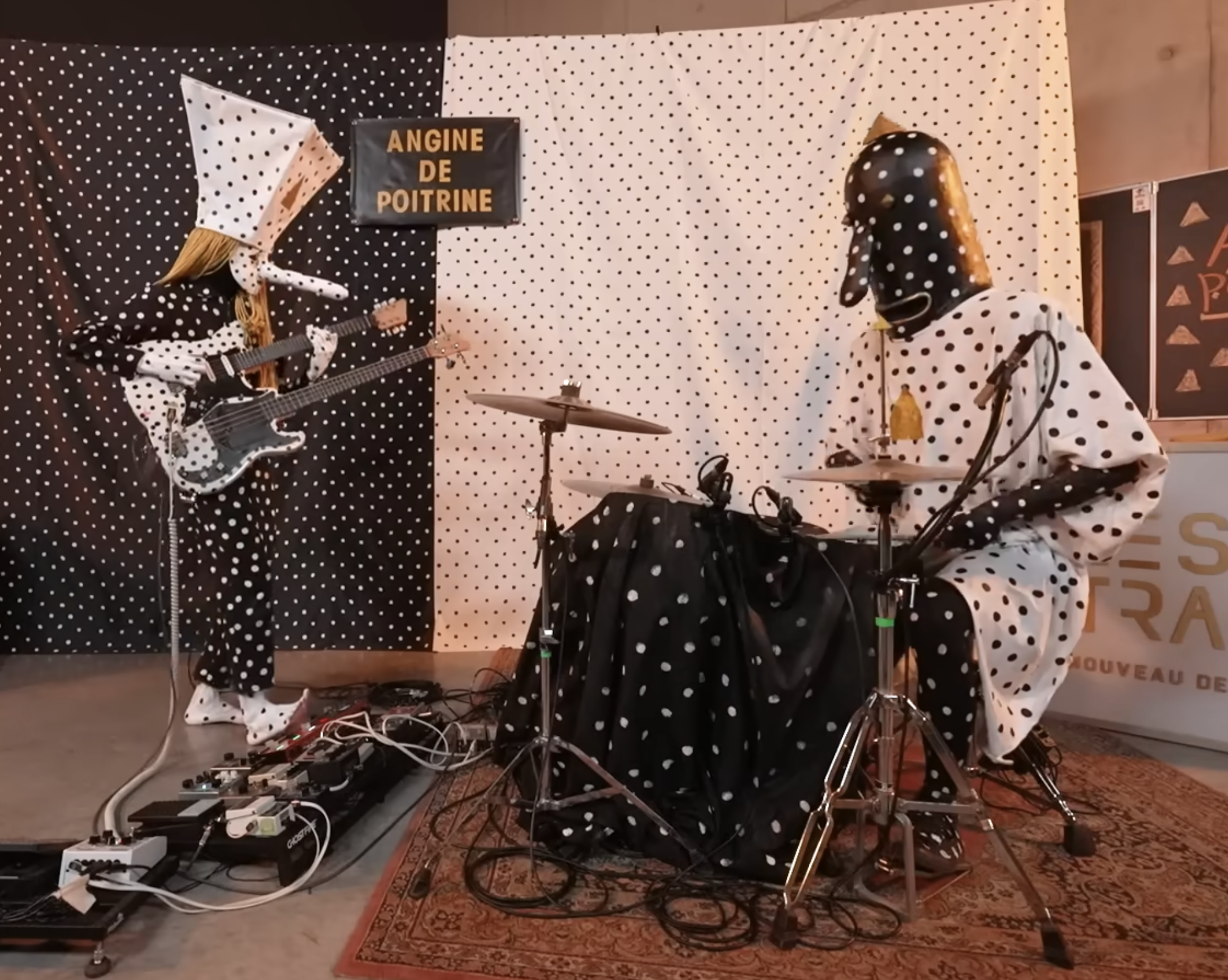
Angine de Poitrine! The video I took this screenshot from is at the end of today’s post.
I recently heard about a French-Canadian musical duo named Angine de Poitrine, and I must say that getting-very-popular band is delightfully quirky in its goofy appearance and mesmerizing songs.
The “q” word reminds me of some of the quirkiest authors and novels I’ve read over the years. Sometimes that quirkiness can be too much, but it’s often a nice change of pace…entertaining, compelling, and original.
One of the first authors to come to mind is John Irving. He frequently deals with quite serious matters – war, abortion, LGBTQ+ rights, etc., but mixes in all kinds of weird things. Bear appearances, wrestling situations, a deadly foul ball during a baseball game, and more. Life is unpredictable…
There’s also Franz Kafka’s writing, which is…Kafkaesque. 🙂 One obvious example is the human Gregor Samsa becoming a giant insect in that author’s The Metamorphosis.
Herman Melville got quirky in his rare 100%-land-based novel Pierre, which includes strong hints of incest as well as the author using his title character as a vehicle to obliquely reference Melville’s real-life dismay over the poor reception for his previous year’s Moby-Dick.
Margaret Atwood’s The Edible Woman? The title alone telegraphs just how oddly the author uses food in her debut novel.
Anthony Burgess’ dystopian A Clockwork Orange is also very offbeat with its slangy different language and more.
Or how about Kurt Vonnegut’s Slaughterhouse-Five? It mixes horror, black humor, time travel, and more as it makes its antiwar points.
Shirley Jackson’s We Have Always Lived in the Castle features an isolated ultra-eccentric family, strange murders, and other eyebrow-raising content.
Mikhail Bulgakov’s The Master and Margarita includes the devil in its cast as well as a flying human (no airplane involved) and other fantastical elements.
Which reminds me that magic-realism novels, such as Gabriel Garcia Marquez’s One Hundred Years of Solitude, can also feature flying humans and other peculiar things.
Flann O’Brien’s The Third Policeman includes absurd content such as cops who speak mostly in non sequiturs and are obsessed with bicycles.
And we can’t forget Alice’s Adventures in Wonderland and Through the Looking-Glass by Lewis Carroll, who offers readers all kinds of surreal stuff: Alice’s body changing sizes, bizarre chess goings-on, the fading-away Cheshire Cat…
I’ll end by noting that there are novels that are mostly not weird but have at least one weird element. For instance, the tragic-yet-delightful ghost in Elin Hilderbrand’s The Hotel Nantucket.
Your thoughts about, and examples of, this topic?
An Angine de Poitrine song:
Misty the cat says: “Before the rain the birds get noisy/That doesn’t mean I live in Boise.”
My comedic 2024 book — the part-factual/part-fictional/not-a-children’s-work Misty the Cat…Unleashed — is described and can be purchased on Amazon in paperback or on Kindle. It’s feline-narrated! (And Amazon reviews are welcome. 🙂 )
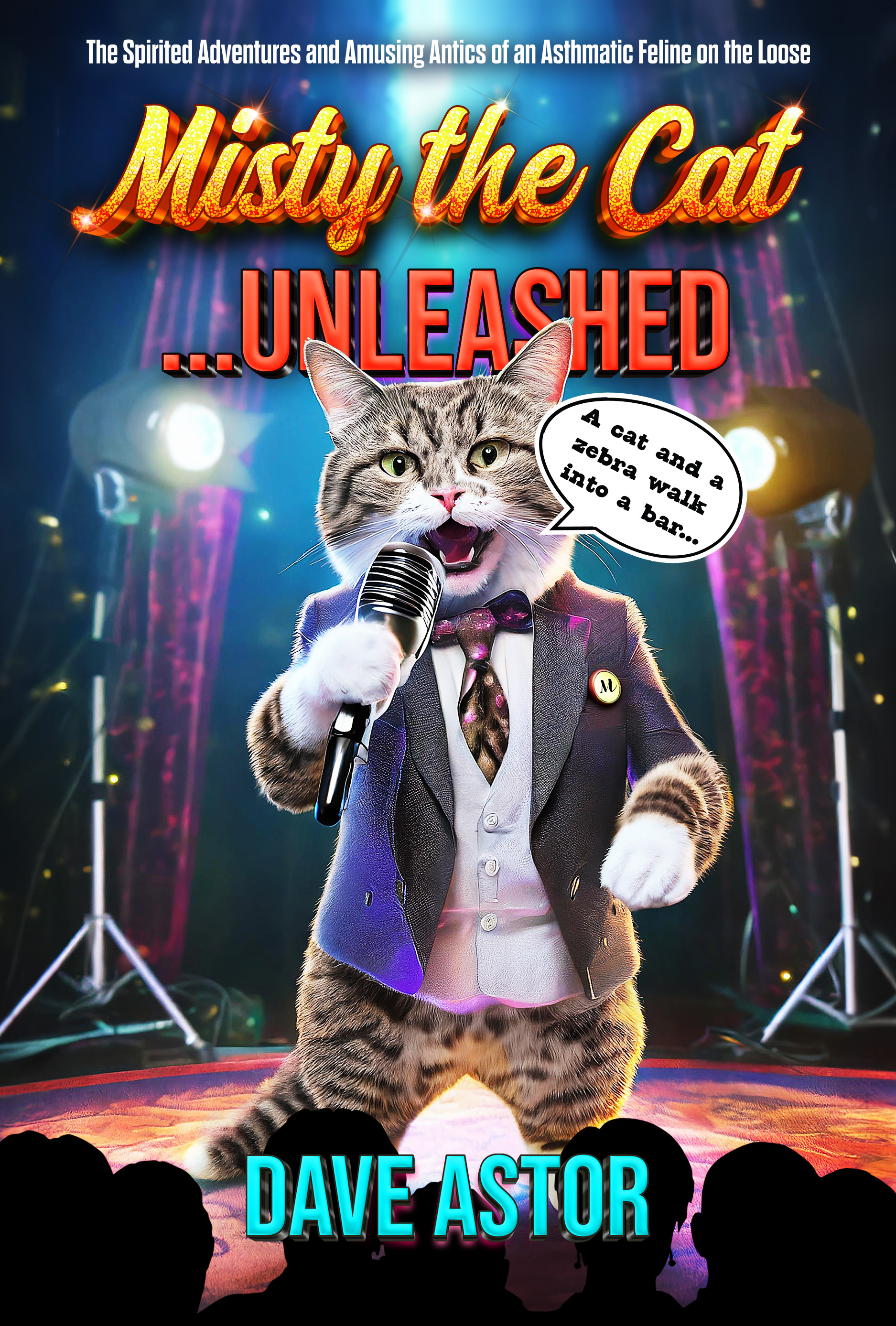
This 90-second promo video for the book features a talking cat: 🙂 Not my voice. 🙂
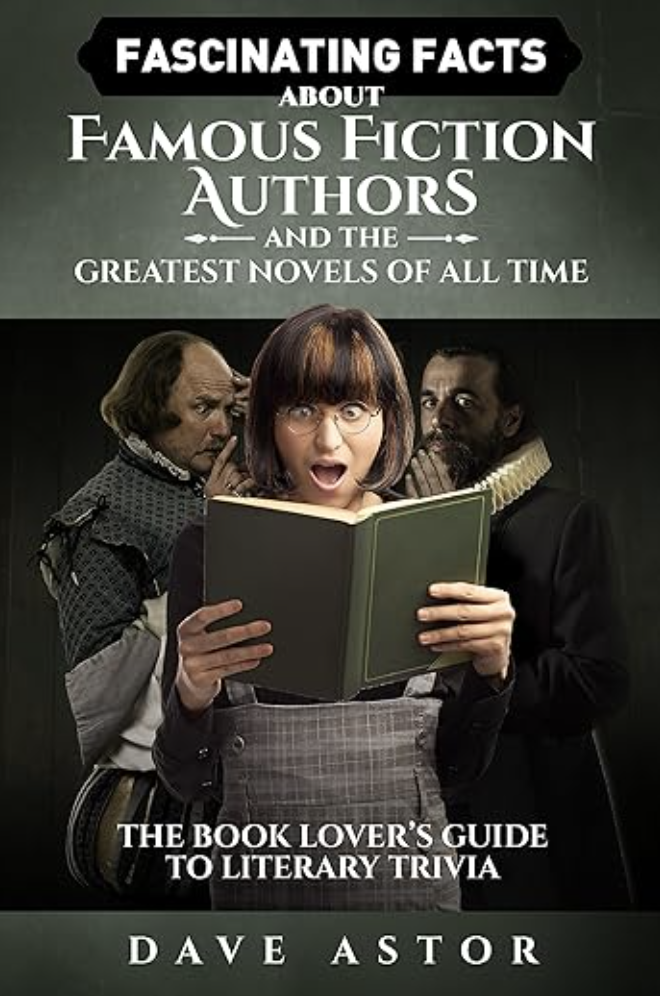
I’m also the author of a 2017 literary-trivia book…
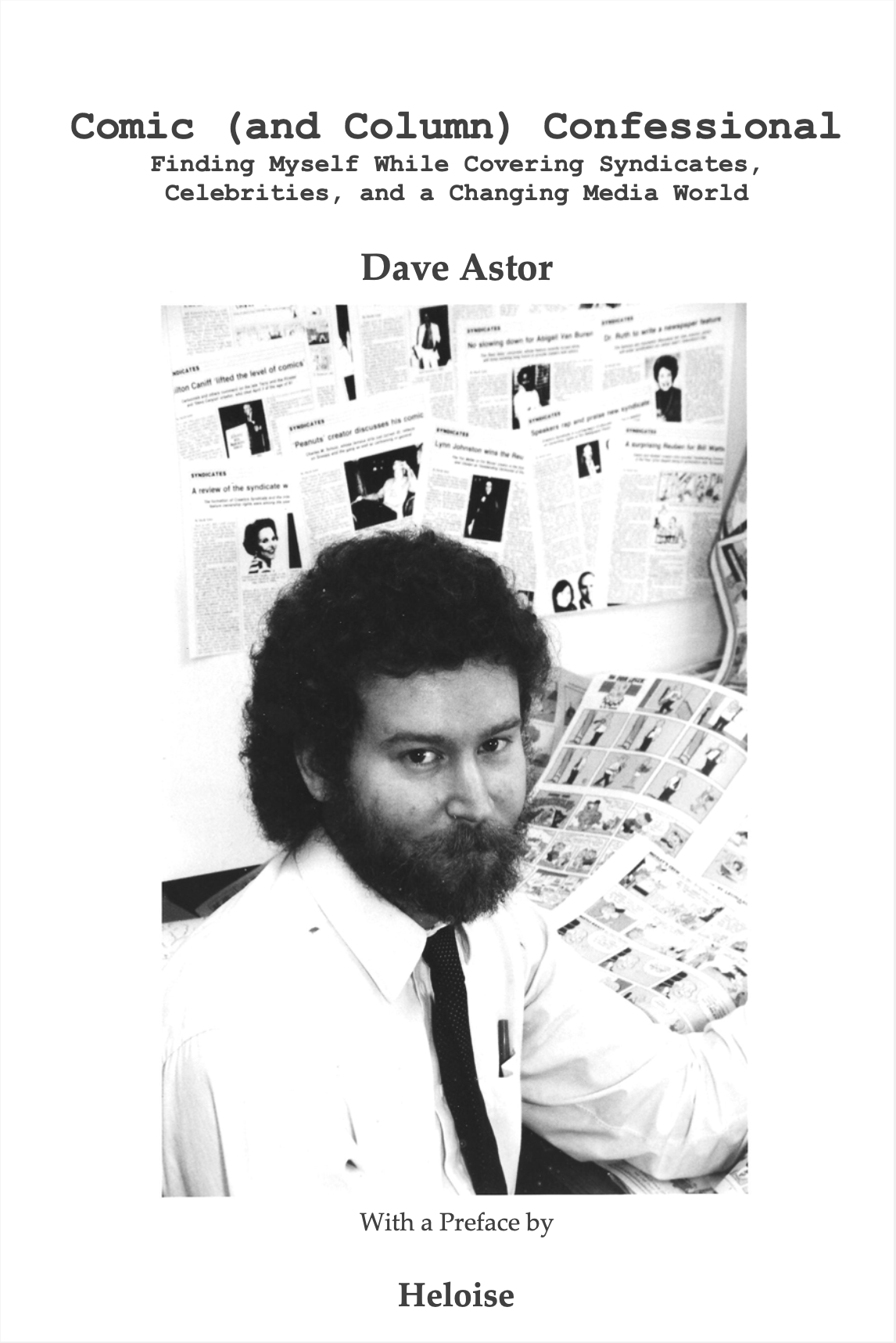
…and a 2012 memoir that focuses on cartooning and more, including many encounters with celebrities.
In addition to this weekly blog, I write the 2003-started/award-winning “Montclairvoyant” topical-humor column every Thursday for Montclair Local. The latest piece – about ICE agents again menacing my town and more — is here.


I think I read more quirky fiction in the 70s and 80s than I do today. John Irving, Margaret Atwood , and Kurt Vonnegut are all favorites. Have you read the newest Irving? I have it on my list but haven’t heard much about it.
LikeLiked by 1 person
Thank you, Lori! Yes, a lot of quirky fiction back in the ’70s and ’80s. The authors you mentioned, and also authors such as Toni Morrison; her classic “Beloved” is certainly quite quirky in its way.
I have not read the newest John Irving book. The most recently published novel of his I got to was 2012’s “In One Person.”
LikeLike
Thank you so much Dave, that’s where I know Margaret Atwood from: ‘The Handmaid’s Tale’!
That immediately triggered a memory. Her other work I have not come across! Wasn’t ‘The Handmaid’s Tale’ made into a film?
Sorry about ‘A Clockwork Orange’, it’s no good when a novel doesn’t leave a lasting positive memory! 🙂
Thanks again Dave for the feedback. I’m always so interested in reading your honest views on fiction.
With kind regards,
Sharon 🥳😃
LikeLiked by 1 person
Thanks for the follow-up comment, Sharon! “The Handmaid’s Tale” was made into a movie many years ago but also an acclaimed recent long-running TV series. The book, the screen adaptations, and Margaret Atwood’s very good sequel novel (“The Testaments”) certainly say a lot about society, patriarchy, far-right thinking, etc.
LikeLiked by 1 person
Thanking YOU Dave for the information!
Ahh! I knew I heard of the movie but not a TV series! ‘The Handmaid’s Tale’ must be quite a book if it can generate a long-running TV series!! Something to look for!
‘The Testaments’, that’s new to me! Margaret Atwood certainly sounds like a writer I should look up!
Thanks again Dave.
With gratitude,
Sharon 🙂
LikeLiked by 1 person
“The Handmaid’s Tale” is definitely depressing, Sharon, but memorable. “The Testaments” sequel — which came 34 years later! — is a little more upbeat.
LikeLiked by 1 person
Hold on Dave, you never mentioned depressing!!! I don’t fancy wading through a depressing book right now! 😦
Perhaps I’ll start with ‘The Testaments’, wrong order I know!! 😀
LikeLiked by 1 person
I hear you about avoiding depressing these days, Sharon. 🙂 😦 “The Testaments” kind of needs “The Handmaid’s Tale” to be read first, and it’s not exactly uplifting even though it’s less depressing than the first book. No Atwood novel is really upbeat, though parts of “Oryx and Crake” are satirically hilarious amid the dystopia.
LikeLiked by 1 person
Dave, I appreciate your feedback but I think I will be giving the wonderful Margaret Atwood a miss! Her books sound heavy, as in not particularly cheering! 😐🙂
Thanks all the same!!
🖐 😄
LikeLiked by 1 person
Totally understand, Sharon! 🙂
LikeLiked by 1 person
😊
LikeLiked by 1 person
🙂
LikeLiked by 1 person
Hi Dave!
I like the concept of quirky and a bit ‘out there’ as the subject for this week’s post. So very fascinating! However, it’s a subject area/genre that I’m unfamiliar with.
I’ve come across John Irving before but don’t think I have read any of his books! I haven’t read anything by Margaret Atwood either, although I know she is quite successful.
I have heard of ‘Clockwork Orange’ but it doesn’t strike me as a book I would enjoy much!
An interesting post Dave where you have shown diversity in fiction.
Thank you!
Sharon 😊
LikeLiked by 1 person
Thank you, Sharon! I agree with you about “A Clockwork Orange”; I’m kind of sorry I read it.
I’m a big fan of Margaret Atwood’s work and a fairly big fan of John Irving’s work. Atwood’s “The Handmaid’s Tale” is of course a prescient classic. In addition to that book and her other speculative-fiction novels, she’s also done excellent historical fiction (“Alias Grace”) and excellent contemporary fiction (“Cat’s Eye,” etc.).
LikeLike
The Metamorphosis is one of those books that I never quite got over haha! 🙂 Definitely quirky. And I’m a forever fan of quirky Alice in Wonderland too! I admit I’ve been a little behind on my reading lately with crazy life stuff, so no quirky stuff is coming to mind on my end – hopefully I’ll have more time soon!
LikeLiked by 1 person
Thank you, M.B.! “The Metamorphosis” does stick with a person, and the Alice books are way up there in the quirky hierarchy. 🙂
Hope things calm down for you a bit in real life, and that you can once again read as much as you’d like to read — while also writing your books and blog posts, of course. 🙂
LikeLiked by 1 person
Hello Dave, and quirky Misty. I think noisy Boise deserves a quirky turkey.
Having made a fool of myself, I will offer up Fear and Loathing in Las Vegas by Hunter S. Thompson and The Electric Acid Kool-Aid Test by Tom Wolfe. (although EAKT is non-fiction).
Drug psycedelia plays in both books.
Hmm – Let me Ratchet up the choices – One Flew Over the Cuckoo’s Nest by Ken Kesey. The entire story is quirky as all get out, but Chief Bromden ripping the marble sink out is a surprise quirk even after all the quirks.
Odd I thought of 3 pretty quickly? If they count!
LikeLiked by 1 person
Thank you, Resa! Your rhyme binge is very much appreciated. 😂
I haven’t read much of Tom Wolfe, but I agree that Hunter S. Thompson’s work is quite quirky! Psychedelic drugs certainly contribute…
And, yes, “One Flew Over the Cuckoo’s Nest” is an offbeat novel (and movie) — and that was one heavy sink!
LikeLiked by 1 person
Now I feel like watching the movie!
LikeLiked by 1 person
A fantastic film!
LikeLiked by 1 person
Yes!
LikeLiked by 1 person
🙂
LikeLiked by 1 person
II read many of the ones you listed, Dave although I guess I didn’t consider them quirky at the time. I would add one I’ve added before, Richard Brautigan’s The Hawkline Monster was quirky in the extreme. I would also toss in Great White Doctor by Bradley Lewis.
LikeLiked by 1 person
Thank you, Dan! I I appreciate the two examples! And I hear you that some novels that might be considered quirky by many readers don’t necessarily scream quirky to everyone.
LikeLiked by 1 person
My first series, with characters who move through their dreams and can see bits of the future, are also quirky…I suppose.
LikeLiked by 1 person
Sounds quirky to me, Dan. 🙂
LikeLiked by 1 person
😉
LikeLiked by 1 person
🙂
LikeLiked by 1 person
Hi Dave, such an interesting post, and I really enjoyed that vid. It seems that I have read rather a lot of quirky novels (I wonder why?). Still, some of my favs are these:
There’s The Ocean at the End of the Lane by Neil Gaiman – such a delightful novelette. Of course, I will mention The Well of Lost Plots by Jasper Fford, and I think for me the best one. Finally, I’ll mention this one: Mr Penumbra’s 24-Hour Bookstore by Robin Sloan. I felt this was brilliant, although I know quite a lot of people didn’t.
LikeLiked by 1 person
Thank you, Chris! Glad you liked the post and that Angine de Poitrine video!
You mentioned some excellent quirky novels. I also enjoyed “The Ocean at the End of the Lane,” “Mr. Penumbra’s 24-Hour Bookstore,” and Jasper Fforde’s work — all with a bit or more of weirdness. 🙂
LikeLiked by 1 person
I remember my first impressions when I read Metamorphosis, and how glad I was to have discovered Kafka! A Clockwork Orange really shocked me as well, although I haven’t read the book, but vividly recall seeing the movie when I was a teen (many years ago!).
LikeLiked by 2 people
Thank you, Ada! I agree that reading Kafka for the first time has a big impact. And, yes, the “Clockwork Orange” movie adaptation was shocking, like the book was but seeing things on screen was even more gruesome.
LikeLiked by 1 person
In your today’s “quirky and perky “reading list I can see several books you mentioned and which I loved, above all The Metamorphosis, and the transformation of the main character into an insects still haunts me today! Many thanks, Dave, for your excellent proposals.
LikeLiked by 1 person
Thank you, Martina! Glad you liked the post! “The Metamorphosis” IS quite something, both as a direct story and as a metaphor (“The Metaphorphosis”? 🙃 ).
LikeLiked by 1 person
Well, maybe it‘s even more precise than the original, or „Die Verwandlung“ because Samsa feels already as a robot in 1915! 😙Thank you, Dave
LikeLiked by 1 person
Nicely put, Martina. 🙂 And “Die Verwandlung” is a great-sounding title in the original German.
LikeLike
🌻
LikeLiked by 1 person
🙂
LikeLike
hi Dave, an interesting post. My first reaction was that I don’t read quirky novels but then when I read your list of books, I realized I’ve read most of them so I do read quirky books. My second thought is that this type of book is quite difficult to get into as the quirky nature of the writing means they are quite complex reads that you have to focus on. I don’t think Catch 22 was on your list. On thinking about it, quirky seems more prominent in American authored books. I think Eva Ibbotson’s books fit this criteria. I love them even now as an adult.
LikeLiked by 3 people
Thank you, Robbie! A great observation that we don’t always see somewhat quirky books as somewhat quirky. 🙂 And, yes, quirky novels might require a certain amount of patience to “get into.” Also, I agree that “Catch-22” is quirky as it goes all out with its humor and antiwar satire.
LikeLiked by 1 person
It does. I liked Catch 22 a lot.
LikeLiked by 1 person
I liked it a lot, too, Robbie!
LikeLiked by 1 person
I have to say Jeanette Winterson’s fiction is quirky indeed. In addition, quite a few of Ray Bradbury’s short stories. Nice theme Dave. It’s been awhile since I’ve posted, but I’ve been up to my ears in cats. Just gave 2 kittens away and have one to go. My mama cat got pregnant right after her first litter all of which we are keeping, no 3rd litter as soon as I can get her fixed. Although, I got a black one outta of the first batch with a white spot on her nose. I guess life is quirky period. As The Moody Blues sang “Isn’t life strange”. Susi
LikeLiked by 2 people
Thank you, Susi! Nice to hear from you again! That’s quite a cat saga you’ve been going through, but those creatures are so worth it. 🙂
I have yet to try Jeanette Winterson’s fiction.
Some of Ray Bradbury’s work, as well as sci-fi by other authors, can indeed be quirky.
That Moody Blues song (which I have at home on their wonderful “Seventh Sojourn” album) is very appropriate for this post. 🙂
LikeLiked by 1 person
I do not know Jeanette Waterson’s work, but when I looked her up, the first novel I saw was called Why Be Happy When You Could Be Normal, which suggests something quirky. I will give her a read. I love quirky people and characters in novels. Eleanor Oliphant comes to mind (she is perfectly fine), and I think Lillian Boxfish was also a bit quirky (Lillian Boxfish Takes a Walk).
LikeLiked by 1 person
Thank you, Madeline! “Eleanor Oliphant Is Completely Fine” is a great mention! A very offbeat novel, with a twist near the end that I didn’t see coming.
LikeLike
That is a great video.
I really like John Irving but I never thought of him as quirky. Kafka, yes.
As to Melville, I’ll go with Bartleby. (K)
LikeLiked by 1 person
Thank you, Kerfe! I guess we differ on whether John Irving’s work is quirky. 🙂 I love Melville’s “Bartleby the Scrivener” story, and its title character is indeed…offbeat.
LikeLiked by 1 person
I find these books a bit hit-or-miss, Dave. I hated ‘A Clockwork Orange’ and ‘One Thousand Years of Solitude’, as well as Kafka, although I was okay with Vonnegut and Alice in Wonderland/Through the Looking Glass. I have ‘The Master and Margarita’ on my TBR pile, so we’ll see about that. I loved ‘Midnight’s Childen’, Rushdie’s story of babies born with special powers on the stroke of midnight when India gained independence. Maybe a love or hate reaction is all a part of quirky stories? Oh, and ‘The Life and Loves of a She-Devil’ might fit this category. Have a good week. 🙂
LikeLiked by 2 people
Thank you, Laura! Yes, some quirky novels are not to everyone’s liking. Re several of the ones you mentioned, I also disliked “A Clockwork Orange,” mostly liked “One Hundred Years of Solitude” despite it being a bit confusing at times, and thought that a lot of “The Master and Margarita” was brilliant. Have a good week, too!
LikeLiked by 1 person
Love the musical quirky duo introduction. You mention some great quirky novels that I’ve enjoyed.
LikeLiked by 1 person
Thank you, Rosaliene! Glad you’ve enjoyed reading some of the novels I mentioned. 🙂 And I agree that Angine de Poitrine is very fun to listen to and watch. 🙂
LikeLiked by 1 person
🙂 ❤
LikeLiked by 1 person
🙂
LikeLike
“We Have Always Lived in the Castle” is still on my reading list! Several friends have recommended Jackson’s book for the quirk factor! I’ll take your post as another friendly nudge, Dave. (And I love the title of this post!) ❤️😉❤️
LikeLiked by 1 person
Thank you, Vicki! Glad you enjoyed the post and its title. 🙂 “We Have Always Lived in the Castle” has a large quirk quotient indeed! Shirley Jackson had a very interesting sensibility in that novel as well as in “The Haunting of Hill House” novel and “The Lottery” short story.
LikeLiked by 1 person
“Quirk quotient” — I love it!!! ❤️😉❤️
LikeLiked by 1 person
When all else fails…alliteration. 🙂
LikeLiked by 1 person
You have skills…no doubt!!! ❤️😉❤️
LikeLiked by 1 person
Thank you, Vicki! 🙂
LikeLiked by 1 person
Thank you, Dave! ❤️😉❤️
LikeLiked by 1 person
🙂
LikeLiked by 1 person
Dave, I rarely remember books as quirky. I remember the characters and the experience of entering their worlds. But looking at your examples, I can see how often the unexpected becomes the very thing that makes a story memorable. I immediately thought of Tove Jansson’s The Summer Book, which I am currently reading. I am going slowly through the chapters because there is depth that is easy to overlook. The conversations between Sophia and her grandmother have a wonderful eccentricity about them. They are not extraordinary in the way Kafka’s giant insect is extraordinary, but they constantly surprise me. Some writers turn the world upside down, while others simply give us characters who see the ordinary world from a slightly different angle. This is a quote from the chapter I just read:
“It’s funny about love,” Sophia said. “The more you love someone, the less he likes you back.”
“That’s very true,” Grandmother observed. “And so what do you do?”
“You go on loving,” said Sophia threateningly. “You love harder and harder.”
LikeLiked by 3 people
Thank you, Rebecca! Unexpected and eccentric are two excellent adjectives to describe the content of of very quirky or partly quirky novels.
“Some writers turn the world upside down, while others simply give us characters who see the ordinary world from a slightly different angle” — yes! There is definitely a range in and a variety of quirkiness.
I appreciate your mention of “The Summer Book,” and that conversation you cited from it is fascinating. Not sure the love referenced there will end well. 🙂 😦
LikeLiked by 1 person
It did, with a surprise. That is what I love about The Summer Book. It is all about a love for a cat. Misty would love this chapter.
LikeLiked by 1 person
Ah, a cat! 🙂 I thought a relationship between humans was being referenced by Sophia. If Misty reads “The Summer Book,” that novel will be “The Autumn Book” by then, but it still sounds good. 🙂
LikeLiked by 1 person
😂😂😂
LikeLiked by 1 person
🙂
LikeLiked by 1 person
Ray Bradbury’s Fahrenheit 451 about burning of books. Not quite as dystopian in today’s insane political climate with this horrid administration wanting to ban books,stories,history of LGBTQ, diversity, equity,inclusion. DJT probably never read a real book in his life,just newspapers and magazines.
Michele
E & P way back
LikeLiked by 4 people
Thank you, Michele! What Ray Bradbury scarily depicted in “Fahrenheit 451” was morally weird yet not unrealistically weird given what various dictators and wannabe dictators have done. Trump, as you note, is certainly one horrid example. I wonder if he even read the books ghostwritten for him?
LikeLike
A brilliant and fun reflection, dear Dave
It is so true that a touch of the unpredictable or bizarre is what makes these authors truly unforgettable.
Thank you for this lovely post!
LikeLiked by 3 people
Thank you, Luisa! Happy you enjoyed the post! “A touch of the unpredictable or bizarre” (nice phrasing 🙂 ) can definitely add to a novel.
LikeLiked by 1 person
You’re so welcome, Dave
I’m thrilled you enjoyed that phrasing! 😊
LikeLiked by 1 person
🙂
LikeLiked by 1 person
One morning, as Gregor Samsa woke from troubled dreams, he found himself transformed in his bed into a horrible verminous bug.
I should be so lucky.
Thus begins my own take on Kafka’s The Metamorphosis. It’s about a guy who’s always on fire. Just go with it. My high school English teacher said I wrote like Kafka, which I found interesting because I was trying my best to rip off Dostoevsky. Well, 30 or 40 years later, I embraced my inner Kafka and… well, probably failed, but I’m proud of it anyway.
LikeLiked by 3 people
Thank you, Michael! I enjoyed your comment. Being told one writes like Kafka or Dostoevsky is a compliment either way. 🙂
LikeLiked by 2 people
I often mention Mervyn Peake’s Gormenghast books. They certainly have quirky characters, and the setting is bizarre.
That band certainly has adopted weirdness. Both the costumes and their name.
LikeLiked by 3 people
Thank you, Audrey! Worth mentioning Mervyn Peake’s Gormenghast books again. 🙂 One of these days I might try the first one, “Titus Groan.”
Yes, that band is weird, weird, weird. 🙂
LikeLiked by 2 people
Speaking of John Irving, I’d say Owen Meany is quirky. Thank goodness his creator didn’t bring in those irritating (and boring) bears!
LikeLiked by 3 people
Thank you, Liz! “A Prayer for Owen Meany” — the novel and its title character — are extremely quirky! Not my favorite Irving book (that’s “The Cider House Rules”), but it’s memorable. And, yes, no bears in “Owen Meany” that I can recall. 😂
By the way, I borrowed “Breakfast at Tiffany’s” from the library after you recommended it, and am liking it so far. (About halfway through that Capote novella.) It will be part of my blog post next Sunday. 🙂
LikeLiked by 5 people
You’re welcome, Dave! I loved Owen Meany. I haven’t yet read Cider House Rules. I look forward to your thoughts on the Breakfast at Tiffany’s novella!
LikeLiked by 2 people
Holly Golightly certainly has an interesting backstory!
LikeLiked by 2 people
Yes, she does. It was a big surprise after seeing the holly of the movie!
LikeLiked by 1 person
I haven’t seen the film, Liz, but I’ve read that it sanitizes the novel somewhat — eliminating the book’s gay subtext, depicting Holly as a nicer person, etc.
LikeLiked by 1 person
Yes, the movie does sanitize the novella.
LikeLiked by 1 person
Unfortunately, not unusual for Hollywood, though perhaps that’s being done a little less now than decades ago.
LikeLiked by 1 person
You’re probably right that sanitizing books for the movies is not quite as prevalent as in the past.
LikeLiked by 1 person
Some progress… 🙂
LikeLiked by 1 person
We’ll take what we can get, eh?
LikeLiked by 1 person
Yup! 🙂
LikeLiked by 1 person
Well, Angine de Poitrine are quirky! I remembered that you also like Rush. A documentary about Neil Peart is coming out on CBC soon, you can probably see it on their app GEM. Maggie
LikeLiked by 3 people
Thank you, Maggie! Angine de Poitrine is quirky indeed. 🙂 And you have an excellent memory about my love of Rush. 🙂 I heard about that Neil Peart documentary (saw a trailer) and hope I can watch the whole thing at some point. The late/great Peart’s drumming successor — Anika Nilles — is doing an amazing job on the current tour.
LikeLiked by 3 people