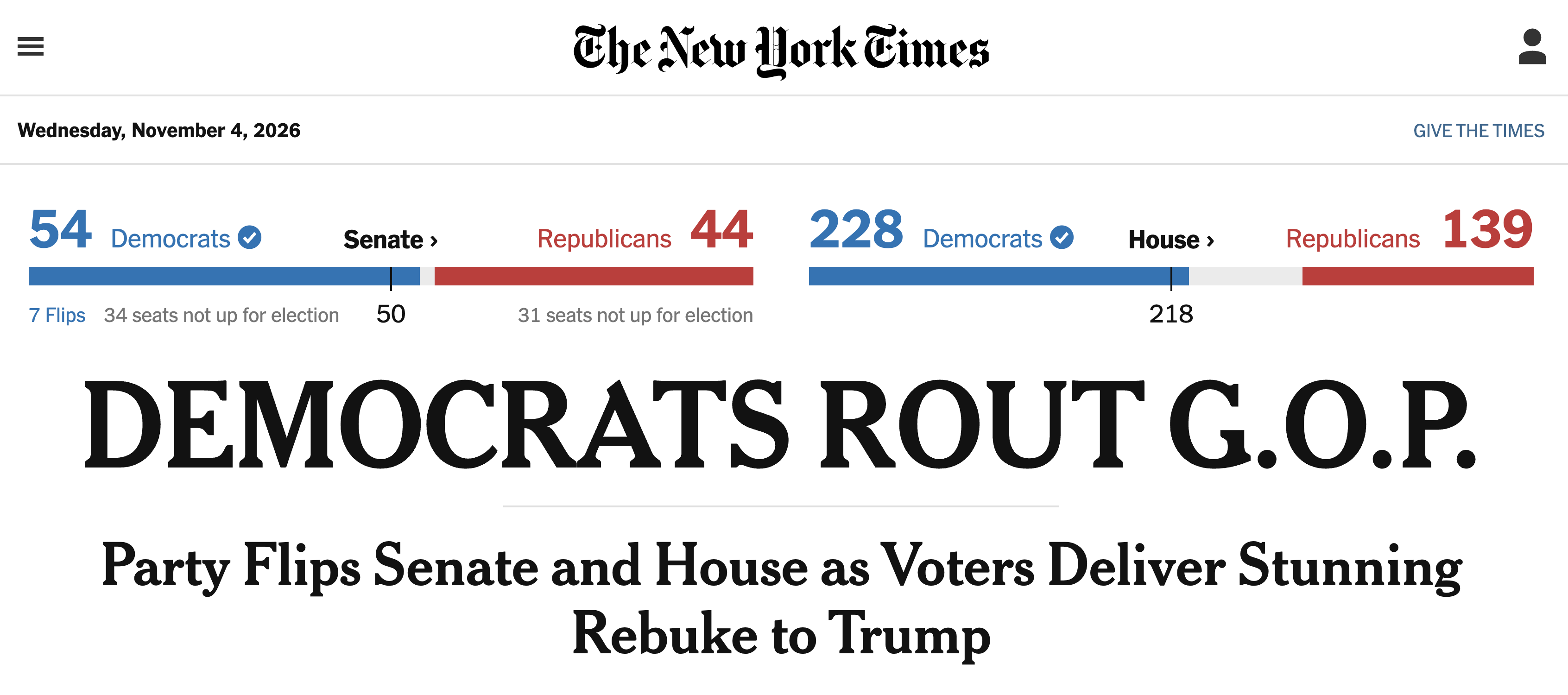
A screenshot of The New York Times website from the morning after the election.
Back in 2024, I discussed betrayal in literature. I’m going to repost that piece down below, while adding a few novels I’ve read during the past two years. But I’ll first talk about a political betrayal, and how it helped lead to the wonderful midterm election results in the United States this past Tuesday, November 3, when a large majority of the country FINALLY turned against the vicious Trump regime and his sycophantic fellow Republicans.
When seeking a return to the White House during his 2024 presidential campaign, Donald Trump’s promised no new wars and lower prices. The man is a pathological liar, of course, but enough people believed him to get him elected. (Trump’s blatant racism and some other things also helped him win two years ago.)
But Trump and Israel started the disastrous Iran War this year for no good reason – causing all kinds of death and destruction, and making the price of gas, food, and other necessities soar. Those betrayals of key campaign pledges – along with Trump’s loony tariff policies, blatant corruption, anti-immigrant cruelty, cover-up of the Epstein pedophilia/sex-trafficking scandal he was tied to, etc. – helped doom the chances of many Republican politicians in the recent midterms.
That said, here’s my post from two years ago about betrayal in literature. After that, I’ll add a few relevant novels I’ve read since then.
Portraying Betraying (October 20, 2024)
Betrayal is a Harold Pinter play, and betrayal in novels is the subject of this blog post.
Literature with a betrayal element can make for intense reading. We feel sympathy for the betrayed, anger at the person doing the betraying, curiosity about whether the betraying person will get their comeuppance, and more.
The Bad Daughter, a Joy Fielding novel I just finished, includes plenty of betrayal – most notably perpetrated by a vile real-estate developer who betrays his son by marrying that son’s fiancée and at the same time betrays one of his daughters because that fiancée was also the daughter’s best friend. Is the father’s betraying action why he gets shot in the book? The Bad Daughter is a suspenseful page-turner with several skillful red herrings, but is unfortunately marred by a surprise ending that doesn’t feel believable.
Another nasty/betraying dad not respectful of boundaries is Fyodor Karamazov, who’s enamored with the same woman (Grushenka) his son Dmitri is in love with in Fyodor Dostoevsky’s The Brothers Karamazov.
Monumentally betrayed is Edmond Dantes, who’s framed for a crime he didn’t commit in Alexandre Dumas’ The Count of Monte Cristo. A long imprisonment and epic revenge ensue.
Another 19th-century classic containing a memorable betrayal is George Eliot’s Silas Marner, whose title character is done wrong by his supposed best friend. This devastates Silas and changes the trajectory of his life in two profound ways – one bad and one good.
Modern fiction offers many other betrayals in addition to those in The Bad Daughter. For instance, the title character in Toni Morrison’s Sula and Nel are best friends when growing up, but Sula later has an affair with Nel’s husband. In Khaled Hosseini’s The Kite Runner, a cowardly Amir betrays his friend Hassan by not intervening when Hassan is attacked – and Amir’s longtime guilt subsequently drives the plot. Ian McEwan’s Atonement features a teen girl who betrays her older sister and that sister’s boyfriend by not-so-mistakenly accusing him of a rape he didn’t commit.
Betraying one’s country is also a thing, as Benedict Arnold did during the Revolutionary War. Arnold is among the real-life notables who have cameos in Diana Gabaldon’s (mostly) 18th-century-set Outlander series of novels.
–
Among the many novels I’ve read since 2024 that fit this theme are Gillian Flynn’s Gone Girl, in which the weird couple Amy and Nick continually betray each other so much it’s almost comical; Taylor Jenkins Reid’s Malibu Rising, in which rock star Mick Riva betrays his wife June and their children with abandonment amid constant womanizing; and John Grisham’s The Confession, in which the police and others frame an innocent Black teen for a rape and murder.
Any thoughts about, and/or examples of, this topic?
Misty the cat says: “Tuesday’s U.S. vote was so amazing that even three deer got elected.”
My comedic 2024 book – the part-factual/part-fictional/not-a-children’s-work Misty the Cat…Unleashed – is described and can be purchased on Amazon in paperback or on Kindle. It’s feline-narrated! (And Amazon reviews are welcome. 🙂 )
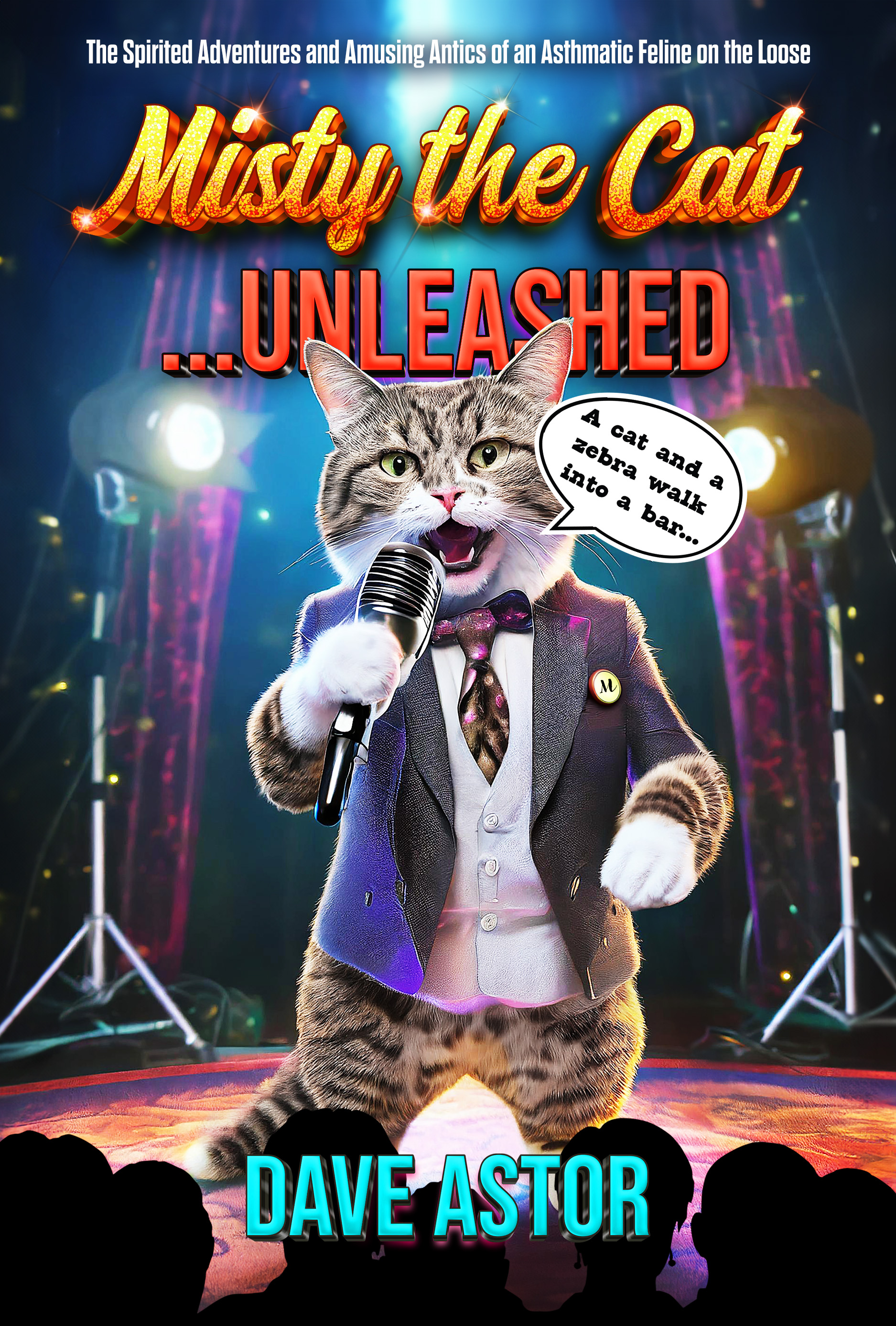
This 90-second promo video for the book features a talking cat: 🙂 (Not my voice. 🙂 )
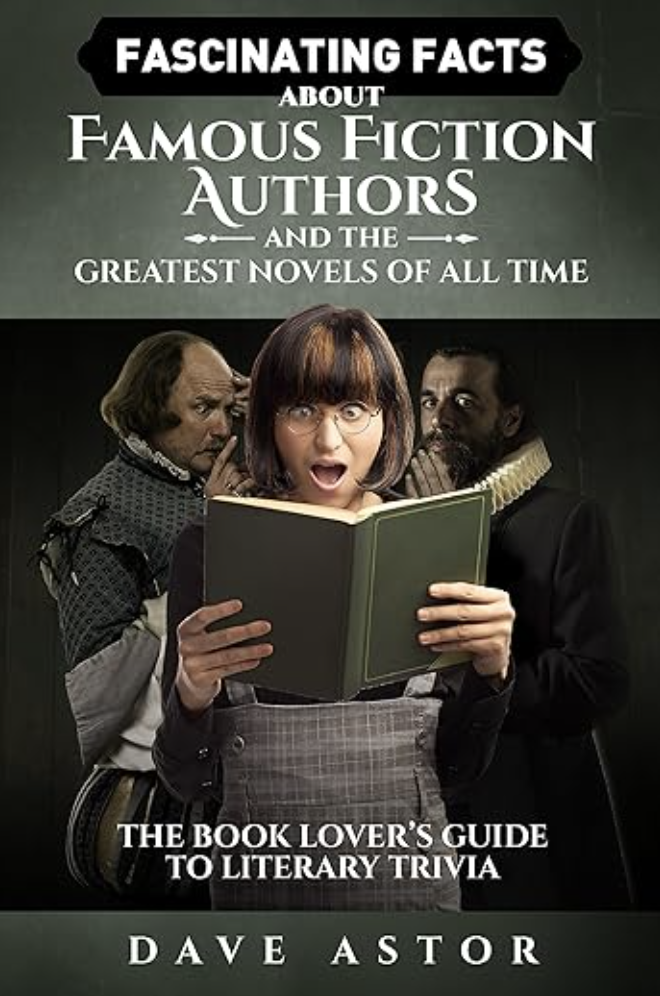
I’m also the author of a 2017 literary-trivia book…
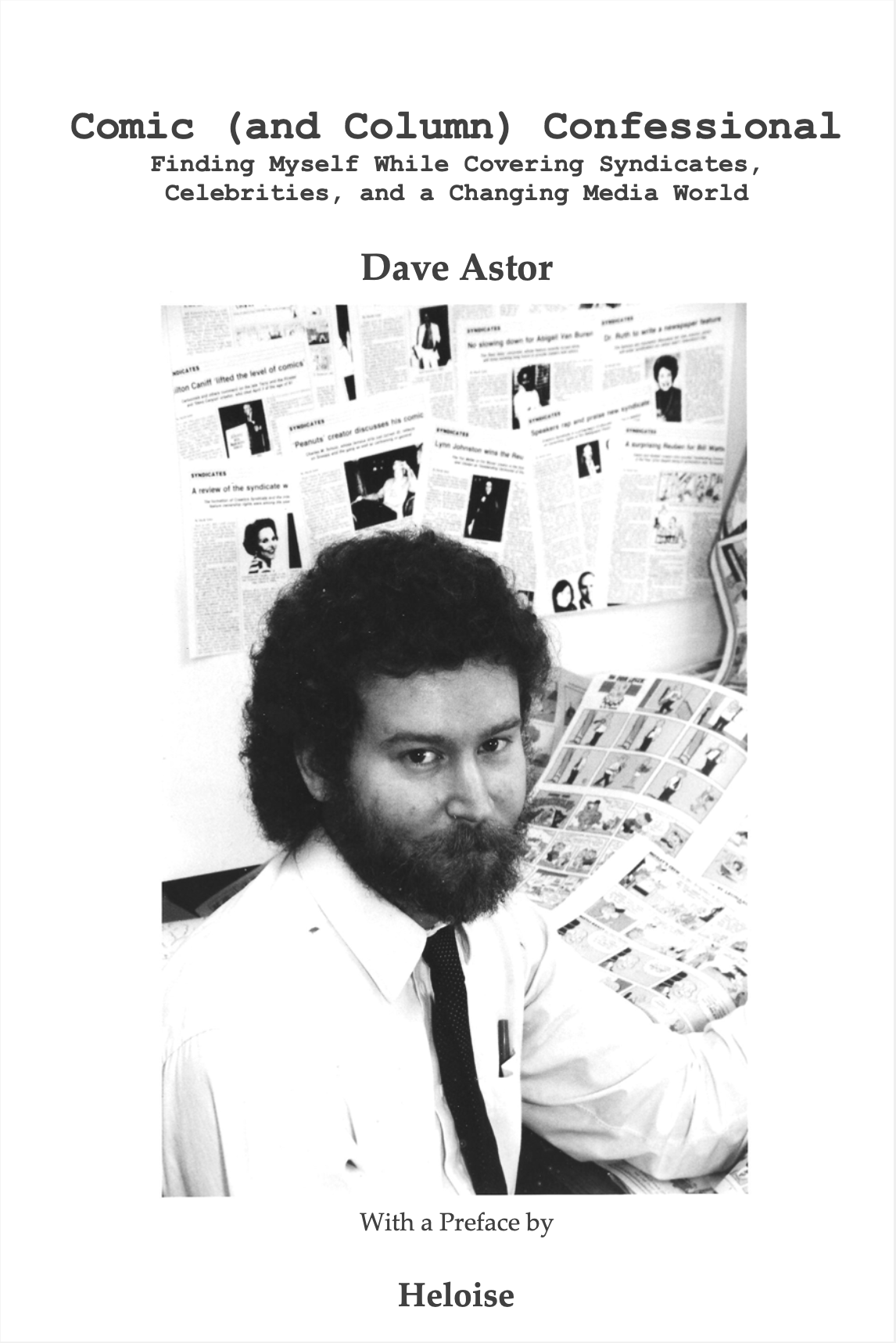
…and a 2012 memoir that focuses on cartooning and more, including many encounters with celebrities.
In addition to this weekly blog, I write the 2003-started/award-winning “Montclairvoyant” topical-humor column every Thursday for Montclair Local. The latest piece – which discusses the elections amid a Star Trek theme — is here.


Various family seniors, including grandparents, (no Tories, might be genetic) – knowing I planned to study politics and history, introduced me to the history of Ramsay Macdonald, who ‘ ‘betrayed the Labour party’ – directing me to the fictional portrayal in ‘ Fame is the Spur’ by Howard Spring, sometimes known as’ the Manchester Dickens.’
LikeLiked by 1 person
Thank you, Esther! It’s interesting when factual stuff can lead us to fiction — as with Ramsay Macdonald and Howard Spring, neither of whom I know much about. I’m off to Wikipedia… 🙂
LikeLike
Thanks, Your site helps me keep up with our various US neighbours/friends, living here.
LikeLiked by 1 person
You’re very welcome, Esther! Glad this site is helpful. 🙂
LikeLike
Betrayal, what a wonderful subject, and what an excellent post, Dave. Have I read any of those, I wonder… as I scrolled down.
Well, there’s The Kite Runner by Khaled Hosseini – very good indeed. Also Atonement by Ian McEwan, (already mentioned) I also thought the book was great but the film defo not, just also saying. And of course, so many excellent plays by Will Shakes – Othello is one of my favs.
LikeLiked by 1 person
Thank you, Chris! “The Kite Runner” — while far from a perfect book — was quite a debut novel! And I’m not surprised that the “Atonement” film wasn’t as good as the book; often the case with screen adaptations. And, yes, “Othello” is a classic. (I’ve heard recordings of Paul Robeson starring in it — magnificent!)
LikeLiked by 1 person
Betrayal is a useful element for fiction. Most people can identify with it from real life, and the usually more serious betrayals in books keep things interesting and test the characters. It’s a necessary ingredient in spy thrillers for sure!
I read Gone Girl and agree with you that it was hard to take seriously.
LikeLiked by 1 person
Thank you, Audrey! I totally agree with all your thoughts on betrayal — among them the fact that many readers can relate to it from their real-life experiences.
As for “Gone Girl,” it’s clever in its way but I don’t understand why it was a mega-bestseller and is considered a modern classic. It IS hard to take seriously.
LikeLiked by 1 person
A great post, Dave, but I’ve only just got here, it’s late and I’m tired, so I’ll sleep on it and come up with a few examples, I’m sure. Great to see the results this week though; congratulations, although I suspect there’s a long way to go before relative sanity is restored. I haven’t read many of the books you note above, but ‘Silas Marner’ is a perennial favourite here, with his rehabilitation through the love for and of a child irresistible. Eppie in the coal hole – so funny – and her eventual repudiation of her biological ‘father’ for her adoptive one is so great. What a great author Eliot was! Catch you tomorrow, have a good evening. 🙂
LikeLiked by 1 person
Thank you, Laura! Totally agree — great election results, but there’s a long way to go before things get back to “normal,” which if it happens will take years.
I agree that “Silas Marner” is a terrific novel that takes a reader from the depths of despair to the wonderful situation you describe. I also agree that George Eliot is a terrific novelist. Very few authors have written five books as good as “Silas Marner,” “The Mill on the Floss,” “Middlemarch,” “Daniel Deronda,” and “Adam Bede.” (I haven’t read her “Felix Holt” or “Romola.”)
Will look forward to your next comment!
LikeLiked by 1 person
Watch this space, Dave …
LikeLiked by 1 person
🙂
LikeLike
Perfect theme for the moment, Dave. Betrayal, in all of its forms, has consequences for all parties involved which makes it an excellent plot device in works of fiction. I haven’t read The Bad Daughter so cannot say if the surprise ending feels believable or not. Given the unpredictability of our real-life betrayer, I won’t be surprised if his ending is an unbelievable event that leaves us gaping.
LikeLiked by 1 person
Thank you, Rosaliene! Great observation that betrayal has consequences for both the betrayed and the betrayer.
Interesting point about Trump! I also wouldn’t be surprised if the ending of his presidential term and the ending of his life have some stunning elements. For those of a religious bent, the ending of life part will be followed by residency in Hell. What an evil man.
LikeLike
I am thinking of film There Will Be Blood,brilliant Oscar winning performance by Daniel Day Lewis who betrayed many people, his son was most sad. Speaking of blood bath on Election Day alot of bad reds are gone but orange guy still around. Am elated on Blue wave,gives me hope for our humanity. The big “beautiful ” bill was a bill of betrayal.
Michele
E &
LikeLiked by 1 person
Thank you, Michele! I’ve never seen “There Will Be Blood,” but I’ve read that it was based on Upton Sinclair’s “Oil!” novel, which I also haven’t gotten to. Sounds like an intense movie, with all that betrayal.
Agree with all your election-related thoughts. Yes, a great victory, but Trump is still President for two more years and will try to do a lot of damage. He’s already done a lot of damage the past few days, including promoting the Jewish Nazi ghoul Stephen Miller to chief of staff. And the Big Ugly Bill indeed betrayed almost everyone except rich people.
LikeLike
Dave, oh what a topic!!! Betrayal is one of those human experiences that generates such intense feelings, because it begins with trust. We can accept that people will disagree with us, but when someone we have trusted betrays that trust, something fundamental changes. Your post also brought me back to Shakespeare’s Macbeth, which I have been revisiting recently. King Duncan, reflecting on a man who betrayed his trust, says:
“There’s no art
To find the mind’s construction in the face.”
The great irony is that Duncan is about to place his trust in Macbeth. Shakespeare understood so well the vulnerabilities of human nature. Thank you, Dave, for another thought-provoking discussion! Always exciting to stop by!
LikeLiked by 4 people
Thank you, Rebecca! Betrayal is indeed a topic that evokes a LOT of strong feelings because of (as you note) the breaking of trust — an awful thing. Shakespeare definitely depicted that in some of his work, in addition to “Macbeth”; Iago betraying Othello is one example that comes to mind.
LikeLiked by 1 person
What an intriguing topic, Dave! I’ve never read The Bad Daughter, but am definitely intrigued (it sounds great!). Atonement is another good example of a book being based in the idea of betrayal and its ramifications; I’ve seen the movie, but never read the book!
LikeLiked by 3 people
Thank you, Ada! Joy Fielding is an excellent suspense novelist — also in “Cul-de-Sac,” “The Housekeeper,” “Grand Avenue,” etc. Re “Atonement,” I’ve read the novel but not seen the movie. I thought the disturbing book was mostly excellent, except for an ending I didn’t like; I wonder what the film did with that? 🙂
LikeLiked by 1 person
I remember the ending also being a bit disappointing in the movie, but the book certainly sounds intriguing! I think I’ll add it to my list for winter reading! 🍂
LikeLiked by 1 person
Sounds like the “Atonement” film basically followed a lot of the novel, Ada.
It’s good to think of winter reading, and having some books lined up for that. 🙂
LikeLike
Betrayal, as a topic, isn’t fascinating. “But, it is interesting.” Please pardon my Spock-ism – lol!
Before there can be betrayal, some sort of loyalty must’ve been established first – a friend who violates an unspoken trust, a spouse who breaks their marriage vows, a citizen who commits treason against their country (a la Benedict Arnold), or an indebted politician who turns on their chosen leader.
Why do we engage in fragile loyalties? We are social creatures who depend upon it to act in concert with each other. Otherwise, our societies would be chaotic and utterly dysfunctional.
When is it acceptable to betray a loyalty? If our friend commits an egregious crime, should we report it to the authorities? If our spouse commits adultery, does that justify our unfaithfulness? Should a convicted traitor be executed by the state? When should a politician break from a thoroughly corrupt leader like Donald Trump?
Such questions involve human morality and ethics which vary greatly from individual to individual. And, on second thought, that is fascinating! 🙂
LikeLiked by 1 person
Thank you, Robert, for your thoughtful and philosophical comment! I think there can very occasionally be a good reason to betray, such as reporting or trying to prevent an awful crime by a friend. But most times betrayal is hardly a positive thing. (I don’t think a traitor should be executed, because I don’t believe in capital punishment.) And Spock-isms are always welcome. 🙂
LikeLiked by 1 person
Many thanks, Dave, for your post of this very special week! I have taken note of Toni Morrison’s Sula and Nel, which I do not know yet. The first novel that comes to my mind concerning betrayal is “Animal Farm” by George Orwell, where animals take over the farm and develop an even worse situation than before.:)
LikeLiked by 2 people
Thank you, Martina! It IS a special week. 🙂 “Sula” is not one of Toni Morrison’s better books (it’s from early in her novel-writing career) but it’s still pretty good. And I agree that there’s betrayal in “Animal Farm.” Great mention! Democrats in the U.S. will need to do better than what Orwell wrote about. 🙂
LikeLiked by 2 people
Absolutely:)
LikeLiked by 1 person
🙂
LikeLike
Wonderful dissertation Dave and I love how you interjected some great shout outs for books and movies with comparison’s!
All I can say is it’s high time we get on with things! ❤️
LikeLiked by 1 person
Thank you, Cindy! Glad you enjoyed the post! And I agree that it’s time to “get on with things.” Hope the Democrats don’t disappoint. Would love to see a push for the end of the Iran War, an attempt to pass Medicare for All, etc.!
LikeLiked by 1 person
You’re so very welcome, Dave and yes… MEE too! xx
LikeLiked by 1 person
🙂
LikeLiked by 1 person
If you want betrayal on a grand scale, look no further than I, Claudius! I think the pilots’ “catch-22” in Catch-22 is a betrayal of military leadership against the men actually fighting the war.
LikeLiked by 3 people
Thank you, Liz! Two excellent examples of novels with betrayal content! And your comment made me think that “Game of Thrones” has some similarities with that content to the earlier “I, Claudius.”
LikeLiked by 1 person
You’re welcome, Dave!
LikeLiked by 1 person
🙂
LikeLiked by 1 person
Thank you very much, my favourite author. You give me the desire to reread *George Eliot’ Silas Marner. *I read it when I was in High School.
LikeLiked by 1 person
Thank you, Ahmadou! I know “Silas Marner” is not loved by everyone, but I think it’s a great book. (And pretty short for a George Eliot novel.) Hope you enjoy the reread if you decide to do that!
LikeLike
I LOVE your thoughts about betrayal and positive outcomes…your opening thoughts reflect what so many of us have been longing and hoping for in order to move forward in our country, with humanity. Thank you, Dave. So well put. 💝
But wait, there’s more! I laughed out loud when I read your quip about Gillian Flynn’s Gone Girl. So many betrayals it began to read like farce…comedy. Yes! 😜
LikeLiked by 3 people
Thank you, Vicki! Glad you liked the post, and, yes, millions of Americans were longing for what happened on Tuesday. Well said by you! Hopefully, enough Democrats will try to pass plenty of good legislation and seek accountability for the Trump regime’s crimes rather than act “Republican lite.” And, re “Gone Girl,” it was indeed almost a farce. I wanted to like that novel but it went off the rails for practically all its pages. 🙂 😦
LikeLiked by 3 people
With you, with you — on all counts! 💝😊💝
LikeLiked by 1 person
🙂
LikeLike