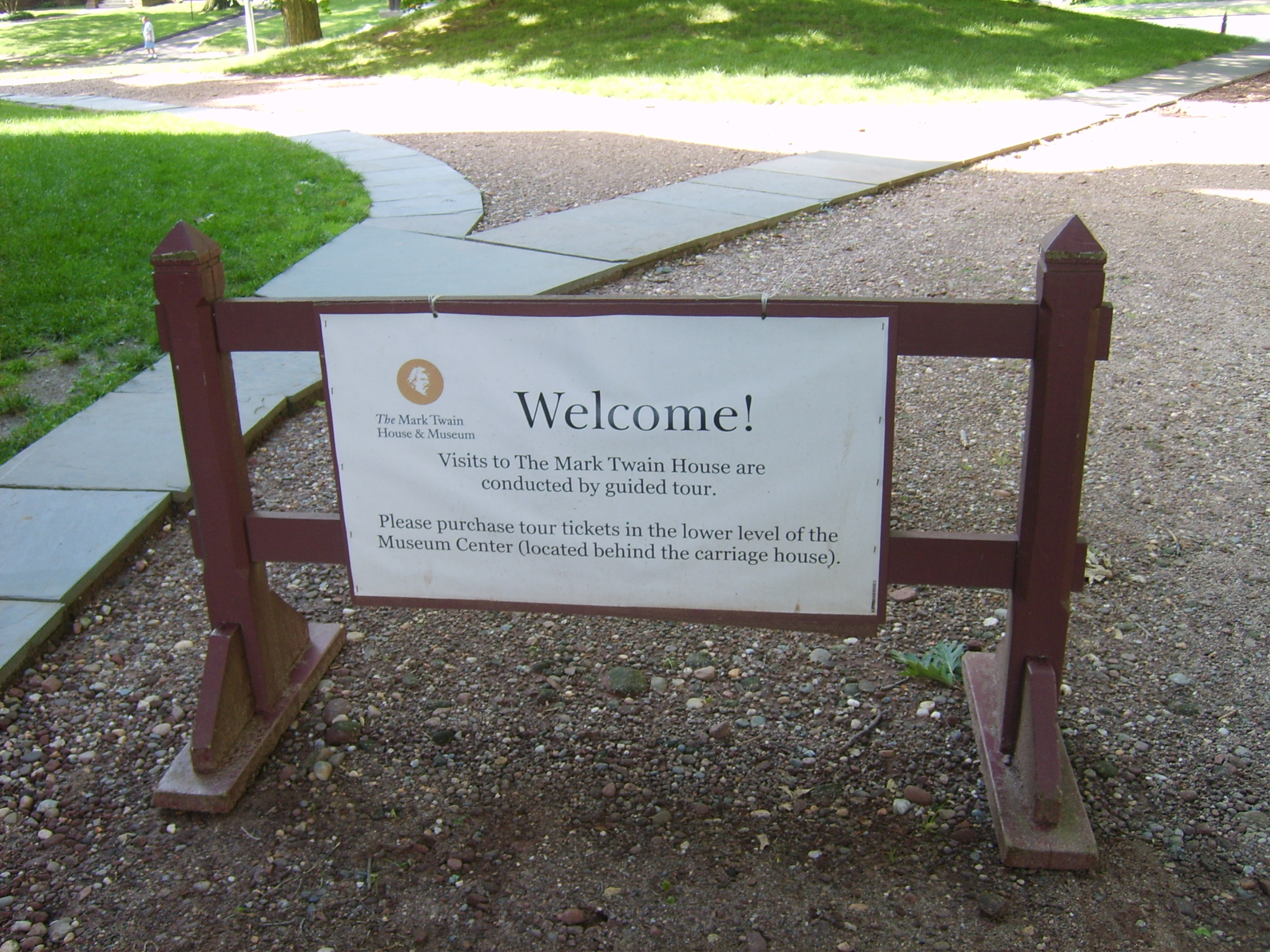
At the Mark Twain House & Museum in Hartford, Connecticut. (2013 photo by me.)
In the Northern Hemisphere, today is the first day of summer – the season when many people travel. And that traveling can be literature-related in certain ways. I’ll discuss some of my experiences, and then ask about yours.
In my post on another topic last week, I mentioned the Pantheon in Paris and Westminster Abbey in London, both of which contain the tombs of famous authors and/or “memorials” honoring them. These writers include, among others, Chaucer and Charles Dickens in Westminster and Alexandre Dumas, Victor Hugo, Voltaire, and Emile Zola in the Pantheon. Sobering, unforgettable visits for fiction lovers.
Speaking of Zola and Dumas, I was in the south of France in 2007 accompanying my French professor wife Laurel to a Zola conference she was speaking at in Aix-en-Provence. Another speaker was Zola’s great-granddaughter, Martine Le Blond-Zola.
During that trip, Laurel and I also visited Marseille – from where we took a boat to the Chateau d’If island prison immortalized in Dumas’ novel The Count of Monte Cristo. Dumas used a jail cell there as the model for the one in which his Edmond Dantes character would be wrongly incarcerated for years.
On an earlier European trip, I visited the London house where Dickens lived from 1837 to 1839 – during which time he finished The Pickwick Papers and wrote Oliver Twist and Nicholas Nickleby.
Also while in London back then, I went to the Madame Tussauds wax museum – where the figures I most remember were of the three Bronte sisters (Charlotte, Emily, and Anne) sitting together.
Back in the USA, I’ve visited literature-related sites such as the Herman Melville “Arrowhead” house and museum in Pittsfield, Massachusetts (where the author lived from 1850 to 1863 and wrote works such as Moby-Dick) and the Mark Twain House & Museum in Hartford, Connecticut (where the author lived from 1874 to 1891 and penned novels such as Tom Sawyer and Huckleberry Finn).
In addition, I toured the Kurt Vonnegut Museum and Library in Indianapolis while attending a conference in that city.
And I’ve traveled to other conferences and gatherings in which speakers included novelists Tom Clancy, Lisa Scottoline, John Updike, Tom Wolfe, and others. (I didn’t go to see those writers per se; they happened to be among the speakers.)
Getting a literary experience while visiting somewhere can be more indirect. For instance, when I spent several days in St. Petersburg many years ago I didn’t see anything specific about Fyodor Dostoevsky but thought about Crime and Punishment’s setting as I walked around the Russian city. And I once stayed in a Terre Haute, Indiana, hotel where there was a lobby display about famous local Theodore Dreiser of Sister Carrie and An American Tragedy novels renown.
I have the vague recollection that I wrote about this topic years ago, but couldn’t locate that possible post in an online search. I’ll add that frequent commenter here Michele indirectly gave me the idea for today’s post when she mentioned a recent New York Times article about literary travel; that story (below) took a different approach than I did.
Any personal literature-related travel experiences you’d like to share?
Misty the cat says: “So THIS is where Anne Tyler wrote her 1995 novel ‘Ladder of Years’!”
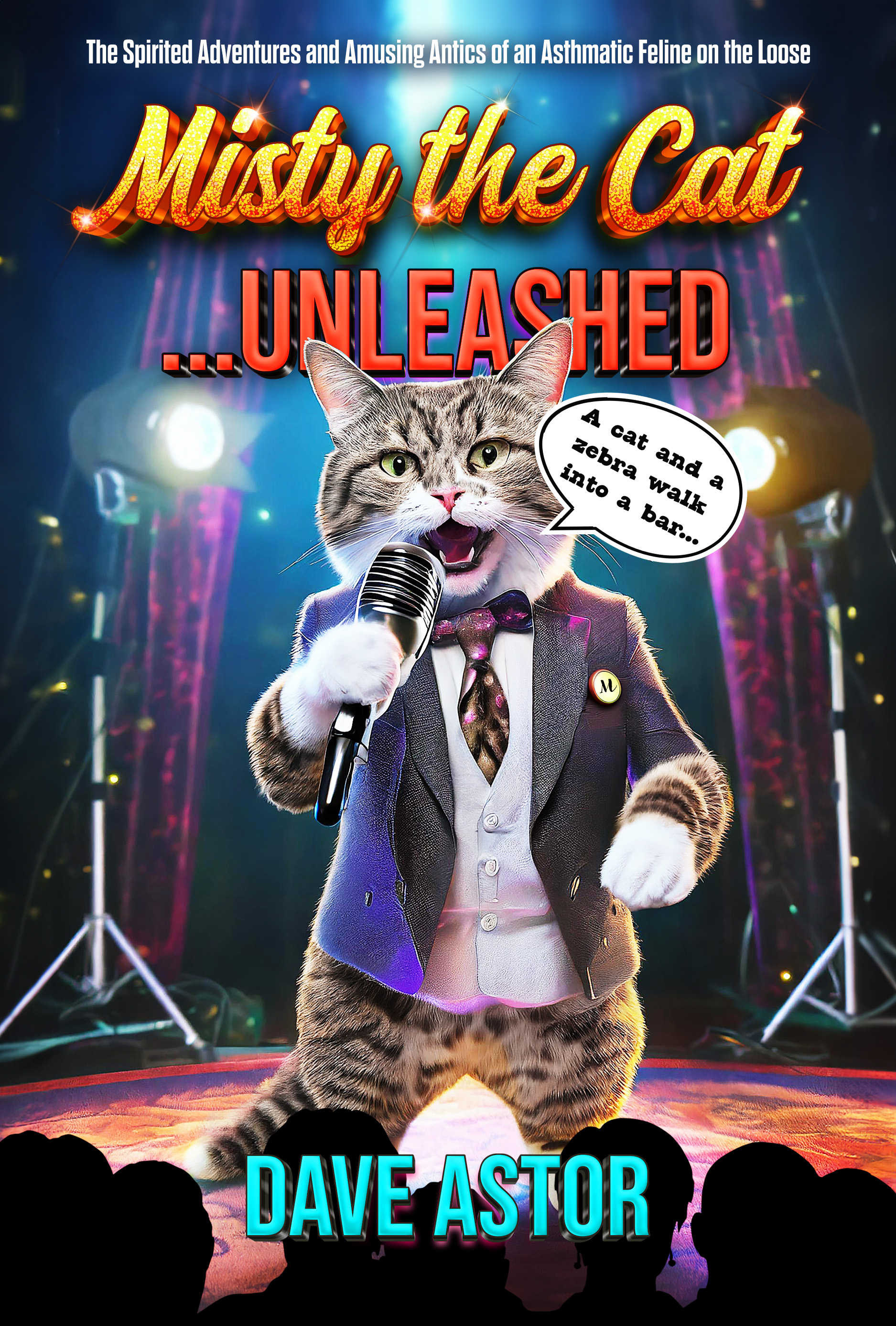
My comedic 2024 book — the part-factual/part-fictional/not-a-children’s-work Misty the Cat…Unleashed — is described and can be purchased on Amazon in paperback or on Kindle. It’s feline-narrated! (And Amazon reviews are welcome. 🙂 )
This 90-second promo video for the book features a talking cat: 🙂
I’m also the author of a 2017 literary-trivia book…

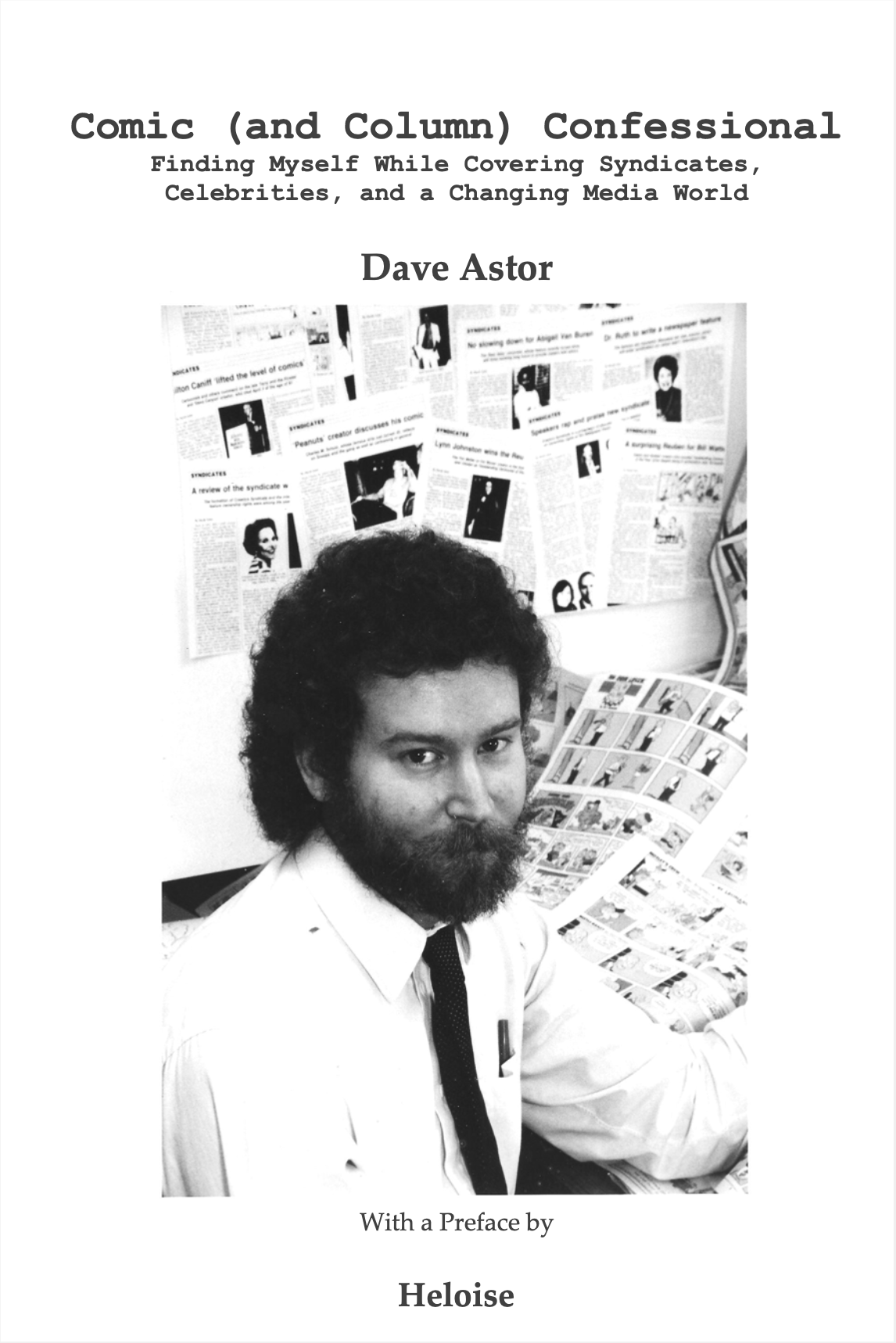
…and a 2012 memoir that focuses on cartooning and more, including many encounters with celebrities.
In addition to this weekly blog, I write the 2003-started/award-winning “Montclairvoyant” topical-humor column every Thursday for Montclair Local. The latest piece — which contains great library news and laments the long delay of a much-needed forensic audit of my town’s deficit-ridden school district — is here.


On my one and only trip outside the US the only activity I planned was a Literary Pub Crawl in London. It was led by actors who took on the personas of famous authors. We had one drink in each of the pubs. I most remember Virginia Woolf. It was lovely.
LikeLiked by 2 people
Thank you, Lori! That London literary crawl — including seeing the Virginia Woolf impersonator — sounds like a VERY fun and interesting activity!
LikeLiked by 1 person
It was fantastic, Dave! I loved every minute of it!
LikeLiked by 1 person
Great that you enjoyed it so much, Lori!
If I ever get back to London… 🙂
LikeLiked by 1 person
🙏🏼💐
LikeLiked by 2 people
🙂
LikeLike
Good description 👌well written
LikeLiked by 2 people
Thank you, Priti! 🙂
LikeLike
What a great experience. I would like to visit the homes and offices of Winston Churchill and Mark Twain. Their standing desks are fascinating.
LikeLiked by 2 people
Thank you, Edward! Mark Twain’s house and work space are definitely must-sees, and I imagine it’s the same for Winston Churchill’s. And I agree that standing desks are fascinating. 🙂
LikeLiked by 1 person
You’re very welcome, Dave. I would love to buy one of those old ones, but they are super expensive, so I settled for one from Amazon.
LikeLiked by 1 person
Glad you found a standing desk, Edward, even though it wasn’t a vintage one.
LikeLiked by 1 person
Hi Dave, this is a great post. You are lucky to have visited so many important literary sites. I’ve visited Shakespeare’s birth house, Anne Hathaway’s cottage and Mary Arden’s farm as well as The Globe Theatre. I’ve also visited the Brontë Parsonage and the village of Haworth. In London, we visited Sherlock Holmes house and Churchill’s wardrooms (he wrote a lot of books). I’ve also visited Charles Darwin’s house and Erasmus Darwin’s house.
LikeLiked by 2 people
Thank you, Robbie! You have also visited many important literary sites — including all those you mentioned in England. As I said to Shehanne in another comment, I regret not getting to the Bronte Parsonage during my one visit to England many years ago.
LikeLike
Hi Dave, I didn’t get to the Charles Dickens Museum last year. It was a walking tour and it rained and rained on the day we booked it so we didn’t go.
LikeLiked by 1 person
Sorry you missed that, Robbie, but a walking tour on a very rainy day would not have been fun.
LikeLike
No, and I had Michael with me and he’s a terrible mosner. It must be his English blood 😂🤣. We went to the Florence Nightingale museum instead and that was fascinating.
LikeLiked by 1 person
A great alternative! 🙂
LikeLike
💓
LikeLiked by 1 person
🙂
LikeLike
Dave,
You may want to mention to Misty that it’s more likely that the Snakes and Ladders game was derived in a back yard than Ladder of Years. This is of course a message from Mischa, who is waiting by my ladder in the plant room, for mice and hopefully a snake.
On with the topic.
Okay, I have not been there, but want to see the Anne of Green Gables heritage farm in PEI. https://www.tourismpei.com/what-to-do/anne-of-green-gables
However, I did travel to various Ontario locations when I was working on Anne of Avonlea (tv series) & Jane of Lantern Hill (movie). I was a lowly seamstress and dresser of extras.
Not only was travelling up north to work on the shows a reminder of all LMM had written, but it was like being there. I had travelled into the past, immersed in the stories due to: locations, sets, props and people dressed up in the times the stories are set in.
Thanks for the memory, Dave!
LikeLiked by 1 person
Thank you, Resa!
Ha! 😂 Yes, there are other kinds of relevant ladders. 🙂
I’d also love to visit that “Anne of Green Gables” site.
Wonderful that you worked on those “Anne of Avonlea” and “Jane of Lantern Hill” productions! What a feeling to become immersed in the past in the way you described. Make-believe can feel almost real sometimes.
Hi to Mischa!
LikeLiked by 1 person
Yes, make believe can almost feel real.
I suppose that was a benefit of working in film. My work was an escape from reality. Life was an escape from fantasy.
No wonder I’m so annoyingly happy!
Meow to you and Misty!
LikeLiked by 1 person
Certainly one of the appeals of working in film (and watching films). 🙂
LikeLiked by 1 person
Yes!
LikeLiked by 1 person
🙂
LikeLiked by 1 person
Hi Dave!
I read your post with such fascination! A kind of ‘literary travel trail’!
St Petersburg in Russia sounded particularly interesting. Setting ‘Crime and Punishment’ in a city like that would make sense!
Great post Dave!
Thank you!
Enjoy the summer.
😊
LikeLiked by 1 person
Thank you, Sharon! “…literary travel trail” — nicely put. 🙂 Yes, the big-city-of-St. Petersburg setting contributed to the tense atmosphere of “Crime and Punishment.” Wishing you a great summer, too!
LikeLiked by 1 person
Thank you Dave! I’m glad you liked the phrase!! 😀
All the very best!
Sharon
LikeLiked by 1 person
🙂
The best to you, too, Sharon!
LikeLiked by 1 person
Wow, Dave, you get around! On our recent trip to France (which I haven’t had time to blog about yet), we visited a restaurant where Hemingway used to eat. They haven’t changed the restaurant or their service since before that time. So cool!
LikeLiked by 1 person
Thank you, Marie! Well, a number of my trips were years ago, and spread over a number of years. 🙂 Great that you visited a restaurant in France where Hemingway used to eat, and that it hasn’t changed much since! Hemingway spent much of the 1920s in that country, from what I can recall reading about his life.
LikeLiked by 1 person
Like you, Dave, I visited Dickens’s house in Bloomsbury on my first trip to London. I can’t remember the details, but I do remember enjoying it. I’d just graduated from college, where I’d read lots of his novels. And like Dan and Liz, I’ve been to Louisa May Alcott’s house in Concord, MA, where she lived as a child with her sisters. I was eleven or twelve, visiting with my sister (two years younger) and my mother, who’d read us LITTLE WOMEN a few years before. I remember that the tour of the house brought Meg, Jo, Beth, and Amy to life. It was as if they were still living there. I loved being there.
LikeLiked by 1 person
Thank you, Kim! Great that you saw Dickens’ London house! I can’t remember much about it, either, but I also saw it soon after college where I had taken an intensive Dickens course that involved reading at least a half-dozen of his novels — including some of the longer ones. I majored in eyestrain. 🙂 And your visit to the Louisa May Alcott house sounds wonderful — as a place and as a family experience!
LikeLiked by 1 person
I was in Hartford Ct but never visited Mark Twain’s house. Found the Stella contest in New Orleans a much livelier affair, ex: https://www.youtube.com/watch?v=Ih7aIa_BWcM Nice post Dave, Susi
LikeLiked by 1 person
Thank you, Susi! That’s a hilarious clip. 😂 Speaking of clips, the Mark Twain museum was where I first saw a 1909 clip containing great film footage of the author the year before he died (also available on YouTube).
LikeLike
I live in Pittsburgh, the birthplace of Gertrude Stein and a way station for Willa Cather. I often drive down the street where she lived, or the high school where she taught. I’ve visited the Dickinson house in Amherst as well as the Mark Twain House in Hartford. Seen the Streetcar named Desire in New Orleans.
Italy, oddly, is a place where I’ve felt close to British poets–Byron, Shelley, and Keats. You can feel their presence at the English Cemetery and the Keats house in Rome. Also in Italy, I’ve been in the chapel in Florence where Dante first saw Beatrice, as well as the city of Ravenna, where he later lived.
I visited the Tolstoy museum in Moscow and the romantic Caucusus town of Piatigorsk, which is featured in Lermontov’s “Hero of our Time.”
Saw Kafka’s house in Prague, though it’s very touristy.
LikeLiked by 3 people
Thank you, Jean! You’ve visited a LOT of great literary destinations. I’m very impressed!
Willa Cather got around — Virginia, Nebraska, Pittsburgh (as you mentioned), New York City, summers in Canada…
I was in Moscow once, but somehow missed the Tolstoy museum.
And, yes, the outdoor graves of renowned writers can be memorable, poignant places to visit (as are the indoor resting places of writers in the Pantheon, Westminster Abbey, etc).
LikeLiked by 2 people
Fascinating, Dave, to have visited such places of great literary significance. Literature-related travel has never been on my travel itinerary 😦
LikeLiked by 1 person
Thank you, Rosaliene! I’ve never traveled abroad specifically for literary reasons, but if there’s something literature-related to be seen while I’m there…I’m in. 🙂
LikeLiked by 1 person
Great post Dave.. Well, here in Dundee any literary figures and their associates are reduced to plaques. And statues. Even though Robbie Burns had nowt to do with the town, we have one of the four identical ones, one of the others being in New York. Our very own bard William McGonagall who was banned from the unveiling of it at the time but turned up and caused a stooshie anyway, after more recent council stooshies has a square named after him and a plaque. We also have plaques where Sarah Wiedemanm, Robert Browning’s mother was born and where Mary Shelley stayed–crediting the area with her flights of fancy…. I’ve been to the Keats Shelley house in Rome, Kafka’s house in Prague, the Walter Scott monument in Edinburgh.
LikeLiked by 2 people
Thank you, Shehanne! Well, plaques and statues are not bad. 🙂 I guess Robert Burns is renowned enough in Scotland to get honored even in places he had nothing to do with. And Mary Shelley deserves honoring everywhere. 🙂
Great that you’ve seen the Keats Shelley house in Rome, Kafka’s house in Prague, and the Walter Scott monument in Edinburgh!
LikeLiked by 2 people
also been to the Walter Scott monument in Edinburgh, Shandy Hall where Laurence Sterne was born, the Bronte parsonage. Got to say I found that one a disappointment. And Wordsworth’s cottage which our then older girl aged 4 turned out….
LikeLiked by 2 people
Great visits, Shehanne, though unfortunate that the Bronte parsonage was a disappointment. In what way? I’ve always regretted not visiting it the one time I was in England, but maybe I shouldn’t regret it too much. 🙂
LikeLiked by 1 person
I don’t know what it is like now. It was quite awhile ago now, but it was very much all behind ropes and just look through the doors. I get that it is all old etc etc and I don’t see anything wrong with that rule. We have Captain Scott’s Antarctica ship here which obviously you get on and a wee wander round etc but a lot is behind ropes, but there is also a great museum attached. There was nothing attached to this. but a convenient big gift shop Even loos were in a car park. Also Haworth was not only not exactly inspiring. It was pretty sizeable actually. I suppose so much has been written about them living in the wilds right on the moors, I had imagined something different. Coxwold where the Sterne house is, is a real lovely old old village. Like that I had always longed to visit the parsonage and we used to go Yorkshire a lot, so maybe that also came into it, that finally one of the times down here we went and it was quite a drive even from the bit we were in. Honestly everyone has a diff opinion cos of diff expectations. You might really like it.
LikeLiked by 1 person
Thanks for that info and explanation, Shehanne! Yes, things might have changed. It definitely can be frustrating when rooms and objects in a historic house are hard to see, though I understand the impulse (that you noted) to try to protect things. It’s also frustrating, but not surprising, when a money-making gift shop is the most accessible part of preserved site. And I guess it’s inevitable that a village and its environs would become more developed during all those decades since the Brontes were alive.
LikeLiked by 1 person
I think it was quite reasonably populated even in their time . Certainly it had a big prob with unsanitary conditions.
LikeLiked by 1 person
Which I assume might have directly or indirectly contributed to some of the family’s way-too-early deaths. 😦
LikeLiked by 1 person
Yep he morality rate there was high.
LikeLiked by 1 person
😦
Some advantages to modern life…
LikeLiked by 1 person
Absolutely. I think some places had higher rates than others. This was one.
LikeLiked by 1 person
That sounds right! Conditions vary…
LikeLiked by 1 person
Good subject, Dave. I’ve never undertaken literature-related tourism, but I’ve travelled many times to Lesvos, where Aristotle lived and worked for a couple of years, and where the poetess Sappho was born and live. I’ve been to Skiathos and seen the house of writer Alexandros Papadiamantis. Closer to home I’ve travelled around Thomas Hardy’s ‘Wessex'(aka Dorset) and seen the grave of Anne Bronte in Scarborough. Even closer to home, the White Hart Inn in Tetford, Lincolnshire, close to where I live, was the local of Alfred, Lord Tennyson; they still have his regular seat there. Dr Johnson of dictionary fame also visited there once, apparently. I think that’ll do, but if I think of any more I’ll be back. Have a good week. 🙂
LikeLiked by 3 people
Thank you, Laura! Literature-related tourism sometimes happens, at least a bit, without planning. 🙂 Exciting that you’ve been to Lesvos many times! And you’ve done some great famous-writer-related visits in the UK!
Have a good week, too!
LikeLiked by 2 people
Great post, Dave. Reading it makes me think I do a fair amount of literary travel, because I find myself in places where books were set–like the time I was on a Boston Harbor cruise and the tour guide said, “…and there is Shutter Island.” “Like the book?” I exclaimed. Or visiting caves in southern France with paintings and saying, “like the Clan and the Cave Bear.” Or on a walking tour in Lyon and approaching a convent (on top of a hill) which the guide pointed to and explained that nuns here protected Jewish children during WWII. Another woman and I said simultaneously “Like in Nightingale” by Kristin Hannah. I have made many other literary connections in my travels, including a trip to Ireland in college connected with an Irish Lit course.
But, intentionally, I went to Amsterdam and Westerbork in the Netherlands because of Etty Hillesum’s books An Interrupted Life and Letters from Westerbork. I wanted to be in the places where Etty had been. In Amsterdam, there is only a plaque on the building where she lived and I could not go inside. But Westerbork was an amazing place to visit. There are probably others (especially in Ireland and England) but this was the most memorable.
LikeLiked by 2 people
Thank you, Madeline! Great that you’ve done a good amount of literary travel, and I enjoyed seeing your various examples of that! The Netherlands is a great country to visit, and literary connections make it even better. Kristin Hannah is one of my favorite living authors, and I loved Jean M. Auel’s “The Clan of the Cave Bear” and its five sequels. 🙂
LikeLiked by 2 people
You are well traveled,Dave.
A few years back I had taken a bicycle trip in VT/NH. I was told off the long, winding road lived JD Salinger.
I have Selected Poems of Walt Whitman on my book shelf. I plan to read Crossing Brooklyn Ferry as a precursor to visiting his birthplace on LI as an homage, not as far to travel.
https://www.waltwhitman.org/
Local library has a pass if i recollect.
Thank you for mention in blog. 🙂
Michele
E & P way back
LikeLiked by 1 person
Thank you, Michele! And you’re very welcome for the blog mention; thanks for sparking the idea!
I was well-traveled “back in the day”; not quite as much in recent years. 🙂
You had an interesting proximity to where the reclusive J.D. Salinger lived! A nice area of the country to take a bike trip.
Great plan re Walt Whitman!
LikeLike
I love all of the connections you’ve made between great works and the evocative places associated with them, Dave! Truly amazing. ❤️❤️❤️
You’ve got my wheels turning trying to remember a childhood experience in a historical museum in Ohio that was quite creepy…an old homestead belonging (I thought) to an author from the 1800s but I couldn’t tell you who! Such a vague flash of recognition popping as I read your post. Hmmm! 🤔 🤔🤔
LikeLiked by 1 person
Thank you, Vicki! Glad you enjoyed the post! I know what you mean about memories that we can’t quite grasp; whatever it is in relation to that Ohio museum, it does sound interesting!
LikeLiked by 1 person
I remembered! It was poet Paul Laurence Dunbar’s childhood home in Dayton! We lived nearby and my dad was fascinated by Dunbar’s friendship with the Wright brothers. Hmmm! I’ll need to add this to my task list…I remember loving Dunbar’s poetry. ❤️
LikeLiked by 1 person
Wow — had no idea that Paul Laurence Dunbar and the Wright brothers were friends! Great to know!
(I knew Ohio-born “Terry and the Pirates”/”Steve Canyon” comic creator Milton Caniff when I covered cartooning for a magazine; he was good friends with Orville Wright.)
LikeLiked by 1 person
What a fun connection! I’ll need to rewind and see if what my dad said was true about Dunbar and the Wright brothers…my dad loved the fact that they were friends—despite racial differences. My how things have changed…and not…over the years.
Thank you for summoning a great memory for me, Dave! On Father’s Day, no less! ❤️😉❤️
LikeLiked by 1 person
Yes, Vicki, Father’s Day. 🙂
It would have been an unusual interracial friendship back then.
LikeLiked by 1 person
Yep, yep…thanks so much, Dave. 💝
LikeLiked by 1 person
You’re very welcome, Vicki! 🙂
LikeLiked by 1 person
What a wonderful collection of literary journeys, Dave. One of the places that spoke most deeply to me was Oxford. Don, my son and I had lunch at the Eagle and Child, where the Inklings gathered, and then made our way to Tolkien’s tree. I understand Tolkien would often walk there to think, and standing beneath it I found myself reflecting on how ideas take root and grow.
I am especially grateful we made that visit when we did, because the original tree is no longer there. From what I have read, seedlings or cuttings have been used to continue its legacy. There is something beautifully Tolkien-esque about that. A tree passes, yet its story continues through new growth.
I believe that one reason literary travel resonates so strongly is that we are not simply visiting places. We are stepping into stories. Sometimes those stories belong to famous writers, and sometimes they remind us that our own lives are part of a larger narrative stretching across generations.
The old that is strong does not wither, Deep roots are not reached by the frost.” J.R.R. Tolkien, The Fellowship of the Ring
LikeLiked by 1 person
Thank you, Rebecca! Wow — what a treasured memory of being in Oxford and experiencing those Tolkien connections. A shame that tree is now gone, but you saw it in time! I enjoyed your comment’s eloquent reflections.
LikeLiked by 1 person
I am becoming more reflective as the years go by, Dave. I think it is a privilege of the aging process. I think of the quote by Mary Catherine Bateson: “The shape of a life is not fixed. it continues to be composed.”
LikeLiked by 1 person
Getting older definitely evokes more reflections, Rebecca. And that’s an excellent Mary Catherine Bateson quote. (Had to look her up to see who she was. Interesting person. Thanks for mentioning her!)
LikeLiked by 1 person
Lovely post! I spent a few summer weeks in the old french village Grignan, where the major literary idol was Mme de Sevigné. There are several books with her reprinted letters, that she wrote to the french aristocracy during the 1600’s. I can recommend “Madame de Sevigné Lettres” that are mainly between her and her much loved daughter, that she wrote while staying in the Grignan castle.
LikeLiked by 1 person
Thank you, Thérèse! That sounds like an amazing few weeks in that old French village! And to read letters from the 1600s is a real historical treat. Your comment had me looking at Wikipedia for more information on Madame de Sévigné. 🙂
LikeLiked by 1 person
I spent some time in the Lexington/Concord area in Massachusetts, and saw some famous author homes or places where they lived for a while.
The ‘Old Manse’, was built by Ralph Waldo Emerson’s grandparents, and is where Emerson wrote his first book, Nature. Later on, Nathaniel Hawthorne wrote the story that gave the house its name, Mosses from an Old Manse. Both authors wrote in the same room.
Nathaniel Hawthorne also named ‘The Wayside.’ He lived there in 1850-60s but Louisa May Alcott lived there as a teenager in the 1840s. Farther down the same road, ‘Orchard House’ is where she would later write Little Women.
I’ve been to the Mark Twain house. My daughter even gave me a gift of being able to write for three hours in the library of that house. It’s not where Twain wrote, but still…
Next to Twain’s house (on the same property) is the Harriet Beecher Stowe’s house.
LikeLiked by 1 person
Thank you, Dan! Great, informative comment! New England has a LOT of famous 19th-century writers. (And more recent ones such as Stephen King.) Love those connections you cited. Hawthorne and Herman Melville were apparently friends as well.
Yes, if I’m remembering right, Twain wrote in that room with the pool table rather than in the library. But wonderful that you were gifted those three hours in that house’s library! And I remember seeing Harriet Beecher Stowe’s home next door.
LikeLiked by 1 person
Yes, we were told that he wrote in the room you mention. I love that he had about a million scraps of paper (notes) all around the room.
LikeLiked by 1 person
Details like that really humanize a writer. 🙂
LikeLiked by 1 person
How interesting!
A long time ago, I had the pleasure of staying in a splendid villa on the Brenta River, which has been transformed into a charming boutique hotel. It’s where Lord Byron spent his summers in 1817, seeking inspiration away from the hustle and bustle of Venice.
I think exploring the places where literary giants lived or found inspiration adds a deep and personal layer to the travel experience! 🏛️
LikeLiked by 2 people
Thank you, Luisa! That stay you had at the villa where Lord Byron spent his summer months sounds wonderful! I guess Venice even in the early 1800s was quite crowded. (I was there in 2004 and found it crammed but still wonderful.) And I totally agree with your very well-said final line!
LikeLiked by 2 people
Thanks a lot for your lovely reply, my dear Dave
LikeLiked by 1 person
You’re very welcome, Luisa! 🙂
LikeLiked by 1 person
Your trip to Marseille and the Chateau d’If island prison intrigues me! As a huge fan of the book, it must’ve been so cool (and maybe a little disturbing?) to see inside. Jails freak me out, as I can’t help but feel empathy for the people imprisoned there, but it must have been quite an experience!
LikeLiked by 2 people
Thank you, Ada! Seeing the Chateau d’If was definitely cool and disturbing. The not-that-short, choppy boat ride there on a rainy day, the grim fortress-like buildings, the cells. One definitely feels empathy for people in prison, whether guilty (if the crime wasn’t too bad) or innocent (as was Edmond Dantes in Dumas’ superb novel). I have photos of the Chateau d’If visit stashed somewhere (prints from camera shots before I had a smartphone).
LikeLiked by 1 person
I am very happy reading your literature-related travel to England, France and America. You’re a truly travelled author, with inspiring accounts. In 2022, I made my first travel to Sierra Leone, a neighboring country of my home country, Guinea. For the first time in my life, I crossed the frontiers of Guinea. I went and enrolled in a PhD program at a rural private Christian university. I saw different people, different animals and different landscapes along the travel. It was, of course, an academic travel, not purely a literature travel. But it was memorable. Thank you very much for your work reminding me of my first academic travel ever. My first travel-out ever. Academically yours, Ahmadou.
LikeLiked by 1 person
Thank you, Ahmadou!
Great that you went to neighboring Sierra Leone in 2022! Wonderful to see different people, animals, cultures, and landscapes, as you note. And being in a different place to get an academic degree definitely adds a lot to the experience.
I used to travel abroad a lot from the United States; not as much during the 2020s, except for Guatemala this past January.
LikeLike
You’re most welcome, my Dear author and it’s marvellous hearing more about your travels, your Guatemalan travel.
LikeLiked by 1 person
Thanks again, Ahmadou! 🙂
LikeLike
Several years ago, my mother and I visited Louisa May Alcott’s house in Concord, MA. She’d taken me there when I was a child, and I thought it would be fun to go back. My husband and I visited Ernest Hemingway’s house in Key West, including his writing studio with stand-up desk.
LikeLiked by 3 people
Thank you, Liz! That sounds like a memorable (re)visit to Louisa May Alcott’s house! I assume there was some stuff there related to “Little Women” — a great novel, but of course only one of many things she wrote.
And it must have also been quite an experience to see Hemingway’s house! I imagine some descendants of his cats there, too?
LikeLiked by 2 people
You’re welcome, Dave! The docent was all about those six-toed cats—and Hemingway’s spendthrift wife.
LikeLiked by 2 people
Yes, those six-toed cats!
Perhaps that docent was a bit sexist (?), like Hemingway himself… 🙂
LikeLiked by 2 people
I wouldn’t doubt it!
LikeLiked by 2 people
Aha, Hemingway… I was about to mention him. Good one, Liz – what a wonderful place you have been with you husband.
LikeLiked by 3 people
Thank you for commenting, Chris! The closest I’ve come to seeing Hemingway’s house was looking at photos my older daughter took when she went there in 2018. 🙂
LikeLiked by 1 person
Yes, lots of good memories.
LikeLiked by 2 people
Hi Dave, I am back to Ernest Hemingway, again. And there is a good reason, since me, my hubby and several friends went to Cuba for a couple of weeks, about 20 years ago. We stayed in various places during that time, but mostly in Havana. EH stayed in the rather grand hotel called Hotel Ambos Mundos in one of the best known roads – Obispo, in the Old Havana. There is a plaque just outside which shows were he stayed there and wrote at least two novels and many articles there. He had a room on the top landing at No. 511, and he kept that place from 1932 to 1939. Us lots had some drinks there in the main bar, and very nice it was.
LikeLiked by 2 people
Chris, great that you visited Cuba for a couple weeks a couple decades ago, and got a sense of Hemingway’s past presence there! Sounds like a terrific, memorable trip — and thanks for the interesting info!
I just did an online search, and the two novels he wrote in Cuba might have been “For Whom the Bell Tolls” (my favorite of his) and “The Old Man and the Sea.” But not sure; online could be wrong. 🙂
LikeLiked by 1 person
That sounds right – those two excellent novels. I, of course, have read both of those (and “For Whom the Bell Tolls” twice). I read “The Old Man and the Sea” while I was in Cuba, very near the beach, and that was wonderful!
LikeLiked by 1 person
Wow, Chris — reading “The Old Man and the Sea” in Cuba, in which/off which the book is based! Nice!
LikeLiked by 1 person